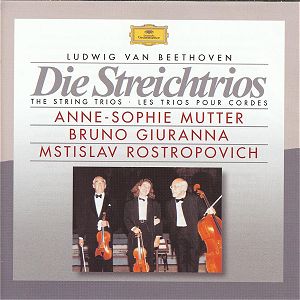
This DG disc
was originally released in
1988 and now reappears on the mid-price Grand Prix series. It is performed by the eminent trio of violinist Anne-Sophie
Mutter, violist Bruno Giuranna and cellist Mstislav Rostropovich.
The Grand Prix series features landmark recordings singled out for particular critical
praise.
The
number of significant works in the repertoire composed for violin,
viola and cello is surprisingly small. With the exception of
Mozart’s String Trio, K.563 I can think of few other
precedents from around Beethoven’s time apart from a few scores
from Haydn, Hummel, Boccherini and two early scores from Schubert.
For Beethoven the medium of the string trio preceded his love
for the string quartet. The form is regarded as difficult owing
mainly to the challenging and relative sparseness of the three
voice textures compared to that of the string quartet.
The first work on CD 1 is Beethoven’s six movement String Trio in E flat major, Op.3. This early score from around 1792 invites comparison
with Mozart’s masterpiece, the six movement String Trio in
E flat major, K.563 from 1788 and is described in his catalogue
as a Divertimento. Although not composed to the same
level of eminence Beethoven probably used the Mozart E flat
major Divertimento, the first major score in the genre of
violin, viola and cello, as a model for Op. 3. In this performance
I loved the Haydnesque quality conveyed in the lengthy opening
Allegro con brio and the inventiveness and variety of
the Andante. I was struck by the syncopation in short
first Menuetto and how the players accentuate the sturdy
dance quality of the second Menuetto movement with Mutter’s
splendid gypsy feel to her violin solo. The Finale felt
a touch too serious as opposed to the humour provided by the
Grumiaux Trio on Philips.
Beethoven
composed his Serenade in D major, Op.8 in 1796-97. The
six movement score designed along the lines of a Divertimento
was issued as a ‘Serenata’ by publishers Artaria
in 1797. The score is often presented in five movements not
six, as it is here, with the first Adagio movement not
being given a separate track listing but included as the closing
section of the opening movement. Characteristically the score
starts and finishes with a vivacious march in the French style.
There is a marked bitter-sweet quality to the opening movement
and I was enchanted by the elegant and inventive Minuet.
The second Adagio is a generally more serious proposition
that includes two briskly agitated sections. One understands
why the winning dancing theme of the Allegretto alla Polacca
became highly popular. Designed as a theme and set of five
variations I enjoyed the light and dreamy character of the closing
movement Andante quasi allegretto.
The
second disc contains Beethoven’s set of three String Trios
Op. 9 that he wrote in 1796-98 and dedicated to one of his
early patrons Count Johann Georg von Browne. Cast in a four
movement plan and containing a generally more serious character
it has been said that the Op. 9 String Trios provide
parallels with the form of the quartet and the symphony.
In
the String Trio in E flat major, Op.9 No. 1 one notices
how the attractive character of the opening movement, marked
Adagio - Allegro con brio, is tinged with sourness. I
found the playing in the second movement serene with a sense
of the otherworldly. The Scherzo - Allegro is
light and agreeable and is followed by the breathless closing
Presto with its moto perpetuo quality.
I
was struck by the regal elegance of the opening Allegretto
of the String Trio in D major, Op.9 No. 2 and the calm
and sophistication of the Andante quasi allegretto.
The Menuetto - Allegro is classy and refined
and I enjoyed the refreshingly cool playing from the trio in
the final movement Rondo Allegro.
The
String Trio in C minor, Op.9 No. 3 opens with a sturdy
and muscular rendition of the Allegro con spirito. I
was impressed with the controlled passion of the Adagio con
espressione and one notices the angular rhythms of the resourceful
Scherzo and the vigorous playing in the closing movement.
Throughout these trios Mutter, Giuranna and Rostropovich have a refreshing and sparkling spring in their step
combined with an overall intelligence and assurance to their
playing. Overall I felt that their playing was unable to match
the gravity and subtlety of my first choice set from the Grumiaux
Trio. For their refinement and disarmingly unaffected performances
the Grumiaux has won numerous plaudits. Their analogue set was
recorded in 1967/68 at Eindhoven, in The Netherlands with the
Op. 9 No. 2 in 1968 at La Chaux de Fonds, Switzerland. My copy
of the two disc digitally re-mastered set is on Philips 4563172.
The
natural musical instincts of the trio of Mutter, Giuranna and
Rostropovich sparkle pleasantly and assuredly throughout to make
a most rewarding and invigorating experience. The essay in the
DG booklet is rather concise and not up to the standard of the
Grumiaux/Philips set. I was impressed with the sound quality from
the DG engineers. It was recorded in Paris in January 1988, although
I had to find that out for myself as this detail is omitted from
the booklet.
Michael Cookson