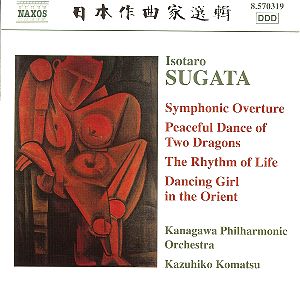
The Naxos 20th Century
Japanese Music series goes from strength to strength and has
thrown up many fascinating, exciting and sometimes curious items.
I would rate this disc in the third of those categories, but that
does not mean that it afforded me little pleasure; quite the reverse.
I will explain, but first the composer.
Sugata
studied in Europe as the Japanese of that
generation mostly did. His teacher, and greatest influence
was Paul Hindemith. Sugata also discovered Stravinsky; who
wouldn’t have done. He was also fully conversant with Japanese
scales and techniques used in the traditional music of his
homeland. Put all of this into the melting pot and you end
up with the music on this disc.
The
Symphonic Overture does not let you into Sugata’s world that
easily. It is the least interesting and distinctive work here
and it has an air of inflated pomposity. Nevertheless it is
well constructed and was chosen for the 1939 celebration of
the 2600th Year of the Emperor held by NHK (The
Japanese Broadcasting Corporation) who commissioned the work.
It is basically the product of Sugata’s studies with Hindemith
with ‘Mathis der Maler’ as its inspiration. But it
is not a clone and has some individual touches especially
in the wind writing and in the fifth-based harmonies.
The
‘Peaceful Dance of the Two Dragons’, as its title may indicate,
is much more reflective of Sugata’s home background. It falls
into three sections mysteriously entitled: JO, HA and KYU.
In the extensive and indispensable booklet notes by Morihide
Katayama the following explanation is offered: “Sugata attempts
to combine the style of Gagaku with his interest in Stravinsky
and Bartók”. He continues: “The dance music of Gagaku is basically
made up of three movements Jo-Ha-Kyu that is Overture, Development
and Rapid Finale.” So that means Jo is a slow tempo, Ha is
faster and Kyu is the fastest tempo. Sugata also introduces
“primitivist rhythms” with open fifths accompaniment and chords
made from pentatonic scales. It makes for a fascinating and
enjoyable mix.
In
the ‘Ballet Music “The Rhythm of Life” another influence is
not only discernible but very strong, that is Igor Stravinsky.
More specifically the music echoes with ‘Sacre du Printemps’,
‘The Firebird’ and ‘Petrouchka’. Sugata quotes from these
works and copies some of the orchestral effects mixing them
finely with his own. No wonder it was never played in his
all too short lifetime. If it had have been then the great
Igor would have been demanding at least his 10%. There are
three movements: Moderato, Andante leading to a Scherzando
and finally a Lento. Listen out for ideas very close to “The
Mystical circles of the young girls”; the rhythms of ‘Petrouchka’
and a melody from ‘Firebird’. Why did he do it and does it
amount to anything? Well as a ballet I think it could work
with its colour and wide variety of sounds and textures. The
orchestration is clever and evocative. Each time I have heard
it, it has retained a hold on my attention.
It’s
a pity that with the disc playing for under an hour and with
music by a composer unknown to most of us, more space could
not have been found for other movements from “Sketches from
the Desert”. The one we have is the fourth of a suite “In
Oriental style”. After completion it took over sixty years
before a performance proved possible. I was reminded of a
Ketèlbey pastiche-Oriental ‘Persian Market’ piece. There’s
a modal/minor gentle ¾ rhythm and reminscences of Ippolitov-Ivanov
and of the only work of his I know, the “Caucasian Sketches”.
Sugata is none the worse for that and the little dance makes
an attractive end to the disc.
The
Kanagawa Philharmonic are new to me. They were founded as
recently as 1970 and give the impression that they knew the
music well in advance of the recording session, which, sadly,
is not always the case. Kazuhiko Komatsu, a leading musical
figure in his country, directs them with understanding and
presents the diverse musical characteristics demanded by the
composer with ease.
A
pleasurable and fascinating hour’s worth of orchestral music.
Well worth exploring.
Gary Higginson