Editorial Board
MusicWeb International
Founding Editor Rob Barnett Editor in Chief
John Quinn Contributing Editor Ralph Moore Webmaster
David Barker Postmaster
Jonathan Woolf MusicWeb Founder Len Mullenger
Simon
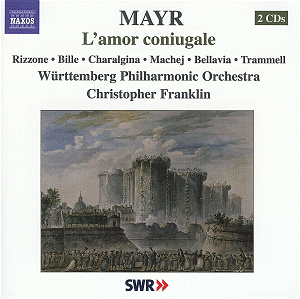
MAYR (1763–1845) L'Amor coniugale(1805) [82.57] Zeliska/Malvino – Cinzia
Rizzone (soprano)
Amorveno – Francescantonio Bille (tenor)
Floreska – Tatjana Charalgina (soprano)
Peters – Dariusz Machej (bass)
Moroski – Giovanni Bellavia (bass-baritone)
Ardelao – Bradley Trammell (tenor)
Wurttemburg Philharmonic Orchestra/Christopher Franklin
rec. live, 19, 21, 23 July 2004, Kursaal, Bad Wildbad, Germany.
DDD NAXOS 8.660198-99 [43.49
+ 39.08]
Mayr's L'Amor
coniugale belongs to a group of Mayr's operas in which
the composer re-vitalised the Italian opera seria tradition.
It belongs to the opera semi-seria genre, in which
the flexible plot-driven opera buffa collides with
the opera seria. It is a genre which we associate
with Rossini but it was in fact Mayr who was influential
in genre before Rossini. Mayr's musical language includes
elements, such as the crescendo and characteristic rhythmic
patterns, which Rossini would go on to make his own.
Mayr
wrote the opera in 1805 and it was premièred in Padua. It
takes as the subject of its libretto a French opera Leonore,
ou L'Amour conjugal by Pierre Gaveaux which was premièred
in 1798. Two other operas were based on the subject, Paer's Leonora
ossia L'amore coniugale (premiered in 1804) and Beethoven's Leonore (premiered
in Vienna in 1805). Beethoven's opera would eventually become Fidelio.
The
plot of Mayr's opera is in fact pretty similar to Beethoven's,
though some compression has occurred. Mayr's opera is billed
as a one act farsa sentimentale and it is in tone
in which the two operas differ. Mayr's opera lacks the intensity
and seriousness of Beethoven's.
Mayr's
librettist, Gaetano Rossi, relocated the action to 17th century
Poland, a popular exotic-operatic location used in both Cherubini
and Mayr's Lodoiska operas. So Leonore/Fidelio becomes
Zeliska/Malvino, her husband becomes Amorveno, his jailer
Peters and Peters daughter Floreska. Pizzaro becomes Moroski,
Jaquino is omitted and Don Fernando becomes Amorvino's brother
Ardelao.
The
recording comes from the admirable Rossini in Wildbad festival,
which has been the source of recordings of a number of early
Italian rarities recently. Here a strong cast - three Italians,
a Russian, a Pole and an American - are directed by Christopher
Franklin with the Wurttemberg Philharmonic Orchestra.
The
opening scenes are all light comedy in which Floreska (Tatjana
Charalgina) flirts with Malvino/Zeliska (Cinzia Rizzone).
Floreska's father, Peters (Dariusz Machej) is in favour of
a match but Malvino puts things off.
Charalgina
has an attractively bright Slav soprano voice and her Floreska
is attractive and suitably pert. Rizzone is an equally attractive
Zeliska; her voice tends to have slightly too much vibrato
in the upper register but she is profoundly appealing in
her only aria. Machej has a pleasant grainy voice and he
succeeds in making Peters a personable, Figaro-like character.
Halfway
through the opera, after Zeliska's aria, the atmosphere changes.
The setting moves to Amorveno's prison cell and he has a
long scena and aria - over 9 minutes of solo music - with
a substantial sombre instrumental introduction. Francescantonio
Bille has an open Italianate voice and makes Amorveno a personable
rather than a tragic character.
The
main problem with the drama is that Moroski, the prison governor,
is not a strongly drawn role and Giovanni Bellavia's performance
is rather low key.
Most
of the cast treat Mayr's fioriture in a rather sketchy, sometimes
smudgy manner. Given the strength of the performances this
is not a disaster, but it is a shame that they could not
have delivered the vocal lines in a slightly cleaner manner.
The
Wurttemburg Philharmonic provide strong support and give
good account of the solo opportunities that Mayr gives them.
Mayr's German background meant that he brought new colours
and treatments to the orchestra in Italian opera and the
Wurttemburgers relish this.
The
CD booklet contains a good article about Mayr and the opera,
plus a synopsis but there is no libretto, which is something
of a drawback in an unknown opera. You can get the Italian
libretto from Naxos's web site.
Whilst L'Amor
coniugale is not a masterpiece, it is a strong
and interesting work, and one which sheds a revealing light
on the development of Italian opera just before Rossini.
Robert Hugill
Please support our advertisers below by clicking on the logos for further information.

























 Zeliska/Malvino – Cinzia
Rizzone (soprano)
Zeliska/Malvino – Cinzia
Rizzone (soprano) 
