Editorial Board
MusicWeb International
Founding Editor Rob Barnett Editor in Chief
John Quinn Contributing Editor Ralph Moore Webmaster
David Barker Postmaster
Jonathan Woolf MusicWeb Founder Len Mullenger
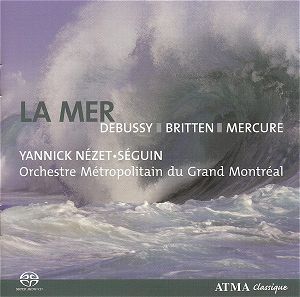
La Mer Claude DEBUSSY(1862-1918) La Mer (1905) [24:26] Prélude à l'après-midi d'un faune (1894) [11:16]* Benjamin BRITTEN(1913-1976) Four Sea Interludes from Peter Grimes Op.33a
(1945) [17:13] Pierre MERCURE(1927-1966) Kaléidoscope (1948) [10:35] Marie-Andrée
Benny (flute)*, Orchestre Métropolitain du Grand
Montréal/Yannick Nézet-Séguin
rec. 27-28 March 2007, Eglise Saint-Nom-de-Jesus, Montreal,
Quebec, Canada. ATMA CLASSIQUE SACD2
2549 [63:28]
The most exciting thing about this album, and the thing that
makes it worth hearing, is Pierre Mercure's Kaléidoscope.
Mercure was one of the leading Québécois composers of his generation
when he died tragically in a car accident a month short of
his 39th birthday. He wrote Kaléidoscope in 1948 while
he was studying with Claude Champagne, a year before he left
Canada to study with Nadia Boulanger and Darius Milhaud in
France.
The booklet notes, which on the whole focus on biography rather than
the music, make the point that Champagne shared Ravel’s philosophy
that a student should “take a model and imitate it … If you
have something to say, your personality will never appear better
than through your unconscious failures to copy your model”.
While Kaléidoscope is still a student work, you can
hear Mercure’s musical personality. The models are audible – Debussy’s
orchestral palette, echoes of La Mer, the inflections
of Les Six and Honegger in particular, flashes of jazz rhythms
and a pounding motif from the world of Stravinsky’s Rite
of Spring – but they have been synthesised into a distinct
idiom. The music moves restlessly to its joyful conclusion
and keeps your attention from its opening chords to its dying
whisper.
The Orchestre Métropolitain du Grand Montréal and Yannick Nézet-Séguin
deserve praise for their advocacy. They play this music with
firm rhythmic drive, clear textures and careful balancing of
parts. At times, though, I found myself wondering what a more
red-blooded approach would bring out of this score. Perhaps
Naxos will give us some Mercure with David Lloyd-Jones or James
Judd at the helm?
While Mercure’s score is the main draw, it is Debussy's La Mer that
gives this album its title. Nézet-Séguin's conception of Debussy's
score is clean and clear. He has obviously rehearsed each movement
carefully with his orchestra, and coaxes some gorgeous sounds
from its players. The details of the score are laid bare by
careful balancing of part, tempi that allow for clean articulation
and ATMA's excellent recorded sound. Still, this is very much
a water colour painting in pastel shades. The vivid hues one
gets from conductors as diverse as Karajan and Munch are
toned down considerably. After listening to the performance
several times I remain impressed by the execution, but feel
cheated of atmosphere. The end of the first movement is a case
in point. The horn calls of proud midday hold so much promise,
but the orchestra fails to deliver a glowing noon sun. Similarly,
the third movement hangs fire and the battle of wind and sea
at its close is underpowered. Nézet-Séguin's gentle approach
works best in the middle movement, where the play of the waves
has a vivid sparkle.
The first three of Britten’s Four Sea Interludes are similarly
impressive. Nézet-Séguin shapes the opening Dawn with
sensitivity, drawing a beautiful gossamer sonority from his
orchestra. The horns are magical here, and they also create
chords of glorious shimmer at the opening of Sunday Morning,
which bobs and pecks with perkily pointed rhythms. Still, I
miss the underlying energy that Previn
and the LSO bring to this interlude in particular and the Four
Sea Interludes as a whole. Moonlight is understated – even
at its climax – but the balancing of parts is quite beautiful.
The concluding Storm, however, produces only drizzle,
with underpowered orchestral playing and some ugly sounds from
the violins above the stave.
The real disappointment on this disc is the closing track, Prélude à l'après-midi
d'un faune. There is nothing especially wrong with the
playing of the orchestra in general or flautist Marie-Andrée
Benny in particular. Nézet-Séguin seems to be aiming for
languor, but for all the beauty of the orchestral playing
there is little tension to the music making here. Some listeners
may warm to this slow and relatively objective account, but
I miss the eroticism that Stokowski (EMI “Classical Archive” DVD
4928429), Munch and
others find in this score. It also has nothing to do with
the sea on an album entitled La Mer. Then again, nor
does the Mercure, and I would not complain about Kaléidoscope.
It remains this disc's primary attraction.
Tim
Perry
Please support our advertisers below by clicking on the logos for further information.

























 Marie-Andrée
Benny (flute)*, Orchestre Métropolitain du Grand
Montréal/Yannick Nézet-Séguin
Marie-Andrée
Benny (flute)*, Orchestre Métropolitain du Grand
Montréal/Yannick Nézet-Séguin  [63:28]
