Editorial Board
MusicWeb International
Founding Editor Rob Barnett Editor in Chief
John Quinn Contributing Editor Ralph Moore Webmaster
David Barker Postmaster
Jonathan Woolf MusicWeb Founder Len Mullenger
Franz Joseph
HAYDN (1732-1809)
Trio in C (H XV,27) [21:51]
Trio in E flat minor (H XV,31) [15:33]
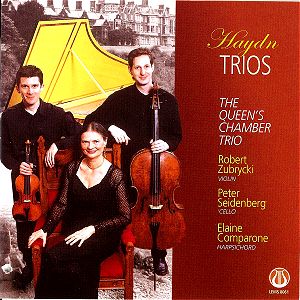
Trio in E (H XV,28) [18:22] The Queen's
Chamber Trio (Elaine Comparone (harpsichord); Robert Zubrycki
(violin); Peter Seidenberg (cello))
rec. no details provided LYRICHORD
LEMS8061 [55:39]
One
of the main issues in the performance of music for or with
keyboard in the second half of the 18th century is the choice
of instrument. During this half century the harpsichord was
gradually overshadowed by the fortepiano. But at the time the
latter was the main keyboard instrument on the concert platform
and many music lovers still played the harpsichord at home.
It is therefore understandable that most keyboard pieces were
published with the indication "for the fortepiano or the
harpsichord". Even the earliest keyboard works by Beethoven
were printed with this kind of indication. One shouldn't conclude
from this that it didn't matter to the composer which instrument
was used or that these two instruments were pari passu in
the composer’s mind.
The
music of Joseph Haydn is a special case as he seems to have
held on to the harpsichord longer than most of his colleagues.
From this perspective it is rather strange that today, even
by representatives of the historical performance practice,
this fact is largely ignored; his keyboard music and his chamber
music with keyboard - in particular the 'piano trios' - are
usually played with a fortepiano. Most players opt for the
most simple solution: they take one instrument - for instance
a copy of a Walter fortepiano - to perform all Haydn's music
for or with keyboard.
But
there is general agreement that Haydn had the harpsichord in
mind in his works at least until well into the 1770s. Fact
is that it was only in 1788 that he was able to buy his first
fortepiano. That doesn't necessarily exclude the fortepiano
to play his keyboard parts of the about 10 years before that,
but historically it is much more appropriate to play them on
the harpsichord. And in most cases they just sound better that
way.
The
present recording brings three trios for keyboard, violin and
cello which all date from the mid-1790s. At that time Haydn
clearly had the fortepiano in mind while for the keyboard.
An additional indication are the dynamic markings in the keyboard
parts in these trios. But here the harpsichord is used, with
reference to the use of indications like 'for fortepiano or
harpsichord' in many prints of keyboard music of that time.
But like I wrote above the main reason for that was commercial:
the music of the 1790s is usually written for the fortepiano.
The harpsichordist has to use some tricks to realise or at
least suggest the dynamic markings Haydn has written down.
I don't understand why Elaine Comparone makes life so difficult
for herself, in particular as she uses an instrument which
is hardly appropriate: a copy of a harpsichord by Blanchet,
built in 1720. If she prefers the harpsichord she could have
opted for a late 18th-century instrument, for instance a Shudi
or a Kirkman, which both had a pedal putting the 'Venetian
swell' into action, creating a kind of crescendo effect.
In
the booklet she writes that she plays "whatever music
lends itself to the instrument. As long as it is idiomatic,
I will play it".
Apparently
she believes the keyboard parts of these trios lend themselves
to the harpsichord and are idiomatic. I beg to differ. Listening
to these trios I am convinced more than ever that they don't
lend themselves to the harpsichord. The keyboard parts beg
for dynamic contrasts, much stronger than the harpsichord used
here can deliver, despite all Ms Comparone's efforts. The booklet
calls the ensemble's approach "decidedly revolutionary".
Most revolutions bring nothing worthwhile, and this 'revolution'
isn't any different.
As
if the use of the wrong keyboard instrument isn't bad enough
the overall interpretation is outright boring. Any expression
is absent here. The second movement of the Trio in C is an
andante, but is played here at an outrageously slow tempo.
The first and last movements - allegro and presto respectively
- are not much better. The latter movement is destroyed by
continuous and arbitrary diminuendos. The Trio in E flat is
much of the same: the opening andante of this two-movement
trio is played at the speed of an adagio. In addition there
is really no expression in this piece at all. The Trio in E
comes off best: at least the tempi of the second and third
movements are more satisfying.
The
violinist uses quite a lot of vibrato, much more than just
as ornamentation. Perhaps the cellist does the same, but that
is difficult to hear, as the balance of the recording favours
the two other instruments.
The
presentation of the disc leaves something to be desired: nowhere
date and place of the recording are mentioned, and the numbers
in the Hoboken catalogue are only given in the booklet, not
on the back of the case, which is very inconvenient for people
looking at this disc in their record shop.
In
a nutshell: this is a most disappointing and unsatisfying recording
which doesn't do any justice to these splendid trios.
Johan van
Veen
Please support our advertisers below by clicking on the logos for further information.

























 The Queen's
Chamber Trio (Elaine Comparone (harpsichord); Robert Zubrycki
(violin); Peter Seidenberg (cello))
The Queen's
Chamber Trio (Elaine Comparone (harpsichord); Robert Zubrycki
(violin); Peter Seidenberg (cello)) 
