Editorial Board
MusicWeb International
Founding Editor Rob Barnett Editor in Chief
John Quinn Contributing Editor Ralph Moore Webmaster
David Barker Postmaster
Jonathan Woolf MusicWeb Founder Len Mullenger
The English Cathedral Series - Volume
XIV – Southwell Minster John COOK (1918-1984)
Fanfare [5:13] Franz LISZT (1811-1886)
Orpheus (1854) [11:01] François COUPERIN (1668-1773)
Messe pour les Couvents [47:44]; (with chant by Guillaume-Gabriel
NIVERS (1632-1714))
Sigfrid KARG-ELERT (1877-1933)
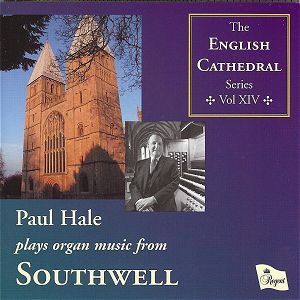
Homage to Handel (1914) [15:31] Paul Hale (organ and cantor)
Robin Blackwell, Samuel Hucklebridge, Benedict Inman, William Inman (trebles) – in
Couperin only
rec. Nave Organ of Southwell Minster, Nottinghamshire, 12 May
2006, 14-15 March 2007
text and translation included. REGENT REGCD248 [79:34]
As this series
is devoted to the organs of English Cathedrals, it is perhaps
appropriate to discuss the instrument before the music or the
player.
There have been
organs in Southwell Minster since 1662, but the instrument
used for this recording is the Quire Organ installed in its
present position in 1996 by Nicolson of Malvern, partly using
pipes made by that firm in 1868 for an organ in Malvern Wells.
Its specification and history are summarised in the CD booklet.
The major work
here is clearly the Couperin. It is one of two Organ Masses
which appeared in 1689-90, and is intended for used in convents
or abbey churches. The many short movements, the longest over
5 minutes but most under 2 minutes, are separated by chant.
Originally that normally employed by the particular convent
or abbey would have been used, but here chant by Nivers published
in 1696 is applied. Any performance of this Mass is a formidable
test of both organist and instrument. All too often I find
myself distracted in this music by the sheer amount and complexity
of the ornamentation, but although Paul Hale does not shirk
the latter neither does he allow himself to appear to concentrate
on it at the expense of the overall sense of the music. The
timbres he coaxes from the organ seem to a non-specialist to
match the composer’s requirements with pungency and sweetness
as required. He also achieves what may be a first on an organ
recording of also appearing as a singer in the brief lines
allotted to the Cantor. There and in the chant, performed by
some of the trebles of the Minster choir, I found myself surprised
at the degree and type of ornamentation. Given its date and
provenance, however, I assume that this would have been expected
in performances of the Mass, however unlikely and even at times
distracting it may appear.
I very much enjoyed
the Mass, but even more the Karg-Elert. His “Homage to Handel” was
written in 1914 to celebrate the composer’s election as an
honorary member of the Royal College of Organists. The choice
of Handel was meant to reflect the close ties between English
and German music, the work appearing just before the outbreak
of war. It is based on a ground bass from the Passacaglia in
Handel’s Keyboard Suite No. 7. The 54 variations on this bass
fall into three main sections. The composer’s instructions
to the player are vivid and give a clear idea of what to expect,
from Lento lugubre ed indeciso at the opening, to Imperiale
e pomposo, Demonico and Trionfante e gigantica towards
the end. It is a colourful and varied work, each variation
short and to the point, and all with a clear sense of purpose.
I have not heard any of the various alternative recordings
but I certainly enjoyed this one immensely.
I got much less
enjoyment from the first two works, due more to their musical
quality than to any defects of performance or instrument. John
Cook was born in Britain but emigrated to Canada and later
to the USA. The Fanfare is based on music written for a Festival
of Britain Pageant at Hampton Court. Although it does show
off some of the louder stops of the organ I found it derivative
and unmemorable. Its greatest virtue is that it is succinct.
Liszt’s Orpheus
is a transcription of the orchestral symphonic poem which was
in turn based on music written to supplement a performance
of Gluck’s opera. The present transcription is by Robert Schaab,
with revisions made by Liszt himself. Unfortunately these are
insufficient to compensate for the loss of the colourful orchestration
of the original, with its frequent use of the harp. The magic
of the latter, especially as captured in Beecham’s versions,
is wholly missing in this organ version. It is indeed hard
to imagine how the poetic fluency of the original could ever
be achieved on the organ, although Paul Hale does play with
admirable flexibility when required.
All too often organ
recitals can seem to the non-organist to be intended to show
off the organ much more than the music. That is not the case
here. The Couperin and Karg-Elert items are both substantial
pieces, enjoyable and worth acquiring in these performances
simply as music. In doing so you will be able also to appreciate
the ability of the instrument, at least in the hands of the
right player, to respond appropriately to the demands of music
of very varied character. And that, presumably, is what this
series is all about.
John Sheppard
Please support our advertisers below by clicking on the logos for further information.

























 Paul Hale (organ and cantor)
