Editorial Board
MusicWeb International
Founding Editor Rob Barnett Editor in Chief
John Quinn Contributing Editor Ralph Moore Webmaster
David Barker Postmaster
Jonathan Woolf MusicWeb Founder Len Mullenger
The Birth of the Cello Gianbattista degli Antonii (c.1640-
after 1696?) Ricercate sopra il Violoncello, Op.1 (1687): Ricercata
No.1 [2:18]; Ricercata No.2 [4:38]; Ricercata No.3 [2:30]; Ricercata
No.4 [3:41]; Ricercata No.5 [4:27]; Ricercata No.6 [5:31]; Ricercata
No.7 [3:46]; Ricercata No.8 [4:11]; Ricercata No.9 [2:32]; Ricercata
No.10 [4:01]; Ricercata No.11 [3:16]; Ricercata No.12 [4:42] Domenico Gabrielli(1651
or 1659-1690)
Ricercari (1689): Ricercar No.1 [2:23]; Ricercar No.2 [7:39]; Ricercar No.3
[3:06]; Ricercar No.4 [5:23]; Ricercar No.5 [1:52]; Ricercar No.6 [3:05]; Ricercar
No.7 [5:32] Julius Berger
(Carlo IX Amati cello, 1566)
rec. 28-30 May and 2-4 July, 2007, Alte Kirche, Boswil, Germany.
DDD. SOLO MUSICA SM112 [74:45]
This CD is offered as
a discovery and presentation of the first solo works for
the cello, played on the oldest surviving instrument. If
that sounds like a somewhat dry proposition – and the chief
appeal will undoubtedly be to specialists and musicologists – there
is, nevertheless, enough here to provide enjoyment for the
general listener, especially the listener who is already
acquainted with Bach’s solo Cello Suites.
The whole feel of this
recording is that nothing has been spared to make the programme
attractive. So detailed and scholarly is the booklet of
notes that it might well pass for a learned journal – and
so large (48 pages) that it would scarcely have fitted into
a normal plastic CD case. The disc is presented in a cardboard
case in the form of a triptych, with the booklet slotted
into the left-hand leaf and the CD in the right-hand. An
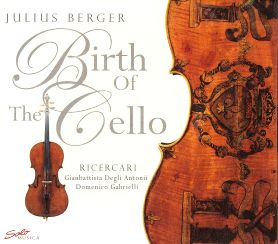
illustration of the decorated rear of a cello – presumably,
Julius Berger’s own Carlo IX Amati instrument – is spread
across the left and centre leaves of the case, with sections
of the same illustration on the cover and on the CD itself.
This Amati cello undoubtedly
provides much of the interest, so it is not surprising that
a considerable portion of the notes should be devoted to
its history. Made in Cremona in 1566, at the beginning of
the slow transition from the viola da gamba to the cello,
it soon became an integral part of the court orchestra of
Charles IX. In the hands of private owners after the French
Revolution, its existence remained unknown until 1926 when
it was identified by a distinguished English violin maker.
Julius Berger first encountered
the instrument in the 1980s; re-encountering it in 2004,
he realised that he had finally discovered his ideal instrument,
one whose sound spoke directly to the heart of the listener. Far
from being merely the ‘spin’ of Berger’s publicity team,
the sound on the CD bears out these claims, aided by a bright
and immediate recording.
The quality of the cello
works of Antonii and Gabrielli was recognised at least as
long ago as 1947: “[W]ith Gabrielli the literature for unaccompanied
cello took its first strides in some remarkable compositions
which stand stylistically, like those of Antonii, on the
borderline of middle and late baroque periods.” (Bukofzer,
Manfred R, Music In The Baroque Era From Monteverdi To
Bach (New York: Norton, 1947) p.139)
Julius Berger, who combines
the roles of distinguished academic and public performer,
has long been a student of their works and has annotated
their music. Frustrated in his attempts to persuade others,
he was finally able at the 2006 Asiago Festival to perform
Gabrielli’s Ricercari in a programme together with
the Preludes of Sofia Gubaidulina, whose appreciation
of his playing is noted in the booklet.
The Solo Musica website – in German only – describes
this 2006 event as a fascinating experience which encouraged
the hope that the music of Gabrielli and Antonii may finally,
after almost 350 years, be appreciated. In case Solo Musica
and I have given the impression that this CD breaks completely
new ground, I should point out the existence of an earlier
recording of these works by Jerôme Pernoo on the Ogam label
(488 0152 – no longer available in the UK); I have not heard
it or seen any reviews of it, and I cannot imagine that it
improves on Berger’s performances.
Berger himself refers to the fascination of playing this music on the oldest
surviving cello and his wish for the audience to experience something similar,
akin to what Bach referred to as Recreation des Gemüths – recreation
of the soul, as the English translation has it, though Gemüth means
much more than that: spiritual satisfaction might be nearer to the mark.
Berger certainly achieves
that aim in large measure for me; his playing throughout
this recording is excellent. All the praise which my colleague
MC heaped on his performances of Boccherini and Leo applies
equally to his performances here (Classical Cello Concertos,
Brilliant Classics 92198 – see review;
JW was slightly less impressed – see review).
My only caveat is that most listeners will find it much easier
to engage with the concertos on that set than with the solo
cello music on offer here. Make the effort, however, and
you will be rewarded – especially if you follow the notes
and music examples in the booklet. If in doubt, go to the
Solo Musica website and
click on hören
und kaufen to hear some examples.
The Antonii Ricercate are
of chiefly academic interest. Though I don’t wish to suggest
that they are dry – certainly not as dry as those early ricercari which
the Oxford Companion to Music rates as “artistically
on a par with Czerny’s duller technical studies” (p.1060) – they
do remind us that the basic meaning of ricercar is
a piece designed to try out the range and capabilities of
an instrument. (See Concise Grove, s.v. ricercar). Originally
published as ricercate sopra il violoncello o’ clavicembalo,
i.e. for cello or keyboard, their publication – and probably
their composition – predates the Gabrielli works, which are
often regarded as the first solo cello pieces. Berger’s
notes dismiss the suggestion sometimes made that they were
intended for performance by cello and harpsichord,
though I suspect that many listeners would appreciate the
greater variety of such an arrangement – or, indeed, Antonii’s
own arrangement for violin and harpsichord.
I suspect that most listeners
will, like me, be more attracted to the Gabrielli works than
to the Antonii. Degli Antonii does not warrant an entry
in either the Concise Grove or the Oxford Companion. Gabrielli
does (see Concise Grove s.v. Domenico
Gabrielli and the Oxford Companion, p.500.) You
may well not have encountered either composer before, but
an attractive Trumpet Sonata by Gabrielli is included on
a Naxos CD of Baroque Trumpet music which I reviewed in September,
2007 (8.570501 – see my review,
also GPu’s review). The Ricercari may
not be as attractive as that concerto, but they are well
worth hearing.
I cannot imagine that
this Solo Musica disc will form a regular part of my listening
programme or that this is the most vital Baroque CD ever,
but its value is certainly more than that of a mere historical
curiosity. It left me feeling academically informed and
entertained in equal measures.
Brian Wilson
Please support our advertisers below by clicking on the logos for further information.

























 Julius Berger
(Carlo IX Amati cello, 1566)
Julius Berger
(Carlo IX Amati cello, 1566) 
