Editorial Board
MusicWeb International
Founding Editor Rob Barnett Editor in Chief
John Quinn Contributing Editor Ralph Moore Webmaster
David Barker Postmaster
Jonathan Woolf MusicWeb Founder Len Mullenger
POLDOWSKI
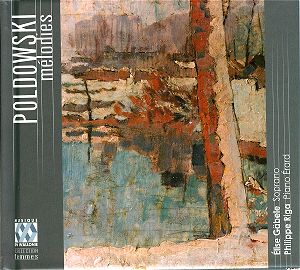
(Régine WIENIAWSKI) (1879–1932) Mélodies 1. L’heure exquise (1913) [2:46] 2. Mandoline (1911) [1:38] Trois mélodies sur des poésies de Paul Verlaine
(1911):3. Dimanche
d’avril [0:54]; 4. Bruxelles [2:27]; 5. En sourdine [2:50]
6. Dansons la gigue (1912) [1:41]
7. Cythère (1912) [1:01] 8. Cortège (1912) [1:25] 9. L’attente (1912) [2:23] 10. Brume (1912) [1:52] 11. Spleen (1912) [2:48]
12. Sur l’herbe (1918) [2:01]
13. Le faune (1919) [1:07]
14. Impression fausse (1912) [2:21]
15. Colombine (1911) [1:56]
16. Fantoches (1912) [1:12]
17. Effet de neige (1913) [2:42]
18. Circonspection (1913) [2:44]
19. Crépuscule du soir mystique (1913) [2:53]
20. A poor young shepherd (1923) [2:23] 21. À Clymène (1927) [2:14] 22. Sérénade (1914) [2:48] 23. La passante (1924) [2:04] 24. Pannyre aux talons d’or (1912) [3:35] 25. Dans une musette (1918) [3:57] 26. Berceuse d’Armorique (1914) [3:15] 27. Soir (1911)*[4:56] Élise
Gäbele (soprano), Philippe Riga (piano),
Sylvain Cremers (oboe d’amore)*
rec. 2 – 4 November 2006 at Academiezaal, Sint-Truiden, Limburg,
Belgium
Texts and English translations enclosed MUSIQUE EN WALLONIE
MEW 0741 [66:50]
The name Poldowski may be new to many readers – it was
to me – but Wieniawski should
ring a bell. Henryk Wieniawski (1835 – 1880) was a Polish
violinist and composer and some of his virtuoso works are
still played, not least his violin concertos, of which No.
2 has some claims to be his masterpiece. He settled in Ixelles
in Belgium in 1874, having been appointed to the Brussels
Conservatory. His daughter Régine was born on 16 May 1879
and less than a year later Henryk died in Moscow, leaving
his wife Isabelle Bessie-Hampton alone with her daughter.
Isabelle was of a London family and eventually, in 1896,
they moved there. Régine studied the piano in Brussels and
gave recitals very early but there seems to be very little
documentation on her further studies, even though she claimed
to have gone to study at the Conservatory. That she was a
child prodigy and started composing very early is beyond
doubt, however. In 1893, when she was 14, she performed in
public two or three of her own compositions.
In London she seems to have pursued her musical training and she also
had two songs to texts by Yeats and Tennyson published under
the name of Iréne Wieniawska. She had become friendly with
Nellie Melba while still in Brussels and meeting the Australian
diva again in London she was introduced to Sir Aubrey Dean
Paul, whom she married in 1901 and became Lady Dean Paul.
When she pursued her dual career as pianist and composer
she chose to appear under the pseudonym of Poldowski. As
a composer she was successful, not only in the field of songs,
but privately she went through several crises of illness,
divorce from her husband in 1921 and heavy financial problems.
She died from a heart attack on 28 January 1932 after an
unsuccessful operation. She had three children, one of whom
died at a very early age.
The majority of her songs were settings to French texts and according
to her daughter Brenda she always spoke French. As can be
seen in the header many of the poems she set had already
been set by Fauré, Debussy and Ravel and her compositional
style shows strong influences from Debussy in particular,
but I think it is unfair to call her a mere epigone. Still
I am sure many knowledgeable listeners hearing her songs
in a blindfold test would think “Debussy” as a likely composer.
They are well crafted, harmonically sure-footed though sometimes
predictably so, and sometimes they can feel a bit too perfumed
and with a melodic sweetness that isn’t too far away from
the parlour songs of the day. Sometimes I even hear a kinship
with Augusta Holmès. Try Dimanche d’avril (tr. 3)!
For more genuine Debussyan echoes En sourdine (tr.
5) or Effet de neige (tr. 17) are good examples while Cythère (tr.
7) and Cortège (tr. 8) are more personal. There is
no denying the craftsmanship and she was certainly inspired
by the poems.
Paul Verlaine was her favourite poet and on this disc all 21 settings
of his poetry are collected. Among the remaining songs one
is a setting of a poem by herself, La passante (tr.
23). A great number of the songs were created during a few
years preceding World War One and after the war she composed
again but not with the same intensity.
By and large these are attractive songs but I don’t think it is a
good idea to play all 27 in one sitting. Three or four at
a time is a much better proposition, and why not start from
the beginning with the beautiful L’heure exquise start
the next session with Dansons la gigue.
The singing is honest and polished. Élise Gäbele has a clean, bright
voice which sounds best at mezzoforte and below. At forte – the
few times she has to be there – it can take on a strident
quality. This also implies that the dynamic scope of the
songs is limited. The accompaniments, sometimes illustrative,
are well played by Philippe Riga and in the final song, Soir,
actually one of the best, a pastoral atmosphere is created
through the presence of Sylvain Cremers’s oboe d’amore, which
blends well with the soprano.
To sum it up: well crafted, agreeable songs but hardly forgotten masterpieces;
pleasing enough, three or four at a time, for listeners with
a liking for impressionism.
Göran Forsling
Please support our advertisers below by clicking on the logos for further information.

























 Élise
Gäbele (soprano), Philippe Riga (piano),
Sylvain Cremers (oboe d’amore)*
Élise
Gäbele (soprano), Philippe Riga (piano),
Sylvain Cremers (oboe d’amore)*