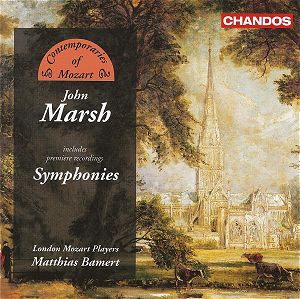
If the name of John Marsh is not well known today, it most certainly
would have been in musical circles near the South Coast of England
towards the end of the 18th century. More specifically
in Salisbury, Canterbury and Chichester, the towns in which
he lived successively between 1774 and the end of his life,
and in which he played a very large part in organising local
musical life.
As
a lawyer and later a property owner he was always a musical
amateur – he wrote in 1823 that “tho’ I have published several
Musical works of various kinds I am no Professor of Music,
nor ever was”. He was nonetheless more than capable as a player
of various instruments, including the organ and violin, and
plainly a very energetic, tactful and effective musical administrator,
virtually running the musical scene in the various cities
in which he lived. How he found time for this and his professional
and social life when he was also a busy composer is unclear.
His
Journals, edited by Brian Robins and published by Pendragon
Press in 1998, give a fascinating record of musical life all
over England in the latter part of the 18th century
and contain many episodes which will be familiar to anyone
involved in amateur performance today. They indicate that
he wrote 39 Symphonies, three Concertos, fifteen Concertos
“in the Ancient Style” and twelve String Quartets, as well
as much keyboard and vocal music. Unfortunately most of these
have not survived, but nine of the symphonies were published
in his lifetime and have been edited in recent years by Ian
Graham-Jones, who also writes the admirable notes accompanying
this disc.
Although
this is part of the series entitled “Contemporaries of Mozart”,
which Marsh certainly was, that is not really relevant to
his symphonies which are much closer to the works of J.C.
Bach, Pleyel and, perhaps above all, Haydn. The first work
on the disc – No. 6 in D (actually his 27th) –
was specifically written “upon the plan of Haydn’s modern
ones”. He had indeed heard the first performances of some
of Haydn’s London Symphonies and was obviously eager to copy
them. Unlike the others on this disc, it is in four movements,
with a slow introduction followed by a wonderfully bracing
first movement built largely on a repeated note rhythm. The
performance here fully realizes its potential, with more than
an occasional nod towards period practice. Marsh himself seems
to have been amazingly patient in the face of performances
where instruments were missing or simply badly played, but
listening to the performances here we can hear what it is
that he was aiming at.
The
Conversation Symphony has been recorded at least twice before,
but it thoroughly merits another version. The orchestra is
not divided wholly in two, as with the Symphonies for Double
Orchestra by J.C. Bach, but instead the first comprises oboes,
violins bassoon and cellos, and the second horns, divided
violas, cellos and bass, with timpani in the middle. With
such rich colours to play with Marsh is able to produce wonderfully
imaginative effects in this comparatively short piece. The
Symphony No. 7 has as its programme the stages of a hunt –
the first movement is “The Hunter’s Call in the Morning and
gradually assembling together”, the second “Setting out from
Home (trotting and occasionally cantering) – The Fox discovered”
and the third simply “Chasse”, ending quietly, perhaps suggesting
that the listener is no longer able to keep up with the hunt.
This is another work full of imaginative touches and well
worth hearing.
The
remaining works are perhaps less striking - and contrary to
the statement on the back of the cover No. 2 is not another
“La Chasse” - but they are both pleasant and well written, somewhat
like a mixture of J.C. Bach and Arne. All five are very well
played and recorded and left me waiting eagerly for a second
disc which could include the remaining Symphonies and the Three
Finales dating from 1799 to 1801. How welcome a disc of his
choral and keyboard music would be also, but this is being greedy.
In the meantime I must give an very warm welcome to the present
disc which can be recommended to any enthusiast for music of
this period.
John Sheppard