Janáček’s
only comic opera is based on a satirical
novel by Svatopluk Čech, The
True Excursion of Mr Brouček
to the Moon. MusicWeb-International
has a marvellous resource
on the operas of Janáček, and
lots of juicy analysis and background
details can be found here on the The
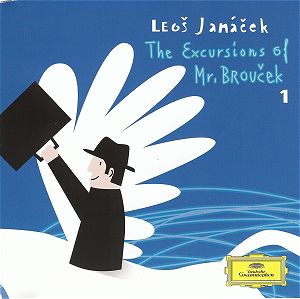
Excursions of Mr Brouček,
including the bizarre background to
the libretto for this opera. A version
of such details can also be found
in the booklet notes for this delightfully
presented new release, as well as
the entire libretto in French, German
and English, alongside the original
Czech. My only complaint is that the
track-listings against the libretto
texts are tiny, and hidden in the
spine of the pages, making finding
your place a real task sometimes.
Each part is on separate discs, but
the libretto of the second part is
spread over two booklets. Any mad
scramble for the box or dash for the
pause button can however be tempered,
as there at least two minutes of orchestral
interlude at the changeover, which
occurs at the opening of Part II Act
II.
The opera is symmetrical,
in two parts, each divided into two
acts. The first part, The
Excursion of Mr. Brouček to the
Moon, involves the drunken
Brouček
in a dream in which he escapes earthly
commitments by going to live on the
moon. This turns out to be a disaster,
involving the dissipated Brouček
in even more complicated relationships
and social quandaries amongst artistically
sensitive lunar luvvies. The second
part, The
Excursion of Mr. Brouček to the
15th Century, has our alcoholic
hero hallucinating that he is transported
back in time, and into the middle
of a Prague which is under
siege from the German armies of the
Holy Roman Empire. The cowardly Brouček,
expected to participate in the defence
of the city, runs and hides at the
earliest opportunity. Later found,
he is accused of treason and sentenced
to death in a beer barrel. Back
in the 19th century, landlord
Würfl
hears groans and whining from the
cellar, and finds Brouček there
inside a barrel. Brouček, relieved
to be home at last, boasts that he
liberated Prague single-handed.
A sticker on the
box proudly announces this as being
the ‘World-premiere recording of the
new edition’ of this opera, but the
booklet notes elaborate no further
on the subject. The Leoš Janáček
website at www.leosjanacek.co.uk
tells us that this is from Universal
Edition, and edited
by Jiří Zahrádka, also
providing some useful extra illustrations
and notes on the work. In fact, with
a dearth of outings for this opera
the present release is also reported
to be its first digital recording.
This recording was made in association
with the BBC and broadcast in 2007
as a live performance – something
UK readers may remember, but which
this ex-pat unfortunately missed.
A trawl of available versions on CD
only turned up one on Supraphon conducted
by Frantisek Jílek, and one
from Bavaria with Joseph Keilberth
on the Orfeo d’or label.
This is one instance
in which you won’t hear me complain
about the acoustic in the Barbican
Centre. The rather dry sounding space
can mean sudden death for orchestral
recordings, but here it makes for
an ideal opera-house-like environment,
with plenty of stage width for the
characters to move around in the stereo
spread, and the orchestra in the most
salubrious pit in Europe.
The combination of
native Czech soloists and the forces
of the BBC Singers and Symphony Orchestra
under Jiří
Bĕlohlávek is very strong indeed.
A case might be argued for a Czech
orchestra if one is seeking to be
really perfectionist, as even now
there are still differences in character
between those bands and your BBC ensemble.
The BBC Symphony Orchestra does
very well with the material however,
and this is a virtuoso effort with
a highly demanding score, especially
for an orchestra which doesn’t normally
specialise in the dramatic twists
and turns and the flexibility demanded
of opera performing: true, it is not
always perfect, but the energy and
emotional commitment is all there
in full measure. The orchestral colours
are typical Janáček,
but more so – the score being one
of the most extended and opulently
scored of any by this composer. The
booklet mentions the surprise addition
of bagpipes and an organ, the latter
of which appears at the triumphant
end to Part II act II. I listened
in vain for the bagpipes. The chorus
sounds convincingly gruff and energetic,
commenting, cajoling and becoming
a threatening crowd by turns.
The soloists are
all equally strong, with Maria Haan’s
silvery tones rising imperiously,
elegantly or playfully over the orchestra
like a bird in flight. The buffo
performances of the leading men
are all highly entertaining, and this
whole production is a magical experience
in every way. One might imagine that
the use of multiple parts per voice
might make for a confusing listen,
but the characters are distinctive
enough through the score, and some
subtle shuffling with stage placements
helps as well. I am normally a little
sceptical about opera on CD, but even
without any visual clues this one
is so well written and so programmatically
clear that there is plenty of imagery
to be going on with, even if like
me, your Czech is limited to only
a few words. In this way it is like
reading a good book, one that you
don’t want to put down, but also one
you want to last longer so that you
can inhabit that world for as long
as possible.
Whatever your likes
and dislikes, this is a marvellous
and forward-looking score by any standards.
There are the marvellous little Janáček
moments, characteristic fingerprints
of colour, and
rhythms which sometimes ape the speech
patterns of the singers. The final
scene has a descending string figure
which could have been straight out
of something by Lutosławski,
and there are surprises all over the
place. I defy anyone to come away
from this without an extra
dance step or two in their feet, or
whistling some miniature melodic fragment
or other. True, there are no really
big tunes to speak of, but every interval
is pure Janáček:
there is no escaping his alchemy with
melodic and harmonic shape,
and his influence on the imagination.
The first opera I ever saw in the
flesh was The Makropoulos Case,
and even though I was hardly of an
age to understand much of it at the
time I became an huge fan of this
composer’s operas, and have been ever
since.
Brouček
has all of the anarchic qualities
of something like The Good Soldier
Švejk, and as a tale could only
ever really be Czech in origin. As
other commentators have noted, The
Excursions have been seen rarely
enough on both stage and record. After
hearing this new recording I suspect
you will find this state of affairs
as inexplicable as I do.
Dominy Clements
Seen
and Heard concert review























 Matěj Brouček – Jan Vaník