In the spring of 1833 Bellini’s ninth opera, Beatrice di Tenda
was presented at Venice’s La Fenice. It was not a success. During
its composition Bellini had quarrelled with Romani, his librettist
and long-time friend, even mentor. At about the same time, back
in Milan, the husband of Giuditta Cantu, his mistress, discovered
some letters that left no doubt about the nature of the relationship
of his wife with the handsome composer. A scandal followed and
the husband and wife separated. Bellini had earlier accepted an
offer from the King’s Theatre in London to present several of
his operas. Turning his back on Giuditta Cantu he left for England.
His operas were successful in London where he met and was infatuated,
or even more, with Maria Malibran.
Despite the success
of his operas in London, no new commissions were forthcoming,
and Bellini went to Paris, the musical capital of Europe.
His earlier operas had preceded him and he was welcome in
every salon, and particularly that of Madame Joubert. Bellini
hoped for a commission from the Opéra, having made contact
with its director, Veron, on his way to London. When no commission
arrived, Bellini accepted one from the Théâtre Italien where
his Il Pirata and I Capuleti e I Montecchi had
been favourably received by audiences if not critics. With
no Romani, Bellini looked around for a new collaborator. His
choice fell on Count Carlo Pepoli, an Italian political radical
in exile in France whom the composer had met at a salon of
like-minded fellow Italians.
Following the
custom of the time composer and poet decided to adapt a recently
successful play as the basis of the new opera. They chose
the historical drama by Ancelot and Boniface based on the
English Civil War in the period after the execution of Charles
I. In this story composer and librettist also sought to exploit
the European infatuation with Sir Walter Scott’s works and
at one stage titled the opera I puritani di Scozia,
the title of an Italian translation of the novelist’s Old
Mortality. Count Pepoli was no Romani and he and Bellini
had many disagreements in the course of the construction of
the libretto. Bellini sought advice from Rossini as well as
depending on his own theatrical experience and what he had
learned working with Romani.
The action of
the story takes place in Plymouth after the massive defeat
of Charles I at the hands of the Puritans, his execution,
and the defeat of the Cavalier rebellion. The Puritan governor,
Lord Valton, has agreed to the marriage of his daughter Elvira
to Lord Arturo Talbot, a Cavalier. This was after persuasion
by her uncle Giorgio and was despite the fact that he had
originally promised her hand to Riccardo Forth, a captain
in his army. Valton explains that he cannot attend the ceremony,
as he is to take a prisoner to London to stand trial. Arturo
recognises the prisoner as Enrichetta, widow of the executed
king. To save her from certain death he smuggles her out of
the castle in Elvira’s bridal veil, passing her off as his
wife. Elvira assumes she has been betrayed and loses her reason.
Giorgio implores Riccardo to save Arturo from death otherwise
Elvira will die of grief. He reluctantly does so. Arturo returns
to the castle and explains his sudden disappearance to Elvira
who, after more mental anguish as she worries that Arturo
will desert her again or be executed. She is finally convinced
and restored to reason after Cromwell, who has defeated all
the Royalists, declares an amnesty.
With a dream cast
of Giulia Pasta, Rubini in the high lying tenor role of Arturo
along with Tamburini and Lablache, Bellini’s long melodic
lines and mad scenes made I Puritani an outstanding
success from the first night. The opera was performed seventeen
further times in the Paris season before travelling first
to London and then throughout Europe. Fellow Neapolitan Queen
Maria Amelia received Bellini and he was awarded the Légion
d’Honneur. Somewhat fragile in health at the best of times,
and after the tensions of the production, Bellini returned
to stay with his Parisian hosts and planned additions to I
Puritani for an Italian production with Malibran. He suffered
a recurrence of the gastric problems from which chronic condition
he had ailed for some time. Despite the attentions of Princess
Belgoioso’s personal physician, Bellini died on 23 September
1835. Unlike his contemporaries Bellini did not compose at
speed. In his brief life he had written a mere ten operas
finding greatest fame with Norma, at least after its
disastrous first night. Like I Puritani it is characterised
by long flowing melodic lines with one section blending nearly
imperceptibly into another. It was a technique that even Verdi
did not either emulate or achieve until late in his compositional
career.
This 1979 recording
of Bellini’s I Puritani has no singers of the stature
of the original quartet – not even Caballé, who in her bel
canto pomp of the 1960s might have been ideal for the
role of Elvira. However, her performance in this recording
shows the vocal consequences of many performances of Norma,
recording Aida as well as surmounting the thick orchestral
textures of Richard Strauss’s Salome. Being recorded
back to back with Cavalleria Rusticana would not have
helped her vocal condition either. Given Caballé’s earlier
repertoire, and capacity for soft pianissimos, it is surprising
that she restricted her singing of Bellini’s melodic music
to many performances of Norma and Imogene in Il
Pirata whilst never singing Elvira on stage or in concert.
At this point in her career she is no longer ideally steady
in holding the legato line and the voice spreads when she
applies pressure. The good expression as well as the defects
can be heard in the mad scene O rendetemi la speme
(CD 3 tr.1) when she fails to recognise Giorgio and Riccardo.
The Giorgio of Agostino Ferrin is woolly-toned whilst Matteo
Manuguerra’s Riccardo has little vocal grace. Their singing
of the long duet Il rival salvar tu dei …uoni la tromba
(CD 3 trs 4-7), regularly encored in the 1835 Parisian performances,
has little distinction. Elsewhere Manuguerra sounds vocally
rough in this music, lacking smoothness of line and vocal
production. Alfredo Kraus, in the Rubini role of Arturo, had
long been an elegant vocal presence in the bel canto repertoire
and after this recording he put his score away forever. Regrettably,
his performance here does his vocal skills and undeniable
vocal taste no favours. There are moments when he caresses
a phrase with that distinctive elegance so long his vocal
trademark. After rather squeezing his tone for the high D
in Arturo’s reprise of his serenade (CD 3 tr.11) he thankfully
eschews the high F in Credeasi, misera! (CD 3 tr.17)
that Rubini and few others, including Pavarotti on the Decca
recording, manage. Muti is variable in his tempi and exhibits
little of the natural feel he has for Verdi. The Ambrosian
Opera Chorus sings with the kind of distinction that is regrettably
lacking elsewhere. The accompanying leaflet has an excellent
introductory essay and track-related synopsis in English,
German and French whilst the recording is nicely balanced.
Lovers of bel
canto seeking a recording of Bellini’s last opera will
perhaps need to look elsewhere for satisfaction. Personally
I find the 1973 Decca recording under Bonynge with Sutherland
as Elvira, Pavarotti as Arturo with Ghiaurov and Cappuccilli
making the most of their opportunities, highly satisfactory
despite the tenor’s tasteless semi-falsetto effort at the
high F referred to. It is often to be purchased at mid price
(Decca 417 588-2). The previous EMI recording with Maria Callas
is seriously cut. It is available at mid price on EMI (review)
and a Naxos remastering (review).
Robert J Farr
























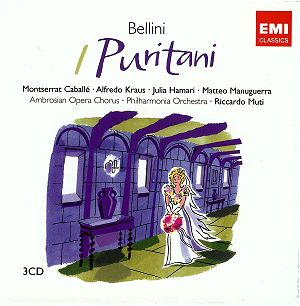

 Elvira - Montserrat
Caballé (sop); Arturo - Alfredo Kraus (ten); Riccardo - Matteo Manuguerra
(bar); Giorgio - Agostino Ferrin (bass); Bruno - Dennis O’Neill (ten);
Gualtiero Valton - Stefan Elenkov (bass); Enrichetta - Julia Hamari
(sop)
Elvira - Montserrat
Caballé (sop); Arturo - Alfredo Kraus (ten); Riccardo - Matteo Manuguerra
(bar); Giorgio - Agostino Ferrin (bass); Bruno - Dennis O’Neill (ten);
Gualtiero Valton - Stefan Elenkov (bass); Enrichetta - Julia Hamari
(sop) 
