“The transcription is in general a subject, which in this day
and age (a prolific time for transcriptions) an author can only
struggle against in vain; but at least one can rightfully demand
that the publisher declares the fact on the title-page, so that
the reputation of the author is not diminished and the public
is not deceived”.
These are Beethoven’s own words from November 1802
in protest against unauthorised arrangements of his music.
Not only was there no modern-day concept of copyright but
it was through transcriptions that many works reached a larger
audience and there was a great profusion of such arrangements.
Perhaps the best-known examples are those wonderful wind octet
arrangements of Mozart’s operas by the trio of Bohemian wind
players Joseph Triebensee (1772-1846), Johann Nepomuk Wendt
(1745-1801) and Wenzel Sedlak (1776-1851). Less well-known
is that Mozart himself arranged Il seraglio as a way
of making some extra money and of retaining some control of
at least one of the transcriptions of his work. Such was the
popularity of this octet ensemble that it was given its own
name - the Harmonie. Sedlak was a court clarinettist
for most of his adult life until 1835, when the Harmonie
of Prince Liechtenstein was dissolved, retiring Sedlak on
a pension. He was a prodigious transcriber of operas by, among
others, Auber, Bellini, Donizetti and Rossini. The transcription
he made of eleven sections from Beethoven’s Fidelio
in 1815 is considered to be his greatest achievement and Beethoven
even sanctioned Sedlak’s arrangement himself. Because of Beethoven’s
predilection for wind instruments, Sedlak’s version of the
Overture to Fidelio loses very little tone colour in
this version for wind octet plus contrabassoon in relation
to the original – testament surely to Sedlak’s great transcription
skills. The Overture is shorn of 25 bars - where, in the original,
there is a modulation from C major to B major. These are replaced
by two bars of unison writing – the sort of ‘artistic licence’
that was common such arrangements. It is also transcribed
down to C major to better suit the ranges of the instruments.
Beethoven made his own Harmonie transcriptions
of his Seventh and Eighth Symphonies in 1816, which were published
along with versions for string quartet, piano trio, piano
duet and solo piano, all ‘under the direct supervision of
their creator’. I have to say that I was slightly disappointed
in the transcription of the Seventh Symphony. This was a surprise
as I am a lover of the wind octet repertoire and, Beethoven
was supremely skilful in his writing for winds. Perhaps the
music of this great symphony does not lend itself to such
diminution; nor to the other mutations to which it is subjected;
the whole symphony is transposed down a whole tone to G major
but the scherzo retains its original key of F major,
thereby destroying the key relationship Beethoven originally
put in place. Although the first and second movements survive
structurally intact in Beethoven’s transcription (including,
perhaps surprisingly, the first movement exposition repeat),
the scherzo is shorn of the whole of the second scherzo
and trio section, while the finale is stripped
altogether of its wonderful development section.
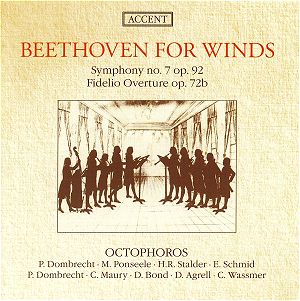
The members of Octophoros play on period instruments
or reproductions. Period-instrument playing was not as highly
developed when this recording was made in 1984 and the sound
lacks a little bite and focus for me – particularly the rather
wobbly, muffled contrabassoon which has little of the impact
I would have hoped for in bolstering the bass line of the
music.
The playing time for this CD is woefully short
– presumably because the CD is just a simple recreation of
a vinyl LP. However, CD-singles apart, I deplore any company
that less than half-fills its CDs for commercial release.
At barely over 39 minutes, this issue could hardly be said
to be value for money. This CD will be an interesting curiosity
for those with a fascination for wind music and transcriptions
but, for me, did not stand up to repeated listening.
Derek
Warby