Editorial Board
MusicWeb International
Founding Editor Rob Barnett Editor in Chief
John Quinn Contributing Editor Ralph Moore Webmaster
David Barker Postmaster
Jonathan Woolf MusicWeb Founder Len Mullenger
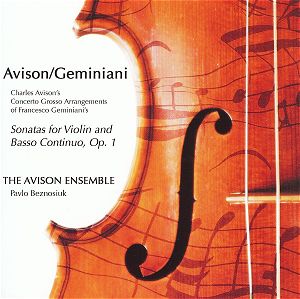
Charles AVISON (1709/10-1770) 12 Concerti Grossi after Geminiani's sonatas for violin and
basso continuo, op. 1
CD 1
Concerto grosso No. 1 in G [8:26]
Concerto grosso No. 2 in d minor [06:37]
Concerto grosso No. 3 in e minor [06:02]
Concerto grosso No. 4 in D [06:29]
Concerto grosso No. 5 in B flat [06:49]
Concerto grosso No. 6 in g minor [19:18]
CD 2
Concerto grosso No. 7 in c minor [06:10]
Concerto grosso No. 8 in b minor [07:25]
Concerto grosso No. 9 in F [08:46]
Concerto grosso No. 10 in D [06:39]
Concerto grosso No. 11 in a minor [07:50]
Concerto grosso No. 12 in d minor [07:35] The Avison
Ensemble/Pavlo Beznosiuk
rec. 2-5 October 2005, Jubilee Theatre, St Nicholas' Hospital,
Newcastle-upon-Tyne DIVINE ART DDA21210 [54:22
+ 45:06]
It still happens now and
then that music manuscripts are discovered. Sometimes they
contain music which is known to have existed and somehow
has gone missing. Sometimes these manuscripts contain music
which was hitherto completely unknown. That is the case with
the Concerti grossi by Charles Avison recorded here. We know
he arranged keyboard sonatas by Domenico Scarlatti as concerti
grossi, and we also know about his admiration for Francesco
Geminiani. But nobody knew that Avison also arranged violin
sonatas by his hero as concerti grossi. "They were discovered
in the second of two of Avison's workbooks that suddenly
appeared in the years 2000 and 2002 respectively. Consisting
of more than 600 pages of music hidden from view for over
two centuries, these two books add significantly to Avison's
repertoire and reputation", Mark Kroll writes in the
programme notes.
Francesco Geminiani was born in 1687 in Lucca, and probably received
his first musical education from his father, who was a violinist.
It is assumed that among his later teachers were Corelli
and Alessandro Scarlatti, but although he is thought to have
been in Rome from 1704 to 1706 there is no firm evidence
for this. That he was close to Arcangelo Corelli is a fact,
since in the foreword to 'A Treatise of Good Taste in the
Art of Musick', which was published in 1749, he refers to
discussions with Corelli about his music. In 1714 he left
Italy for England, probably because he didn't see any real
chance of a career either in Rome or in Naples, where he
also spent some time. And as England had attracted other
musicians from Italy before it was a logical choice to try
to find employment there.
In England he found fertile soil: admiration for Italy and the Italian
music was widespread, and there were ample opportunities
to perform and to teach. In England Geminiani found his first
patron in the person of Baron Johann Adolf Kielmannsegg.
It was he who arranged a public performance with the king
in attendance, in which Geminiani was accompanied by Handel
at the harpsichord. It was also Kielmannsegg to whom Geminiani
dedicated his 12 sonatas for violin and b.c. opus 1. This
collection had considerable success, and as the sonatas were
stylistically close to Corelli he could convincingly present
himself as Corelli's pupil.
Charles Avison was born in 1709 in Newcastle-upon-Tyne, in the north
of England, where he received his first musical training
from his father, who was one of the city waits. From 1724
to 1735 he stayed in London to further his musical education,
and then returned to Newcastle, where he stayed the rest
of his life and played an important role in musical life.
During his time in London he met Francesco Geminiani, who
made a lasting impression on him. His admiration for the
Italian master was such that in 'An Essay on Musical Expression',
which was published in 1752, he claimed Geminiani to be a
better composer than Handel. This caused a vivid debate as
many of his colleagues strongly disagreed and defended Handel
against what they considered an unfair attack.
The influence of Geminiani is reflected
in Avison's own compositions, like
the Concerti Grossi op. 6 - also recorded
by the Avison Ensemble (Naxos 8.557553-54
- see review).
His admiration also made him arrange
the sonatas opus 1. He turned them
into concerti grossi for seven instrumental
parts, divided into two groups: the
'concertino' - consisting of the instruments
who play the solo sections - and the
'ripieno', the full ensemble. The
manuscript contains only eleven concertos,
as it seems Avison didn't arrange
the Sonata No 11. For this recording
Pavlo Beznosiuk made his own arrangement
of this sonata. As much as I admire
the result I don't see the point.
If one wants to present the arrangements
by Avison, then why fill in what he
- for whatever reason - left out?
The Twelve sonatas by Geminiani are of the two then-usual types of
'sonata da chiesa' (Sonatas 1 - 6) and 'sonata da camera'
(Sonatas 7 - 12), although the tempo indications don't show
any difference. The sonatas of the second half contain several
dance movements, but are still referred to as vivace, andante
or allegro.
Although Geminiani remained his hero all his life Avison wasn't a
conservative composer, let alone a Geminiani clone. In his
Concertos op. 6 mentioned above he composed four concertos
in which he made use of the modern sonata form. And in these
arrangements of Geminiani's sonatas opus 1 he doesn't slavishly
follow his model either. The most interesting example is
the Concerto grosso No 6 in g minor, which ends with an andante.
Here Avison adds a lengthy passage of his own, a theme with
variations in two parts, after which the original andante
by Geminiani is to be repeated. Avison refers to the andante
as 'menuet', and this last movement is in fact a combination
of menuet and trio - one of the most popular forms of the
emerging classical style. The way this theme with variations
should be played is a bit of a problem. Mark Kroll sees performance
on a harpsichord as a possibility, but considering the scoring
of these concertos this seems rather odd. The option followed
here, violin and cello, is much more convincing. The structure
of this last movement remains rather unsatisfying, though:
the duet is very long (more than 200 measures) meaning that
the other instruments have to keep silent for about 10 minutes.
This set of concerti grossi is an important discovery. Not only is
it a fine tribute to the art of Geminiani, but it also reflects
the admiration for the master, not just by Avison, but by
English music-lovers at large. It also reflects the quite
usual practice of showing one's admiration by arranging music
of one's hero. Geminiani once did the same, when he turned
Corelli's sonatas for violin and bc op. 5 into concerti grossi.
These performances are good but I have some reservations with regard
to the sound, which I find a little sharp and - in the long
run - a bit tiresome. Somewhat more variety in phrasing and
articulation, more dynamic shades and in general a little
more warmth and passion would have done this recording considerable
good. I would advise listeners to assimilate this set gradually,
and not at a sustained stretch as I have done.
These concertos give plenty of evidence of Avison's great qualities
as a composer, and one can only hope other compositions – such
as his chamber music and vocal works - are to be explored
in due course.
Johan
van Veen
Please support our advertisers below by clicking on the logos for further information.

























 The Avison
Ensemble/Pavlo Beznosiuk
The Avison
Ensemble/Pavlo Beznosiuk 
