|
Making
a Donation to MusicWeb
About MWI
Site
Map
More
Reviews
How to find a review
Books
Film
Music (Archive)
Interviews
Nostalgia
Records Of The Year
Monthly Best Buys
Comment
Arthur Butterworth Writes
Phil
Scowcroft's Garlands
Classical
blogs
Reviewers
Logs
Announcements
Don't
Go Here!
Community
Bulletin Board
Web
Ring
Reviewers
Helpers
invited!
Resources
How
Did I Miss That?
British
Composers
British
Light Music Composers
Other
composers
Review Indexes
By
Label
By
Masterwork
Discographies
Composer
National
Themed
Review pages
Complete Books
Programme
Notes
External sites
British Music Society
The BBC Proms
Performers
Orchestra Sites
Recording Companies & Retailers
Online Music
Agents & Marketing
Publishers
Other links
Newsgroups
Web News sites etc
Editorial
Board
Classical Editor
Rob Barnett
Seen & Heard
Editor and Webmaster
Bill Kenny
MusicWeb Webmaster
Len Mullenger
Assistant Webmaster
David Barker
PotPourri
A
pot-pourri of articles
MW
Listening Room
MW
Office
Helping
MusicWeb
Advice
to Windows Vista users
Questionnaire
Site
History
What
they say about us
What
we say about us!
Where
to get help on the Internet
CD
orders By Special Request
Graphics
archive
Currency
Converter
Dictionary
Magazines
Newsfeed
Web Ring
Translation Service
Rules
for potential reviewers :-)
Do
Not Go Here!
April Fools


|

 |
 |
|
Availability
Dux
|
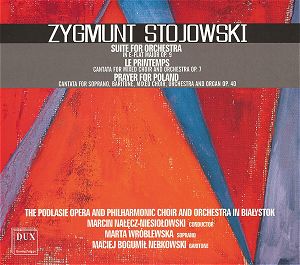
Zygmunt STOJOWSKI (1870-1946)
Suite for Orchestra in E flat major op. 9 (1890-91) [23:13]
Le Printemps - cantata for mixed choir and orchestra op. 7
(1895) [7:24]
Prayer for Poland - cantata for soprano, baritone,
mixed choir, orchestra and organ op. 40 (1915) [22:03]
Marta Wróblewska
(soprano); Maciej Bogumil Nerkowski (baritone); Rafal Sulima
(organ)
The Podlasie Opera and Philharmonic Choir and Orchestra in
Bialystok/Marcin Nalecz-Niesiolowski
rec. Podlasie Opera and Concert Hall, Bialystock, December
2007. DDD
DUX 0625 [53:56]  |
|
|
Poland here acknowledges the
forgotten work of one of its musical sons. He was born near
Kielce and. He studied at the Cracow Conservatory. We may
know him from the Hyperion recording of his two
piano concertos and solo
piano music. Dux have also given us his violin
sonata and cello
sonata. His Rhapsodie
Symphonique for piano and orchestra is on ABC.
His op. 9 may bear a forgettable
title but its three movements are packed with interest. The Thčme
varié begins in Slavonic accents redolent of Mussorgsky's Dawn
on the Moskva River. A series of intricate variations
then flies along at hectic pace too quick and concentrated
for boredom to set in and always intensely inventive. The
cortex of this music is Brahmsian but there are magical nationalist
overtones which add spruce and shine; try the harp silver-lights
at 5.27. Other works which relate to the core of this work
are Dunhill's Elegiac Variations and Parry's Symphonic
Variations. Stojowski's invention is genuinely touching
as at the long aureate melody at 7:57 onwards. The second
movement is an Intermčde Polonaise which starts with
a figure irresistibly recalling Hamish MacCunn's most
famous overture but soon shakes off the impression with delightfully
piquant woodwind and string dialogue (1:11). The finale is
a Reverie and Cracovienne, distinguished by some engaging
work for the bassoon and the stahlspiel. The Suite was premiered
complete in 1894 by the Berlin Philharmonic. Hans von Bülow,
to whom it is dedicated, conducted it in Hamburg in one of
his last concerts. It also featured in the Lamoureux season
in Paris in 1895. It was there that he wrote his short cantata Spring and
dedicated it to Delibes. This Delian effusion is intensely
romantic and cantabile. It might be thought of as in the
same genre as Rachmaninov's own Spring Cantata and Three
Russian Songs as well as Coleridge-Taylor's choral works.
Delightfully inventive music again.
The doughty Prayer for
Poland may run to only 22 minutes but it has patriotic
aspirations and they are fulfilled in ringingly confident
grandeur. It vibrates with the storm and ardour of Finlandia and
the idealism of John Ireland's much later These Things
Shall Be. Stojowski throws his forces into the fray
with the precision of a master creator and orchestrator.
Marta Wróblewska has an open vibrant soprano voice which
has not yet succumbed to Slav wobble. The writing she is
given at 6:51 predicts the music of Szymanowski. The baritone
Maciej Bogumil Nerkowski has a similarly fine voice. After
such white hot fervour the music relaxes at 13:00 with
a return to the gleaming tone of Spring and of the
first section of Rachmaninov's The Bells. Other
sections of this work recall the tumult of Havergal Brian's Gothic and Siegeslied and
the romantic release of Hanson's Lament for Beowulf.
All in all Dux and their artists
put not a foot wrong.
The performances burn with
a special fervour not that often found in commercial recordings.
Bialystok can pride itself on music-making of such constantly
ripe commitment. I hope that they will record more from Poland's
neglected late nineteenth and early twentieth centuries and
that the Bialystock concert hall will be noted by other recording
producers for its resinous resonance. Worth the trip … on
this evidence.
Shame about the short running
time - surely there was some other work by Stojowski that
could have been added. However the music itself is intrinsically
valuable. Your assurance on this point is that it draws you
back for repeat hearings.
Rob Barnett
|
|
Advertising
Rates
Visitor
stats
MusicWeb
International
has over 30,000 Classical CD reviews on offer

Gerard
Hoffnung Concerts &
The
Bricklayer Story
MusicWeb
DOWNLOADS
MusicWeb
can now offer
you discs from the following catalogues:
Prices include postage
Musicweb
Special
Offers

New
Releases

New
Releases


MusicWeb
sells the Polish
catalogue CDAccord
£10.50 post free W-W

MusicWeb sells the
Arcodiva catalogue
£12.00 post free W-W

£11.75
post-free world-
wide
Google Ads -
for information about privacy matters, click here.
|