|
EXPLORE
Musicweb - CLICK
------------------
Message Board
Announcements
Twitter @MusicWebINt
------------------
RECORDING
OF THE MONTH
Shostakovich Symphony 8
RCO, Nelsons
RECORDING
OF THE MONTH

HALLÉ WALKURE
4+1CDs £22 post free
RECORDING
OF THE MONTH

Complete Orchestral Works

EMI Complete Ferrier

Storyteller

Mahler
Symphony 7
Bamberger Symphoniker
Jonathan Nott
................
RECORDING OF THE MONTH

Simone Young
RECORDING OF THE MONTH
Italia Nicola Benedetti

Only complete set
on the Market
35CDs £67

RECORDING
OF THE MONTH
Momentous!
BARGAIN
OF THE MONTH

Italian Cello Concertos
and Sonatas
3CDS £10.95

Brahms Symphonies Zinman
£26.85
RECORDING
OF THE MONTH
Beethoven Symphonies
Thielmann


Magic Moments of Opera
10 Operas Arthaus £95

Brilliant Classics 40CDs

Brilliant Classics 60CDs

9 Symphonies Chailly
£31.90

9
Symphonies C Davis
Ł18.70
BARGAIN
OF THE MONTH
Absolutely marvellous!
£5.99 post free

Bruch VC1 Gluzman
Quite the finest performance of the Bruch concerto
I have ever heard.

The best opera DVD of the year so far [ST]

Mahler Song Cycles
Katarina Karnéus
Available
again
The Raga Guide
4CDs + 196 page book
£33 post-free world-wide
15,000 copies sold
Editorial
Board
Classical Editor
Rob Barnett
Seen & Heard
Editor Emeritus
Bill Kenny
Editor in Chief
Stan Metzger
MusicWeb Webmaster
Len Mullenger
Assistant Webmaster
David Barker
|
 |
 |
|
alternatively
Crotchet
AmazonUK
AmazonUS
|
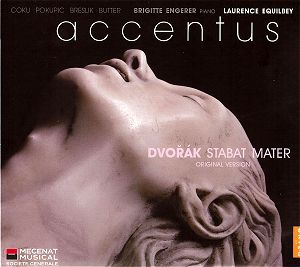
Antonin DVOŘÁK (1841-1904)
Stabat Mater Op. 58 (1876 version) [60:00]
Alexandra Coku
(soprano); Renata Pokupic (alto); Pavol Breslik (tenor); Markus
Butter (bass); Brigitte Engerer (piano); Accentus/Laurence
Equilbey
rec. July 2007, Cité de la musique, Paris
text and translations included
NAĎVE V5091 [60:00]  |
|
|
The normally performed
version of Dvořák’s “Stabat Mater” dates from late 1877.
This disc however suggests that this does not represent his
original intentions when he started the work in early 1876.
That followed the death of his daughter Josefa in September
of the preceding year and consisted of only seven movements,
scored for soloists, choir and piano. According to the notes
to this disc, the detailed nature of the piano part appears
to imply that at that time he had no intention of producing
an orchestral version. The version with which we are more familiar
was written in the autumn of 1877 following the deaths of his
other two children. It has not only an orchestral accompaniment
but three further movements.
Thus the present
recording offers a chance to assess what can be discovered
of the composer’s first thoughts and to compare them with the
later version. Inevitably to anyone familiar with the latter
for much of the time it sounds like a choral rehearsal without
orchestra, and evaluation is made more difficult as the piano
is so favoured by the recording balance that at times one feels
more like the page turner to the pianist than a listener in
the body of a concert hall. However even putting these considerations
aside, it is hard to regard the piano part as being in any
way idiomatic. Much of it sounds more like a somewhat literal
transcription of an orchestral work, including in the first
movement whole bars of tremolando chords.
Presumably the
edition is the work of Miroslav Srnka who contributes an interesting
article to the booklet. I remain unclear however as to the
strength of his evidence that the composer did not originally
envisage orchestrating the work. Srnka refers to “the meticulous
state of completion and the extreme precision of the writing,
even down to dynamic and articulation marks” as evidence that
it was intended to be performed with piano, but he goes back
on this later when he refers to the deficiencies of the score
in terms of detailed tempo markings and apparently incomprehensible
dynamic markings. I hope that his version will be made more
widely available in due course in print for study and performance,
but for the present one may perhaps be forgiven for some doubts
as to whether this really is what the composer really hoped
for originally in terms of eventual performance. There are
certainly some interesting differences in detail between what
we hear on this disc and the later version, including a lengthy
passage in the last movement that was later cut. Nonetheless
I am by no means convinced that this so-called 1876 version
can be regarded as more than a very interesting curiosity.
My view may however
be coloured by a performance which might be described generously
as intimate, or more crudely as weak. The piano-heavy balance
does not help, although this does help the listener to enjoy
Brigitte Engerer’s performance, perhaps the most satisfactory
part of the whole. Perhaps I am too used to the more full-blooded
orchestral version, but the relatively small choir and the
apparently small-voiced soloists do seem to reduce the emotional
power of the work. I would not want to put anyone off buying
this disc if they have a particular interest in the composer
and his compositional methods, but others should perhaps be
a little more wary. I would certainly not recommend it to anyone
lacking a recording of the final version of the work.
John Sheppard
|
|
Advertising
Rates
Visitor
stats
MusicWeb
International
has over 40,000 Classical CD reviews on offer
Discs
received
Having a problem
Donating?

Gerard
Hoffnung Concerts &
The
Bricklayer Story
New
Releases

New
Releases


MusicWeb
sells the Polish
catalogue CDAccord
£10.50 post free W-W

MusicWeb sells the
Arcodiva catalogue
£12.00 post free W-W

£11.75
post-free world-
wide
MusicWeb
can now offer
you discs from the following catalogues:
Prices include postage
Musicweb
Special
Offers
Monthly
Best Buys
Google
Ads - for information about privacy matters, click here.
Amazon Musicweb International is a participant in the Amazon
EU Associates Programme, an affiliate advertising programme designed to provide
a means for sites to earn advertising fees by advertising and linking to Amazon.co.uk
and Amazon.com
|