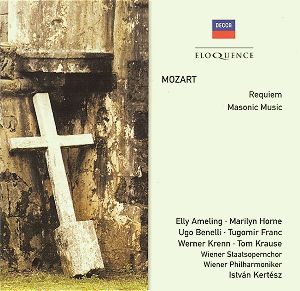
This is big, old-fashioned Mozart, and is all the better for it.
Don’t expect any period inflections or early-music-subtleties
from these 1960s performances from Kertész: instead revel in
the big, lush sounds and sumptuous textures. The performers
in the Requiem are the peerless Vienna Philharmonic who
play with all the grace and grandeur one would expect from one
of Europe’s finest orchestras. The close-up recording allows
you to “wallow” in their sound in a way that is largely impossible
with performances from smaller-scale period bands. Kertész himself
has a noticeably old-school approach to the Requiem:
the Rex Tremendae, for example, is taken far more slowly
than you would expect to hear in most performances today. However,
he is surprisingly fleet of foot in the opening Introitus
and he keeps the fugue in the Offertorio going at quite
a lick before expanding to revel in the rit. at the end.
The solo singing is almost uniformly excellent.
Elly Ameling has a wonderful purity of tone that shines through
all of her big moments, reminding me of the young Gundula Janowitz.
The under-recorded Ugo Beneli is an Italian tenor of the old
school who wears his heart on his sleeve, and Marilyn Horne
is astonishingly characterful in her singing. Her rich Rossini
heritage is obvious here and her contribution to the Tuba
Mirum in particular makes one sit up and take notice. Only
Tugomir Franc is a bit underwhelming: his opening phrase of
the Tuba Mirum is gravelly and lacks the consistency
of tone that is so obvious in his colleagues. He is particularly
under-parted during the Recordare which he begins by
tending to blend into the background and let the others do the
work, though he improves by the beginning of the Ingemisco.
The Vienna State Opera Chorus are very obviously an opera
chorus: you would never think that this is a liturgical choir!
That does mean that you miss out on some of the devotional aspects
of this work and at times they are rather rough around the edges,
but they make up for it with a - sometimes startling - grasp
of the drama behind this work. If you don’t mind being grabbed
and compelled through the choruses then you will love this.
Just listen to the Confutatis to see what I mean!
The sound on this recording is both a blessing
and a curse. Engineered by Erik Smith and Gordon Parry, part
of the legendary team behind the Decca Ring Cycle, every
single aspect of the music is captured with clarity that is
breathtaking for the time. Decca has always prided itself on
the quality of its opera sound and those skills transfer ideally
to this recording, at least in terms of the voices. You can
hear, for example, different sections of the choir coming in
through different channels - basses to the left, tenors to the
right - and this helps to catch you up in the music in a way
that a perfectly blended performance perhaps misses. The snag
is that at times you can hear individual singers dominating
over their section and that at times, particularly in the Dies
Irae, the orchestra is noticeably in the background. On
the other hand, the trombone solo at the beginning of the Tuba
Mirum is quite appropriately spotlit. Personally, though,
I love the sense this whole recording gives of being part of
a performance, and it illuminated textures in the work which
I hadn’t picked up on before.
The Masonic items are taken from Kertész’s very
successful 1969 Decca survey of Mozart’s Masonic Music and are,
if anything, even better played. Kertész creates an inexorable
momentum in the Funeral Music which, more than in any other
performance I’ve heard of this work, hammers home the solemn grandeur
and underscores the links with the - still far in the future -
Magic Flute. The two cantatas are bright and cheerful,
characterfully sung with fabulous contributions from the star
soloists and a good sense of homogeneity from the all-male Edinburgh
Festival Chorus. The sound still delineates the different sections,
but on the whole there’s a better sense of blend and the London
Symphony Chorus is every bit as characterful as the Viennese.
It’s a bit of a shame, though not surprising for the price, that
there are no texts or translations, which would have been especially
useful for the two Masonic Cantatas.
In this day and age this probably wouldn’t be a
first choice for the Requiem; Schreier on Philips probably
still picks that up if you’re looking for a budget recording on
modern instruments. However, buy it for a gripping sense of the
drama in these works, for the remarkable solo singing and as a
reminder of the Decca machine in its golden age. What’s more,
this CD is positively packed with music so is fantastic value
for money.
Simon Thompson