Purchase Brilliant Classics from MusicWeb - "CLICK" here

Classical CD and DVD reviews. Make a regular donation(£1, £2, £5) here MusicWeb is not a subscription site and our advertisers help pay for it. Please visit their sites regularly to see if anything might interest you. Purchasing from them keeps MusicWeb free.

Classical Editor: Rob Barnett                               Founder Len Mullenger


CD REVIEW

Site Map

More Reviews

How to find a review

Classical CD Review Archive

Book Reviews

Film Music Reviews

Jazz CD Reviews

Nostalgia

Comment

Norman Lebrecht Weekly

Arthur Butterworth Writes

Phil Scowcroft's Garlands

Classical blogs

Reviewers Logs

Announcements

Don't Go Here!

Community

Bulletin Board

Web Ring

Reviewers

Helpers invited!

Resources

How Did I Miss That?

British Composers

British Light Music Composers

Other composers

Indexes
   Label
   Masterwork

Discographies

On-line Music
[Download sites]

Themed Review pages

Our Classic Classics

Online books
MWI Classical
     Encyclopaedia

Gilder Dictionary of
     Composers

MWI Pop
     Encyclopedia

Other Complete Books

Programme Notes


British Music Society
Performers
The BBC Proms
Musical WWW pages
Classical Music Online

Recording Companies and Retailers
Agents and Marketing
Publishers
Non-Classical Web pages
Orchestra Web Sites
Newsgroups
Web News sites etc


Editorial Board
Classical Editor
   
Rob Barnett
Seen & Heard
Editor and Webmaster
   Bill Kenny
MusicWeb Webmaster
   Len Mullenger
Assistant Webmasters
   Patrick Waller
   David Barker

PotPourri
A pot-pourri of articles

MW Listening Room
MW Office
Helping MusicWeb
Advice to Windows Vista users  
Questionnaire    
Site History  
What they say about us
What we say about us!
Where to get help on the Internet
CD orders By Special Request
Graphics archive
Currency Converter
Dictionary
Magazines
Newsfeed  
Web Ring
Translation Service

Rules for potential reviewers :-)
Do Not Go Here!
April Fools

Would you like a hyperlinked weekly summary of the CDs we have reviewed?
Click for further details

Sample: See what you will get

alternatively
AmazonUK  AmazonUS


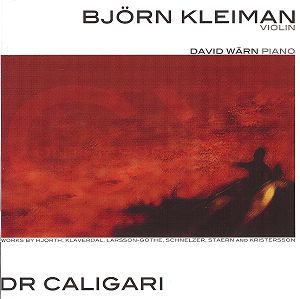
Dr Caligari
Mats LARSSON-GOTHE (b. 1965)
Dr. Caligari
(1991) [14:35]
Albert SCHNEIZER (b. 1972)
Solitude
(1999) [6:38]
Stefan KLAVERDAL (b. 1975)
Dual Chant
(2003) [13:31]
Benjamin STAERN (b. 1978)
The Lonely One
(2000/2005) [11:33]
Albert SCHNELZER (b. 1972)
Frozen Landscape
(2003) [7:49]
Stefan KLAVERDAL (b. 1975)
The Longing of Eurydice
(2005) [13:54]
Daniel HJORTH (b. 1973)
Modal Move
(2003) [5:36]
Björn Kleiman (violin); David Wärn (piano)
rec. Malmö, Sweden, 8-9 April, 11-12 August, 9 October 2006. DDD
C-Y CONTEMPORARY CY0701
[73:42]
Experience Classicsonline


The Cabinet of Dr. Caligari was one of the first and most influential of German films, injecting expressionism into the cinema for the first time in the 1920s. The derived movies and related works have always kept a sense of the surreal as well as references to the somnambulist world the characters propagate and inhabit. This recent recital by Björn Kleiman and David Wärn is no exception, though only connected to the movie in the most tangential of ways.
 
The pieces are all related by their themes of existing on the line between reality and dream. Occasionally grating and harsh harmonies stand opposed to beauty and virtuosity. Even a quote on the booklet states that “To sleep is a pleasant way to kill time. As if we could.”
 
There are few truly pleasant dreams on this album however. It tends to careen from the interesting surreal scene to a mild nightmare. Dr. Caligari is virtuosic, expressive and punctuated with brief sonic explosions of vocal and instrumental sound. It takes the listener on a trip through a dystopia and only at the end allows some respite, as if suddenly the subject awakes to find himself recovering from electroshock therapy. Solitude is a work for solo violin that finds a variety of modern bowing techniques designed to make the instrument cry and howl in loneliness and solemn desperation.  It is moving and deep, and very beautiful, but not a quiet, easy listen.
 
Dual Chant is among the more innovative works on the album with solo violin and synthesizers combining to great effect. The synthetic sounds are of the goblins/hollow bells/synth voice/synth strings varieties that are often used in fantasy and sci-fi movie soundtracks. This would be the one piece of respite on the album where the listener looking for simple beauty may find calm. Even so, with the synthesized sounds so abundant, there is something mildly disconcerting here in the midst of the rest of the album. It is as if the only way for us to find any peace in our dream-state involves us fleeing any other humanity and relying solely on soulless technology.  This may not be the intended effect, but it is difficult not to find irony in the fact that all of the natural sounds on the album reflect the darker side of dreams and night.
 
As soon as we leave the cocoon of synthesized sound we find The Lonely One - another work for unaccompanied violin drawing the listener into the realm of quiet pain and loneliness. This is again deeply moving and outstandingly performed, and it leads directly into Frozen Landscape, a duet with the piano. The piano begins the work with a stark few notes that serve as disjointed melody. The violin provides effects evoking the barren winter lands that would lead to the sense of the monumental loneliness that is so brilliantly evoked in the previous piece.
 
The piano and violin are joined by some electronic effects and punctuations in The Longing of Eurydice, which is less hopeful than our previous electronically-softened respite. This is darker, and somewhat menacing at times. In other places we have nearly romantic sounds which retain this quality despite the distinctly artificial nature of the electronica. As the work culminates the violin moves to more traditional virtuosity while the synthesizers project an alien sound drawing us to the work that concludes the album.
 
Modal Move is a violin sonata built on a work by Mozart. The original is transformed into a Dorian modal harmonic progression with a myriad chord extensions and color tones bringing Mozart’s melody deep into the 20th century. The effect is very pretty, but fragile sounding, and somewhat sad.
 
This album is masterfully programmed, with each piece leading into the next. The violin work is exquisite. The piano complements the solo instrument well and the electronic elements are very tastefully deployed. There is a great deal to recommend this collection which is skilfully executed, and should appeal to most classical music fans who are open to new music.
 
Patrick Gary


Advertising Rates
Visitor stats
MusicWeb International
has over 21,000 Classical CD reviews on offer


Gerard Hoffnung Concerts &
The Bricklayer Story

Naxos Classical

Purchase Brilliant Classics

Australian Eloquence CDs on Buywell.com


New Releases

Hyperion
New Releases


Guild Music


MusicWeb sells the Polish
catalogue CDAccord
£10.50 post free W-W


MusicWeb sells the
Arcodiva catalogue
£12.00 post free W-W


Price Reduction: £11.00
post-free
world-wide
Try it and see - Sale or Return


MusicWeb can now offer you discs from the following catalogues:
Prices include postage

[Acte Préalable £13.50]
[Arcodiva £12.00]
[Avie from £6.25]
Brilliant Classics
[British Music Society £13.49]
[CDACCORD from £10.50 ]
[ClassicO £12.50]
[Hallé from £11]
[Hortus £14.99 ]

[Lyrita ONLY £11.00 ]
LYRITA Sale or Return
[Onyx £12.00
]
ONYX Sale or Return
[REDCLIFFE £11 ]
[Tactus £11.50 ]
[Talent from £12.00 ]
[Toccata Classics £12.50 ]

MusicWeb Recommended Recordings 2008

DISCS OF THE YEAR 2007


Return to Review Index


Reviews from previous months
Join the mailing list and receive a hyperlinked weekly update on the discs reviewed. details
We welcome feedback on our reviews. Please use the Bulletin Board.  Please paste in the first line of your comments the URL of the review to which you refer..


You can purchase CDs and Save around 22% with these retailers: