Editorial Board
MusicWeb International
Founding Editor Rob Barnett Editor in Chief
John Quinn Contributing Editor Ralph Moore Webmaster
David Barker Postmaster
Jonathan Woolf MusicWeb Founder Len Mullenger
Johann Sebastian
BACH (1685-1750)
1. Brandenburg Concertos Nos 1-6 BWV 1046-51 (1721) [1:42:59]
2. Air from Suite No 3 in D BWV 1068 [5:13]
3.“Sheep may safely graze” (from Cantata BWV 208) (arr. Bantock) [5:28] Willam BYRD (1543-1623) – Arthur
OLDHAM (b.1926) – Michael
TIPPETT (1905-1998) – Lennox
BERKELEY (1903-1989) – Benjamin BRITTEN (1913-1976) – Humphrey SEARLE (1915-1982) – William WALTON (1902-1983)
4. Sellinger’s Round (Variations on an Elizabethan Theme) (1953) [15:07] Thomas ARNE (1710-1778)
5. “ Alfred” – Rule Britannia [5:17]
6. “The Fairy Prince” – Now the air shall ring [3:59] Henry PURCELL (1659-1695)
7.”O Lord grant the Queen (orig: King) a Long Life” [7:00] Anon (arr. Britten)
8. God save the Queen [2:39] Jeremiah CLARKE (1674-1707)
9. Trumpet Voluntary [2:47] English Chamber Orchestra (1);
London Symphony Orchestra (8,9); Orchestra of the Royal Opera House, Covent Garden
(2,3); Trumpeters of Kneller Hall Royal
Military School of Music (9); The Aldeburgh Festival Orchestra (4,5,6,7); Peter
Pears (tenor) (5,7); Arda Mandikian (soprano) (6); Gladys Whitred (soprano) (6);
Alfred Deller (counter tenor) (7); Norman Lumsden (bass) (7); Aldeburgh Festival
Chorus (5,6,7); London Symphony Chorus (8); Benjamin Britten (conductor) (1,4,8,9);
Imogen Holst (conductor) (5,6); Sir Adrian Boult (conductor) (2,3)
rec. The Maltings, Snape, December 1968 (1), Kingsway Hall,
London, November 1959 (2,3), Parish Church, Aldeburgh, June
1953 (4,5,6,7), Kingsway Hall, London, December 1961 (8,9):
texts included DECCA ELOQUENCE 442
9521 [74:13+76:49]
Clearly the main
item here is the version of the Brandenburg Concertos conducted
by Britten, but there is one other substantial piece – the Variations
on Sellinger’s Round – and a number of interesting oddments,
which in one case is rather more than that.
The Brandenburgs
were recorded during the series of sessions at Snape Maltings
which also included a disc of English music for strings and
the “Salute to Percy Grainger”, both of which have come to
be regarded by many as being among the best of Britten’s
recordings as conductor. The Brandenburgs are less obviously
successful, and indeed may come as something of a surprise
to those used to the brisker performances with period instruments
which have become the norm. Speeds are generally on the sober
side, and the use of a harpsichord is the only obvious bow
to period practice as it is now understood. They are in fact
comparable in style and character to the recordings made
much earlier by Adolf Busch and Boyd Neel - now available
from Dutton - both of which remain classic recordings due
to their sheer musicality.
Even if Britten’s
set may not be a complete success it still has much to offer.
Nos. 3 and 6 – the only two entirely for string instruments
- are by some way the best, with real rhythmic impulse and
sense of direction, and with a care for balance that is rare
in these works. All too often No. 6 can sound turgid and
overlong, but here it is pure pleasure from beginning to
end. In No. 3 the brief decoration between movements, presumably
by Britten, adds much to the character of the Concerto as
a whole. No. 5 and No. 1 are good in parts although slow
speeds do make the final movements of the latter seem to
last a very long time. Nos. 2 and 4 are certainly not negligible
as performances, with matters of balance dealt with very
convincingly, but at these somewhat slow speeds even these
players find it difficult to obtain real rhythmic lift to
the phrases.
Overall this
is set very worthwhile adding to your collection, especially
as an alternative to more recent recordings using period
instruments, even if it is unlikely to be anyone’s favourite
as a whole.
What makes the
set an essential purchase for the Britten enthusiast is the
very varied selection of shorter items on the second disc.
The Variations on Sellinger’s Round for string orchestra
were written especially for the opening concert of the 1953
Aldeburgh Festival. This took place only weeks after the
Coronation of the present Queen, at a time when there was
much talk of a “New Elizabethan Age”, and I would imagine
that the subtitle “Variations on an Elizabethan Theme” and
the division of the composition between six leading British
composers of the time were very much linked to this. It is
good to hear the first performance on this disc, even if
the recording is very thin at times and the playing does
sound somewhat approximate in places. Nonetheless it is an
enjoyable piece, which would be worth an occasional performance
today. For me the best parts are the Variations by Tippett
and Searle, but the whole can be recommended both in itself
and to anyone with an interest in that period.
The other items
deriving from that opening concert are more of curiosity
than musical interest, as even more are the two short Bach
items conducted by Boult. Indeed their relevance to the rest
of the programme is by no means clear. Britten conducts the
Trumpet Voluntary in a suitably festive manner although I
could not claim that it is any sort of revelation. The best
by far of the short items is Britten’s arrangement of the National
Anthem, whose quiet first verse always surprises audiences
but whose clangorous end is immensely effective.
This is obviously
an essential purchase for Britten enthusiasts, but can also
be recommended to others with an interest in him as composer
or performer, and to those who simply want a satisfying alternative
to other recordings they may have of the Brandenburgs.
John Sheppard
Please support our advertisers below by clicking on the logos for further information.
























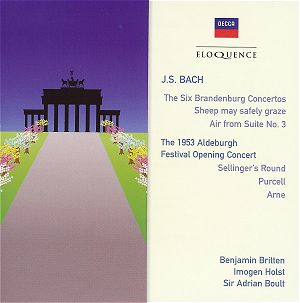

 English Chamber Orchestra (1);
London Symphony Orchestra (8,9); Orchestra of the Royal Opera House, Covent Garden
(2,3); Trumpeters of Kneller Hall Royal
Military School of Music (9); The Aldeburgh Festival Orchestra (4,5,6,7); Peter
Pears (tenor) (5,7); Arda Mandikian (soprano) (6); Gladys Whitred (soprano) (6);
Alfred Deller (counter tenor) (7); Norman Lumsden (bass) (7); Aldeburgh Festival
Chorus (5,6,7); London Symphony Chorus (8); Benjamin Britten (conductor) (1,4,8,9);
Imogen Holst (conductor) (5,6); Sir Adrian Boult (conductor) (2,3)
English Chamber Orchestra (1);
London Symphony Orchestra (8,9); Orchestra of the Royal Opera House, Covent Garden
(2,3); Trumpeters of Kneller Hall Royal
Military School of Music (9); The Aldeburgh Festival Orchestra (4,5,6,7); Peter
Pears (tenor) (5,7); Arda Mandikian (soprano) (6); Gladys Whitred (soprano) (6);
Alfred Deller (counter tenor) (7); Norman Lumsden (bass) (7); Aldeburgh Festival
Chorus (5,6,7); London Symphony Chorus (8); Benjamin Britten (conductor) (1,4,8,9);
Imogen Holst (conductor) (5,6); Sir Adrian Boult (conductor) (2,3) 
