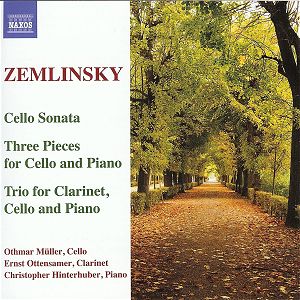
As Richard Whitehouse notes in the booklet, Zemlinsky was little
more than a name in the record catalogue thirty years ago and
is now heavily represented on discs in every area of his musical
production. This disc contains chamber works from the 1890s showing
a young man who already has an assured technical equipment and
is proceeding to get out from under the shadow of the all-powerful
Brahms.
The
Three Pieces for Cello and Piano are among the earliest works
we have from Zemlinsky. At the same time they are almost new
as they were lost for over a century, along with the Cello Sonata,
until rediscovered by the cellist Raphael Wallfisch in his father’s
effects. All three are still heavily Brahmsian, but the Lied
shows some individuality and an ability for development that
would continue in the later works. The Humoreske is not
quite as important, but is very winning and shows good thematic
contrast. I found the Tarentell less interesting.
The
Cello Sonata dates from three years later (1894) and like the
Three Pieces was prepared by Zemlinsky authority Antony Beaumont.
It is quite substantial, even weighty, and shows a good deal
of progress over the 1891 work. The opening allegro has
an expression marking of mit liedenshaft, but there is
also a more modern undercurrent of agitation. The second theme
is calmer and again Zemlinsky shows his ability to provide thematic
contrast. The andante movement starts out in a more poetic
fashion, but turbulence returns with the middle section, which
at the same time contains some beautiful writing for the cello.
The theme of the first section returns for something of a fusion
of the moods of what has gone before. The concluding allegretto
is cheerful and witty and was the first time I was reminded
of some aspects of the mature Zemlinsky. Again the composer’s
ability at thematic contrast is to the fore but there is also
more distinction in the development itself. As in the second
movement, the last part is ruminative, even a little sad.
Later
in 1894 Zemlinsky actually met Brahms and the senior composer
voiced some criticism of the younger’s “modernity” as evidenced
in the Cello Sonata and other works. Zemlinsky seemed to accept
the criticisms and produced the Clarinet Trio in 1896. However,
except for the Brahmsian forces it shows no going back in Zemlinsky’s
progress; yet at the same time it was approved of by Brahms.
In the Trio the harmony in the first movement is quite distinctive
and there is a lovely weaving around the clarinet by the two
other players. Contrapuntal interest grows throughout the movement
and so does the emotional intensity towards the end. The andante
reminds one of the Cello Sonata in its alternation of lyricism
and agitation. The final allegro is quite compact. The
first theme pays tribute to Brahms in a way we haven’t seen
up to now; it sounds like one of the Hungarian Dances. More
relaxed ideas follow and again there is some harmonic experimentation,
and some fine writing for the clarinet, before a slightly surprising
ending.
For
me the real star on this disc is Ernst Ottensamer. He shows
himself to be a fine technician as well as being able to handle
all the harmonic subtleties of the well-known Trio. Christopher
Hinterhuber is also to be commended for his ability to both
blend in with and stand out from the others. Othmar Müller impressed
me less than the others though he was able to get a great variety
of emotions from the Cello Sonata. Part of the blame may be
due to the Raiding Hall which I felt greatly interfered with
the cello’s projection and added dryness to the sound of all
the instruments.
William
Kreindler