Rossini’s decision
abruptly to end his operatic career
at the age of only thirty-seven has
been the subject of many debates and
copious articles over the years. His
operas – of which Guillaume Tell
(1829) was the last - tend to overshadow
his later works, in particular his
wonderful Péchés
de vieillesse (Sins of old age).
This could be one of the reasons why
they are neglected. These Péchés
comprise pieces for solo piano,
for vocal and instrumental ensembles,
songs, and the beautiful Petite
Messe Solennele. They are organised
in fourteen volumes, each with different
names, containing various pieces.
Rossini never intended them for publication
though some were issued during his
lifetime. Most did not come out until
the 1950s, which is possibly another
reason for their general neglect.
However, I still find it difficult
to understand why the songs do not
appear more frequently in Mélodie
and Lieder recitals. Rossini’s
substantial quantity of piano music
is hardly ever played by today’s greatest
pianists. It is true that the composer’s
style advanced little in most of the
works that form the Péchés
de vieillesse and therefore their
musical language is generally conservative.
However quite the contrary can be
said of the character of many of the
solo piano pieces; they are clever,
amusing parodies of fashions of the
time, of other musicians contemporary
of Rossini, and of himself and his
own work.
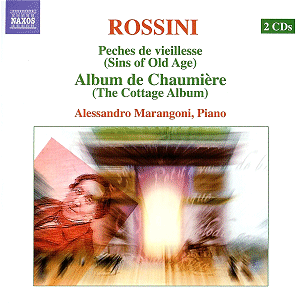
Naxos and the distinguished,
award-winner pianist Alessandro Marangoni,
deserve to be congratulated for the
decision to record the complete Péchés.
This CD set is the first of the intended
series, entitled "Rossini’s Complete
Piano Music". The present set
occupies two CDs and each is a delight
from beginning to end though I preferred
the first.
CD 1 contains the
majority of the compositions that
form volume VII of the Péchés,
entitled Album de Chaumière
(The Cottage Album), an ironical title
if one bears in mind that Rossini
did not like the kind of romantic
oil painting the name invokes. Marangoni
plays each piece with enthusiasm,
loving care and dedication. His performance
is humorous and joyful as well as
precise without being dry. He is also
capable of sensuous beauty in the
more delicate, lyrical passages. In
Gymnastique d’écartement
(Exercises for opening), he expresses
well the caricature character of the
piece but his style remains sober.
It never slips into unnecessary exuberance,
a "sin" that a lesser pianist
might easily have committed. I particularly
enjoyed Marangoni’s interpretation
of the second piece, Prélude
fugassé (Fugal prelude),
a strange title to say the least,
as a composition cannot simultaneously
be a prelude and a fugue. This is
a piece evocative of J.S. Bach and
of the mark his work left on Rossini’s
own writing. The composer pays here
an endearing and funny tribute to
the great master of the Baroque era.
Marangoni’s rendition is suitably
humorous and energetic, showcasing
his classical brilliance while, in
number 5, Prélude inoffensif
(harmless prelude), a poetic little
gem, he changes into an intentionally
romantic, lyrical style, at times
beautifully legato, as suits
the piece. Undoubtedly this is a gentle
tribute to Chopin both in the music
and its title. From here, Marangoni
easily moves to the charming little
parody that is Petite valse "L’huile
de Ricin" (Castor Oil Waltz),
and swiftly follows it with the final
piece of this first CD. Rossini wrote
this piece in two sections: one a
deep sleep, Un profond sommeil,
a quiet, meditative episode, and the
other a brusque or sudden awakening,
Un réveil en sursaut,
which is lively, fast and joyful.
The transition from peaceful meditation
to rousing energy requires a poetic
touch and a resilient, secure technique.
These attributes are wonderfully displayed
by Marangoni who seems to glide effortlessly
across the keyboard in what is arguably
the most virtuosic and dramatic piece
of them all.
CD 2 continues with
the remaining compositions from the
Album de Chaumière,
which are less attractive than the
previous eight though no less demanding
in terms of execution. These five
pieces are then followed by four precious
but little known gems extracted from
volume IX of the Péchés,
the album for piano, violin, cello,
harmonium and horn. The first, Mélodie
candide, is one of my favourites.
As the name indicates, it is an innocent
melody, beautifully modulated, almost
naive in character, which made me
picture children playing and echoed
happy childhood memories. It is attractively
and lovingly performed by Marangoni
who again demonstrates his versatility
in terms of style and his impeccably
expressive technique. He moves through
the final three pieces with equal
ease, delivering a memorable performance
of what is to me the "tour de
force" in CD 2, the final piece,
Impromptu tarantallisé
(Improvisation in the form of the
Italian dance tarantella).
Marangoni revels in the glorious whirling
attributes of the music, inviting
the listener to stand up and joyfully
dance around the room.
The whole work is
a joy to listen to, touching and moving
at times, humorous, ironic and dramatic
in other instances. It requires virtuosity,
sensibility and an excellent understanding
of the composer’s style. Marangoni
demonstrates that he has all these
qualities in abundance. He obviously
delights both in the music and in
the fabulous piano at his disposal
– a Steinway from the collection of
the famous Italian master technician,
Angelo Fabbrini – and this delight
comes across in his playing making
it all the more attractive.
This CD set is undoubtedly
an excellent recording of Rossini’s
often neglected but wonderful piano
music, finally being given the attention
it deserves. I can hardly wait for
the next volume in the series to be
available.
Margarida Mota-Bull
see also review
by Dominy Clements

























 Alessandro Marangoni (piano)
