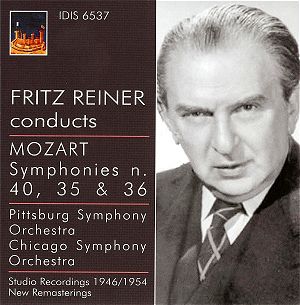
As can be seen from the recording dates, these will not be “authentic”
performances insofar as they use a large orchestra, but they will
be authentic performances because they are performances from the
heart, given with fire and spirit. It should also be remembered
that Mozart once said, whether in jest or not I don’t know, that
for him the perfect orchestra included forty violins! The first
movement of K550 sets off at a brisk pace and Reiner never drops
the tempo, keeping it in control with a fine sense of line and
style, and repeating the exposition. The only downside is the
huge, and very vulgar, rallentando he employs over the final chords
which spoils an otherwise perfectly judged performance. The slow
movement is lovely; moments of utter simplicity alternate with
high drama, with charming playing, but spoiled by another huge
rallentando at the cadence. The minuet and trio is straight forward
with a delightful transition from minuet to trio, which contains
some gorgeous woodwind playing, and yet another large rallentando
at the end. The finale races away but not with joy, this is Mozart
in G minor, remember, with desperation. This is a fine performance,
especially well judged in tempi, drama and repose. My only objection
is the slowing down at the ends of movements – however, I am sure
that when this recording was made, and for some time after, this
was the norm and we never questioned it. Don’t let it ruin a fine
Mozartean performance.
The sound for the Haffner Symphony is fierce and hard driven,
and so, I am sad to report, an intelligent performance is spoiled.
Reiner sets a cracking pace for the opening Allegro; it is thrilling
and it is matched by a slow movement of great tenderness but
in this latter the beautiful sound she elicits from the strings
sounds hard edged. The minuet is fast but the trio is fantastic
– full of gemütlichkeit and with a real dancing lilt.
The finale is a fraction too fast making some of the string
articulation a problem. This is a fine performance, full of
humour and with a great spirit, let down by the recording.
Sometimes it’s the small things which tip you off to the quality of
a performance. In this recording of the Linz Symphony
in bars 8, 9 and 10 of the slow introduction of the first movement,
there’s the merest hint of a forte before the music falls
back to piano. Reiner accents these fortes with
such subtlety that I knew I was I for an intelligent performance.
And so I was. The first movement races along at a cracking pace,
joking and full of high spirits. The slow movement is a serene
haven of peace. Here, Reiner withholds full power from the fortes
which gives a much more singing quality to the whole piece.
The Minuet is distinguished by some lovely oboe and bassoon
playing and the finale is taken at a true racing pace – a real
Presto and it’s thrilling, made all the more exciting by Reiner
not applying the brakes in the final cadence but racing through
it bringing the music to rousing conclusion.
This is a very interesting issue, especially so for students of interpretation.
The recorded sound is of its age, of course, but in the Linz
and 40th Symphony the remastering is excellent,
showing us fine and intelligent Mozartean performances. The
fierceness of the sound in the Haffner Symphony
can be tempered somewhat with a treble cut, but this does rob
the sound of some of its bloom. Certainly this isn’t a disk
of Mozart for everyone but I hope that I have managed to convey
some of the excitement and satisfaction I felt whilst listening.
Bob
Briggs