2008 has been cause
for celebration, not so much because
it is fifty years since Vaughan Williams’
death but because the performance
annals, literature, recording catalogue,
even the video footage about the man
and his music has expanded by leaps
and bounds.
Various boxed sets
of the symphonies have appeared or
reappeared. Chandos, working with
Richard Hickox, continue steadily
to issue works we have not heard before.
EMI Classics have produced a whopping
30CD bargain box of pretty much everything
that is RVW in their archive and so
it continues.
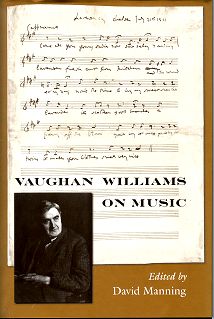
The present invaluable
book, painstakingly edited by David
Manning, draws together from far and
wide a predominantly fresh helping
of Vaughan Williams' own writings
on music. The disparate essays and
asides have been culled from dispersed
sources so while you may already know
a few of them it is unlikely that
you will be familiar with many.
From the book emerges
a picture of a composer with piercing
insight and the muscular confidence
to express himself. He has little
time for diplomacy and along the way
takes few prisoners. Despite the manufactured
image of ‘Uncle Ralph’ he is not all
that indulgently avuncular as an author.
We learn something of the furies that
scream through the Fourth and Sixth
symphonies as well as something of
seraphic intimacy.
Take his 1902 piece
on Good Taste in Music, in
which he dismisses the values that
measure music against 'taste'. Music
written under the urgency of invention
is written independent of any such
critical apparatus. In the English
Hymnal’s Introduction he is happy
to drive from the temple those enervating
tunes favoured for their simplicity
and to replace them with tunes embodying
good music. His In Memoriam
piece on Gervase Elwes stands back
from the facts of the singer’s life
and instead concentrates on the enduring
qualities of the man's singing - a
much more challenging task for the
wordsmith. The revival of the music
of Weelkes, Byrd and Wilbye by Cecil
Sharp and Edmund Fellowes is celebrated.
A general theme is England's Music
which rises from its folksong,
its own history, its own mulch and
is no less to be venerated and loved
than the musics. His Tovey contribution
from 1937 is perhaps rather thin and
fragmentary. However what is there
is sincere as the composer vividly
sets out appraisals and events surrounding
Tovey. A December 1939 BBC radio script
stresses the significance of music
for evacuees and generally the impact
of the start of the war. There is
another challenging and brave piece
from The Listener (1940) in
which the composer mentions the possibility
that the war may have been unnecessary.
It is a passing comment but must have
raised hackles in some quarters.
I am unconvinced
by having a chapter per piece when
this forces whole blank pages for
the shorter pieces of writing. A case
in point is the gap between chapters
19 and 20 and later on the single
sentence entry for Schoenberg. It
is an extravagant use of paper when
these pieces could have been organised
within the five sections (see end
of review) as a continuous run.
RVW’s 1954 Howland
Medal lecture, given at Harvard, is
as transcribed from an audio tape
rather than the version in National
Music and other essays – to which
this book is complementary. The lecture
once again records Holst's friendship
with RVW as well as cautioning against
excessive deference to foreign models
suffocating local enterprise. It even
pauses for a gentle and surprising
swipe at Whitman for his regard for
Verdi and Wagner.
We also read a full-on
assault on the BBC governors over
threats to dumb down The Third Programme.
Sadly we are not given the context
of this piece in a footnote. In fact
this is a weakness of the book’s approach.
The same goes for the failure to give
any (even pedestrian) background on
Gervase Elwes or on Elwes’s RVW performances
or recording activities.
In the Continental
Composers section VW tackles Strauss's
Ein Heldenleben conceding it
is 'new, wonderful, astonishing' and
he says all of this in 1903 yet then
poses the question 'Does it satisfy
us?' He is less than direct here.
His 1951 contribution to Music
and Letters on the death of Schoenberg
adopts a different kind of circumlocution:
"Schoenberg meant nothing to me -
but as he apparently meant a lot to
a lot of other people I daresay it
is all my own fault." and that's it.
There speaks a man pressurised to
contribute and defiantly - even punitively
- confident of his own judgement.
Manning lists the
writings in order of publication spanning
1897 to 1959. The earliest is The
Romantic Movement and Its Results
and the latest his Introduction
to Classic English Folk Songs.
We must be grateful
to Mr Manning and the OUP team for
securing all the necessary IPR permissions.
It must have been a Herculean labour.
While, as with all
such anthologies, we meet the composer
in words he wished made public - the
face that he wanted to present – this
sequence still provides surprises,
shocks and delights. Here speaks the
composer in his own unreconstructed
(editors allowing) words written with
all the force and risk of contemporary
expression. That is as it should be.
Rob Barnett
Table of Contents
Section 1: Musical Life and English
Music
1. The Romantic Movement and its
Results 2. A School of English Music
3. The Soporific Finale 4. Good Taste
5. A Sermon to Vocalists 6. Preface
to The English Hymnal 7. Who Wants
the English Composer? 8. British Music
9. Gervase Elwes 10. Introduction
to English Music 11. Elizabethan Music
and the Modern World 12. Sir Donald
Tovey 13. A. H. Fox Strangways, AET.
LXXX 14. Making Your Own Music 15.
Local Musicians 16. The Composer in
Wartime 17. Introduction to News Chronicle
Musical Competition Festival for HM
Forces 18. First Performances 19.
Art and Organization 20. Choral Singing
21. Carthusian Music in the Eighties
22. Howland Medal Lecture 23. Preface
to London Symphony 24. Introduction
to The Art of Singing 25. Some Reminiscences
of the English Hymnal 26. Hands off
the Third
Section 2: Continental Composers
27. Palestrina and Beethoven 28.
Bach and Schumann 29. The Words of
Wagner's Music Dramas 30. Brahms and
Tchaikovsky 31. Ein Heldenleben 32.
The Romantic in Music: Some Thoughts
on Brahms 33. Verdi: A Symposium 34.
Arnold Schoenberg (1874-1951) 35.
Sibelius at 90: Greatness and Popularity
Section 3: Folk Song
36. Preface to Journal of the Folk
Song Society 37. Introduction to Folk
Songs from the Eastern Counties 38.
English Folk-Songs 39. Folk-Song in
Chamber Music 40. Dance Tunes 41.
Sailor Shanties 42. How to Sing a
Folk-Song 43. The Late Mr. Frank Kidson
44. Lucy Broadwood: An Appreciation
45. Ella Mary Leather 46. Folk-Song
47. Cecil Sharp's Accompaniments 48.
Arthur Somervell: June 5th 1866--May
2nd 1937 49. Cecil James Sharp (1859-1924)
50. Traditional Arts in the Twentieth
Century 51. The Justification of Folk
Song 52. Let us Remember Early Days
53. Preface to Journal of the English
Folk Dance and Song Society 54. Lucy
Broadwood, 1858-1929 55. Appeal on
Behalf of the English Folk Dance and
Song Society 56. Preface to Index
of English Songs 57. Address to the
Fifth Conference of the International
Folk Music Council 58. Cecil Sharp:
An Appreciation 59. Preface to International
Catalogue of Recorded Folk Music 60.
Martin Shaw 61. Preface to Folksong-Plainsong
62. The Diamond Jubilee of the Folk
Song Society 63. The English Folk
Dance and Song Society 64. Introduction
to Classic English Folk Songs
Section 4: British Composers
65. Sir Hubert Parry 66. Charles
Villiers Stanford, by Some of his
Pupils 67. Introductory Talk to Holst
Memorial Concert 68. A Note on Gustav
Holst 69. Gustav Theodore Holst (1874-1934)
70. Foreword to Eight Concerts of
Henry Purcell's Music 71. Gustav Holst:
A Great Composer 72. The Teaching
of Parry and Stanford 73. Gerald Finzi:
1901-1956 74. Mr Gerald Finzi: A Many-Sided
Man 75. Elgar Today
Section 5: Programme Notes on Vaughan
Williams's Music
76. Heroic Elegy and Triumphal Epilogue
77. Pan's Anniversary 78. A Sea Symphony
80. A London Symphony 81. A Pastoral
Symphony 82. Flos Campi 83. Piano
Concerto 84. Fourth Symphony 85. Five
Tudor Portraits 86. Sixth Symphony
87. Folk Songs of the Four Seasons
88. Sinfonia Antartica 89. The Pilgrim's
Progress 90. Tuba Concerto 91. Violin
Sonata 92. Eighth Symphony 93. Ninth
Symphony Section 6: Program Notes
on the Music of Other Composers 94.
Bach Cantatas 95. British Choral
Music and Dvořák Stabat Mater
96. Bach, St Matthew Passion 97. Dvořák,
'New World' Symphony 98. Elgar, Introduction
and Allegro for String Orchestra 99.
Gordon Jacob, Passacaglia on a Well-Known
Theme 100. Weber, Overture Der Freischutz
101. Brahms, Choruses from
the Requiem 102. George Dyson, The
Canterbury Pilgrims