Editorial Board
MusicWeb International
Founding Editor Rob Barnett Editor in Chief
John Quinn Contributing Editor Ralph Moore Webmaster
David Barker Postmaster
Jonathan Woolf MusicWeb Founder Len Mullenger
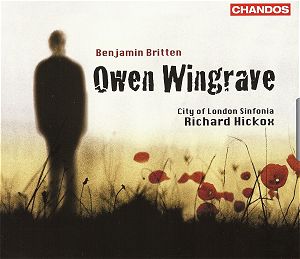
Benjamin BRITTEN(1913-1976) Owen Wingrave(1970) [107:18] Peter Coleman-Wright
(baritone) – Owen Wingrave
Alan Opie (baritone) – Spencer Coyle
James Gilchrist (tenor) – Lechmere
Elizabeth Connell (soprano) – Miss Wingrave
Janice Watson (soprano) – Mrs Coyle
Sarah Fox (soprano) – Mrs Julian
Pamela Helen Stephen (mezzo) – Kate
Robin Leggate (tenor) – General Sir Philip Wingrave and
Narrator
Tiffin Boys’ Choir
City of London Sinfonia/Richard Hickox
rec. Blackheath Halls, London, December 2007. DDD CHANDOS CHAN 10473(2) [64:31
+ 42:47]
This marvellous new recording,
only the third in the work’s history, deserves to go a
long way towards popularising this late Britten masterpiece.
It isn’t difficult to
see why Owen Wingrave has always been one of Britten’s
least popular stage works. Like all of his operas, it concerns
an outsider and his attempts to fit into a world that does
not accept him. In this case, however, it was a subject
particularly close to Britten’s heart. A committed pacifist
throughout his life, Britten struggled to fit into the
culture of wartime Britain in the 1940s, indeed spending
much of the war in the USA as a conscientious objector.
So Henry James’ ghost story on this theme appealed to him
more than normally.
Owen is the last in the
long line of a family of military heroes. He rejects fighting
and is shunned by his family and fiancée. As a test of
courage she dares him to spend the night in the haunted
room of the Wingrave mansion, Paramore. He does so, but
is found dead the next morning, his death brought about
by the strength of his own convictions. Britten’s opera
was originally commissioned for television by the BBC in
1967 and his original cast recording survives on CD (only
available now as part of a bigger set). However Britten
always said that the opera would work just as well on stage
and he supervised the first staged production at Covent
Garden. The Linbury Theatre at Covent Garden performed
it in April 2007, but the opera has seldom been revived
and a new production of Owen Wingrave is a rare
event indeed. Dramatically the opera isn’t as tight as
Britten’s other operas, and the overt pacifism of Act 2
can get a little wearing, but there is much to enjoy, and
this new set from Hickox is a perfect way to begin discovering
it.
Britten was always a master
of structure in his operas and he weaves a tight web through Owen
Wingrave. In The Turn of the Screw, another
James-based ghost story, Britten works the introduction
to each scene as a steadily intensifying set of variations.
Similarly, the prelude to Owen Wingrave consists
of a musical depiction of each of the ten Wingrave portraits
that adorn the walls of Paramore. Each portrait is accompanied
by an instrumental cadenza; most striking is the fifth,
a double portrait of the father who killed his son and
whose ghosts are said to inhabit the haunted room. Britten
takes these instrumental textures and honeycombs them through
the opera, especially Act 1. The tone becomes more spectral
with Act 2, which opens with a melancholy ballad (with
off-stage tenor and boys’ chorus) telling the story of
the ghosts. It is this vacant trumpet melody which dominates
Act 2. The City of London Sinfonia has lots of experience
of Britten opera under Hickox (listen to their outstanding Midsummer
Night’s Dream and Rape of Lucretia) and they
fit into this score as if it was made for them. The instrumental
cadenzas each inhabit an entirely different characteristic,
they are spellbinding when charting Owen’s convictions
in Act 1 and terrifying when accompanying the tense nocturnal
conversations at the end of Act 2. Furthermore they are
just the right size for this kind of music: nothing is
lost, but nothings is drowned out either. They remain one
of the best Britten orchestras around.
Similarly, I have no doubt
that Hickox is the greatest Britten conductor of our -
or perhaps any - day. He has conducted nearly all of Britten’s
operas for Chandos and Virgin/EMI and every one is a revelation.
He manages to shed new light on each of these masterpieces
in a way that even the composer’s own recordings don’t
often manage and he is helped in every case - including
this one - by demonstration quality sound. The “production” here
is not intrusive: we hear singers approaching from the
right and left but it does not distract. The off-stage
events in Act 2 - the aforementioned ballad singer and
Sir Philip’s denunciation of Owen - are ideally placed
and only add to a sense of drama. Throughout, Hickox paces
the drama ideally, allowing the slower passages, such as
Owen’s dialogues with other characters, but building up
extraordinary tension towards the dénouement.
The singing is also tremendous,
with one exception. The tenor roles are sung dramatically,
and the three Paramore women are particularly well characterised.
Elizabeth Connell’s voice can be alarmingly piercing when
first heard, but this is entirely appropriate for the shrieking
harpy that Miss Wingrave is. Janet Watson and Sarah Fox
differentiate the roles of mother and daughter well, no
mean feat considering how similar the roles are. Alan Opie
is marvellously authoritative as the teacher, Coyle: he
and his on-stage wife, Janice Watson, provide the only
grains of sympathy for Owen in the piece. It is, unfortunately,
with Peter Coleman-Wright’s performance of the title character
that we run into problems. There is a rather unpleasant “grit” to
his voice, which too often leads to an unsteady timbre
and uneven singing. At first I tried to ignore this, and
then I tried to convince myself that it was part of his
characterisation of the role: I’m not at all sure of this,
though, and, regrettably, I think it’s more likely that
he was just having a bad time while he was working on this
recording.
This is a real shame,
because if his performance had been more secure then this
would easily become the top choice for this work. As it
stands, we must continue to pay equal heed to Britten’s
own recording with Benjamin Luxon, John Shirley-Quirk and
Janet Baker. I still think that Hickox one wins out on
balance, though: his compelling interpretation together
with the orchestra and the marvellous sound make this a
winner. Fans of Britten opera need not hesitate, and any
other opera-lovers who fancy a challenge should head for
this enthusiastically.
Simon Thompson
Please support our advertisers below by clicking on the logos for further information.

























 Peter Coleman-Wright
(baritone) – Owen Wingrave
Peter Coleman-Wright
(baritone) – Owen Wingrave 
