Editorial Board
MusicWeb International
Founding Editor Rob Barnett Editor in Chief
John Quinn Contributing Editor Ralph Moore Webmaster
David Barker Postmaster
Jonathan Woolf MusicWeb Founder Len Mullenger
Sir Arthur
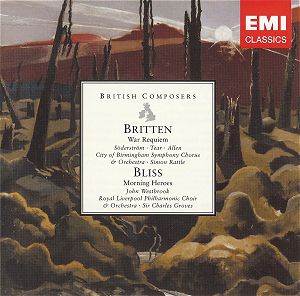
BLISS (1891-1975) Morning Heroes (1930) [59:33] John Westbrook
(orator)
Liverpool Philharmonic Choir
Royal Liverpool Philharmonic Orchestra/Sir Charles Groves Benjamin BRITTEN (1913-1976) War Requiem (1961) [83:25]
Elisabeth Söderström (soprano), Robert Tear (tenor) Sir
Thomas Allen (baritone)
Boys of Christ Church Cathedral, Oxford, CBSO Chorus
City of Birmingham Symphony Orchestra/Sir Simon Rattle
rec. Philharmonic Hall, Liverpool 23-24 July 1974 (Bliss);
Great Hall, University of Birmingham 27 February, 1-4 March
1983 (Britten) EMI CLASSICS
BRITISH COMPOSERS 5059092 [69:37 + 73:30]
This
is the first time to my knowledge that these works have been
paired together on disc. It’s such an intriguing idea that
I’m surprised nobody has done so until now. Both works represent
their respective composers’ heartfelt response to the horrors
of warfare. Morning Heroes written as an act of personal
catharsis following the death of Bliss’s brother in the trenches,
the War Requiem a less immediately personal but no less
genuine reaction on the part of its famously pacifist composer.
Bliss
himself saw active service in the trenches during the Great
War, being wounded on the Somme and gassed at Cambrai. These
experiences, together with the loss of his brother, resurfaced
some ten years later when Bliss began to suffer recurring nightmares.
It was ostensibly as a memorial to his brother but also to
exorcise his own demons that Bliss began to write his large-scale
choral symphony, Morning Heroes.
Morning
Heroes foreshadows works by Britten such as the Spring Symphony or Nocturne in
its use of a collection of poems by different authors responding
to a common theme; in this case the impact of war on all
that it touches, from the soldier to his nearest and dearest.
The work is scored for narrator, chorus and orchestra and
contrasts poems dealing with both the “public” face of war
(Whitman’s The City Arming) to its effect on individuals
(passages from Homer’s Iliad and Li-Tai Po). Finally,
two First World War poems by Wilfred Owen and Robert Nichols
paradoxically lend both particularity and universality to
the work. At no point do we feel that Bliss is preaching
any kind of anti-war polemic; war is seen as a necessary
evil. Bliss takes as his theme the acts of collective and
personal heroism that war engenders.
Sir
Charles Groves performed Morning Heroes several times
in his career, for instance at the 1971 Cheltenham Festival
in honour of the composer’s 80th birthday, and at
a 1982 studio performance once available on BBC Radio Classics.
His 1974 recording reissued here was once issued on an earlier
British Composers CD incarnation but that has long been unavailable. John
Westbrook is clearly involved as the narrator, and all forces
show tremendous dedication in their performance.
Those
familiar with the piece will not need to be reminded of its
virtues; if you’ve never heard it before, do try to get hold
of these CDs. Morning Heroes is an inspired, deeply-felt
and memorable work.
It’s
something of a sobering thought that it’s now almost a quarter
of a century since Simon Rattle’s recording of Britten’s War
Requiem first appeared. At the time it was the first widely
available version to challenge the composer’s own 1963 recording.
Rattle performed a lot of Britten’s music at this stage in
his career – as the excellent booklet notes tell us these forces
had given a performance of the War Requiem immediately
before recording the work. He and his performers were fully
attuned to the piece.
Now
that we have had recorded versions of the War Requiem from
conductors such as Robert Shaw, Richard Hickox, and Kurt Masur – not
to mention Giulini with the composer himself on BBC Legends – the
Rattle finds itself in a much more competitive marketplace.
I had not listened to his recording for many years so was interested
to find out how the performance measured up.
On
sonic grounds the work is given a wide ranging recording set
in an atmospheric acoustic. The producers have been careful
to maintain the aural perspectives required for the three levels
or strata of the music – the distant boys choir, the full orchestra,
chorus and soprano soloist and the tenor and baritone soloists
with chamber orchestra in the foreground. Sometimes this can
give a rather unrealistic sound-picture. To get an acceptable
impact from the full forces you have to turn the sound up several
notches, only to be blasted out of your seat by Robert Tear’s
first entry! However, after a while, the ear soon adjusts.
Simon
Rattle takes an intensely dramatic view of the score, with
powerful brass, prominent timpani and an unerring sense of
pace and tempi. One of the great strengths of the performance
lies in the committed singing of the CBSO Chorus, bitingly
dramatic and enunciating their text with unusual clarity. It
is a pity that the somewhat recessed recording rather blunts
the potential impact of their singing. The Boys of Christ Church
Cathedral sing with similarly clear diction – Britten once
advised a boys’ choir to sing their words “as though they were
biting an apple” – and the Oxford choristers appear to have
taken this advice to heart.
Rattle’s
soloists are a good team, very different from Britten’s but
valid in their own way. Elisabeth Söderström sang a fair amount
of Britten’s music during her career; she appeared as the Governess
is one of the early Swedish performances of The Turn of
the Screw and later performed Our Hunting Fathers in
the composer’s presence at Aldeburgh (subsequently recording
that work for EMI). Like Heather Harper she does not really
have the kind of dramatic voice that Britten imagined in the
part but she compensates for this with singing of great beauty
and sensitivity in the more lyrical sections, and projects
her line effectively enough in the more declamatory passages.
By
the time he came to make the recording Robert Tear had been
singing the work for many years, and this is demonstrated in
his awareness of the text and in the considered inflections
he gives all aspects of the music. Tear was greatly influenced
early in his career by Britten, Pears and the Aldeburgh circle,
and if in later years he distanced himself from that tradition
he gives a dedicated performance of the tenor part. His is
a more robust approach than that of Pears and occasionally
he misses some of his older colleague’s sensitivity to dynamics
and wholehearted involvement in the music.
Thomas
Allen sings superbly throughout and rather steals a march on
Fischer-Dieskau in his perceptive delivery of the text and
his identification with the music. His is a more lyrical approach
than that of F-D or John Shirley-Quirk, summoning both deadened
tone and biting irony in “After the blast of lightning” and
eloquently conveying broken resignation in “Strange Meeting”.
A very fine performance indeed.
Britten’s
own recording is a priceless historical document and has been
remastered and reissued several times in the intervening years
so that the limitations of the 1960s recording are not as immediately
obvious. The CDs also come with a secretly recorded rehearsal
sequence giving us an invaluable glimpse of the composer as
interpreter. In addition we have the benefit of hearing the
three performers – Vishnevskaya, Pears and Fischer-Dieskau – for
whom Britten conceived the work, symbolising reconciliation
between Russian, British and German forces.
Rattle’s
performance gives us a fascinating view of a masterpiece – we
feel that he has approached the music afresh on its own terms,
without being influenced by tradition. He has the advantage,
as Britten did not, of a choir and orchestra with the music
in their blood, so there need be no concerns on grounds of
musical accuracy. His pacing of the work overall is masterly
in his projection of the overall structure; the drama of earlier
parts of the score such as the Dies Irae is not allowed
to overshadow the final cataclysmic climax in the Libera
Me, which is devastating in its power. In the Owen setting, “Strange
Meeting” which follows is sung with great concentration by
both Tear and Allen, emphasising as Britten intended the personal
cost of conflict and its futility. If the final In Paradisum does
not come as the overwhelming peroration that it can do in some
performances, Rattle appears to be aware that not all the questions
have been answered, and the final F major chorus brings a sense
of unease, a lack of resolution, that is not inappropriate.
Ewan McCormick

























 John Westbrook
(orator)
John Westbrook
(orator)