Graham Whettam had no formal musical education.
This did nothing to hinder his productivity. There have been
five symphonies, four string quartets and various pieces for
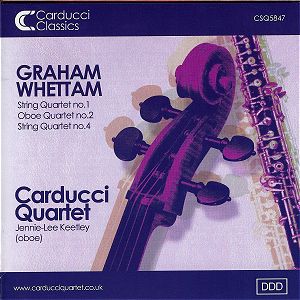
chamber music. This brings us neatly to the disc in question.
It is stunningly recorded and has a wonderful
plangent immediacy. The first string quartet was commissioned
by Jack Brymer. It is dedicated to the composer-conductor Eugene
Goossens who was a house guest of Whettam’s at the time of writing.
The music moves from stabbing lyricism that has parallels with
Tippett to the sort of desolation associated with Warlock's
The Curlew. The drive and urgency carries over to the
central scherzo. The finale has the character of a tombeau
- gravely reflective, emotion drained. It is impressive for
a concentration that fitfully recalls the last two Bridge quartets.
It ends in a mystical interplay of high harmonics. Having written
an Oboe Quartet for Victor Swillens in 1960 Whettam returned
to the medium a decade or so later. Again Whettam impresses
with eldritch writing which moves between the singing heart
of the oboe as reflected in the Arnold concerto to a Curlew
like loneliness. The final Rondo skips along in a macabre
cavort that might well recall the King Pest movement
in Lambert's Summer's Last Will but crossed with the
bagpipe skirl to be expected from the title. The Fourth Quartet's
opening movement evolved from playing with the Arts Council's
initials in music. This piece is concentratedly dissonant and
more powerful than the other two works. Whettam likes long scherzos
and that is what we get. This one is gritty, aggressive, macabre
and flies along with a strong wingbeat. After a predominantly
morose Passacaglia lit by an astringent cantabile comes
a Rondo-Finale. This is again borne along by muscular and athletic
propulsion. Even so, there is an enchanted still centre - quietly
whistling, almost self-effacing, gently chafing. This rises
to extended and memorable dominance in the last whispered three
minutes.
This will certainly appeal if you already
have the two Redcliffe Whettam CDs. Beyond that it should also
be sought out if your tastes already centre around Frank Bridge,
his later quartets, Oration and There is a Willow
and the music of Bernard van Dieren and Eugene Goossens.
As ever these are appallingly rough approximations but will
give you some idea of what to expect.
Before I close this review of a fascinating
disc I would like to remind you of two other Whettam discs -
this time orchestral. They have been around since 2000-2001.
The first is the Sinfonia Intrepida (1976) played
by BBCSO/Sir Charles Mackerras. You can find it on Redcliffe
RR016 and it plays for 44:11. It is of an analogue recording
made at Maida Vale on 8 October 1980. This is Whettam's second
symphony and was written over a period from 1960 to 1976. The
premiere was given in Liverpool by the RLPO/Groves. It is dedicated
“to the memory of those who were slaughtered and in honour of
the Phoenix I have seen in Europe: Warsaw, Rotterdam, Dresden”.
As must be expected this is an intensely serious symphony written
in three epic movements. A massive emotional surge can be felt
goading along this emotionally turbulent music. It is as if
Whettam taps into a community of tortured souls, of pain and
bereavement. There is violence aplenty in the meaty outer movements
and a degree of dissonance but no more than you might hear in
middle period Arnold or in Shostakovich. To me this evokes
the stillness of dust settling, of dry throats and of ruinous
landscapes. The 17 minute final movement draws on desolation
and some dissonance but at first its character is statuesque
and forbidding. After about four minutes snarling and skirling
brass - already dominant in the first movement - combine with
the impact of percussion to evoke the awe of devastation in
the making. Gradually a more meditative mood enters through
solo lines providing a trembling backdrop to tragic human experience.
There is redemption or at least hope in a grandly roaring rhetorical
finale - a gigantic bow-wave carrying all before it.
The other Redcliffe CD is RR017. It includes
the Concerto Drammatico for cello and orchestra (1998)
[32:29] and the much earlier nuclear war-centred Sinfonia
Contra Timore (1962) [27:30]. The Concerto is ably played
by Martin Rummel with Ian Hobson conducting the Sinfonia da
Camera in sessions dating from 2000. This is in three continuous
sections; here separately tracked. The voice of the cello is
never flattened by the orchestra. In fact Whettam allows only
light and transparent contributions where the cello addresses
the listener. It comes as no surprise that he also wrote a solo
cello sonata. At other times the cello is silent. By now the
intensely powerful and serious language used by Whettam comes
as no surprise. Difficult to draw parallels but this music
does at times sound like Walton but this is a Walton with a
scarifying abrasion built into its fabric. The outer two of
the three movements were written in 1962 about the same time
as the Sinfonia contra timore. The finale ends in a magically
poised confiding tremor and whisper - almost a benediction -
as if the composer was speaking to a loved one. The premiere
of the Concerto was given by these artists on 30 September 2000
at the University of Illinois at Urbana-Champaign.
The Sinfonia Contra Timore is played
by the Leipzig Radio Symphony Orchestra - now the Mitteldeutsche
Rundfunk sinfonieorchester. Apart from some rumbling imperfections
at the start this October 1975 recording has come up very cleanly.
In the first of the three movements the music has an air of
Malcolm Arnold at his most impudent and apocalyptic. A searing
trumpet at 2:58 and the following guttural shudders do nothing
to dispel the parallel. Arching melancholy carried in large
part by the strings pervades the central Adagio. The finale
moves between Whettam's trademark intimation of desolation to
a rhythmic energy jauntily propelled by trumpets and Schuman-hot
percussion including anvil. The dedication of the work seems
to have been taken as a red rag to a bull. He wrote “To Bertrand
Russell and all other people who suffer imprisonment or other
injustice for the expression of their beliefs or the convenience
of politicians and bureaucracies.” Local political intervention
brought about the withdrawal of the work from its announced
Liverpool world premiere in 1964. Birmingham picked up the dropped
honour and it was the enterprising and perceptive but unglamorous
Hugo Rignold who gave the premiere with the CBSO on 25 February
1965. These same forces were soon to record Arthur Bliss’s Music
for Strings and Blow Meditation for Lyrita.
Whettam owes much in recent years to the
advocacy of Francis Routh and of Paul Conway. His remains a
gripping voice in the annals of British music – potently serious
yet mysteriously ignored.
Rob Barnett

























 Jenny-Lee
Keetley (oboe)
Jenny-Lee
Keetley (oboe)