Editorial Board
MusicWeb International
Founding Editor Rob Barnett Editor in Chief
John Quinn Contributing Editor Ralph Moore Webmaster
David Barker Postmaster
Jonathan Woolf MusicWeb Founder Len Mullenger
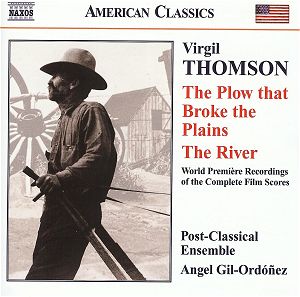
Virgil THOMSON (1896-1989) The Plow That Broke the Plains (1936)
(1. Prelude [4:04]; 2. Pastorale (Grass) [1:20]; 3.
Cattle [2:07]; 4. The Homesteader [2:48]; 5. Warning
[1:30]; 6. War and the Tractor [3:55]; 7. Speculation
(Blues) [2:55]; 8. Drought [1:46]; 9. Wind and Dust [2:04];
10. Devastation [4:23]) The River (1937)
(1. Prelude [0:40]; 2. First Forest [1:01]; 3. A Big River
[2:46]; 4. Cotton Pickers [2:43]; 5. Ruins [1:19]; 6. Logging
[2:00]; 7. Coal [2:37]; 8. Floods [7:39]; 9. Requiem [1:14];
10. Tenancy [3:21]; 11. Finale [3:23]) Post-Classical
Ensemble/Angel Gil-Ordóñez
rec. 11-12 June 2005, Omega Recording Studios, Rockville,
Maryland, USA NAXOS AMERICAN
CLASSICS 8.559291 [55:35]
Pare
Lorentz’s documentaries, The Plow That Broke the Plains and The
River, are considered to be some of the best ever made.
Dismissed by some as government propaganda they draw their
strength from the filmmaker’s unwavering support for Roosevelt’s
New Deal and the belief that farmers in the drought-stricken ‘dust
bowls’ were entitled to federal support. Commissioned by
the US Government the films highlight the very real dangers
of farming in the Great Plains – then in the grip of a terrible
drought – and the need for flood prevention along the Mississippi.
Thanks
to Naxos and Angel Gil-Ordóñez and his Washington-based Post-Classical
Ensemble we now have Thomson’s complete scores on CD at last.
Yes, there is something of the plain-spoken style one associates
with Copland – who admired The Plow for its ‘frankness
and openness of feeling’ – but the ‘voice’ is unmistakably
his own.
And
despite the biblical proportions of this tragedy Thomson
eschews the epic approach in favour of something much plainer,
more intimate. The gentle Pastorale (Grass) certainly
recalls Copland at his open-hearted best. This is a vision
of Eden, of grasslands as yet unspoilt, and Thomson manages
to suggest both this happy state and a sense of wide open
spaces with a remarkable economy of style. Beneath the music’s
often naïve charm the timps beat, portents of the destruction
to come, yet for all that Thomson never allows the music
to become portentous. Indeed, Lorentz’s script may seem a
little too poetic for modern ears but there is no doubting
the filmmaker’s sincerity, a quality that Thomson complements
so well.
Some
of the most winning music in this score can be found in the
dance-like rhythms of Cattle. There’s no crude
musical onomatopoeia – though there is a Grofé-like imitation
of hooves at one point – and in The Homesteaders Thomson
mixes the martial trumpets and drums with snatches of banjo
and catchy folk tunes. There is a sense of ease and contentment
here which – to use a Hollywood analogy – is more George
Stevens than John Ford or Howard Hawks. But even though this
is not a hard landscape the timps remind us that with no
rivers and little rainfall the settlers farm here ‘at their
peril’.
The
repeated trumpet calls and jaunty march rhythms of Warning and War
and the Tractor are a reminder of conflicts past
and present, not to mention the advancing legions of machines
that ‘break’ the land. Judicious as always Thomson never
resorts to musical histrionics, even at moments of high drama;
just sample the wistful, bluesy sax in Speculation, whose
growing dissonance dissolves into the strange empty harmonies
of Drought. This pared-down approach is equally
effective in Wind and Dust, with its swirling
figures and distressed trumpets.
The
earlier folk-like melodies resurface in Devastation but
this time there is a hollow ring to the once reassuring tunes.
Lorentz’s script is bleak indeed, describing the farmers
and their families fleeing the dust bowls, with ‘no place
to go and no place to stop’. This almost biblical exodus
was to dominate John Ford’s equally bleak 1940 film of Steinbeck’s Grapes
of Wrath. Not surprisingly both films have been deposited
in the US National Film Archive.
Lorentz
made The River a year later, in 1937. The film, which
showcases the dam-building and flood-prevention efforts of
the Tennessee Valley Authority, is a much simpler, more direct
narrative. That said, Thomson provides a stream of good tunes,
with a thrusting Prelude and some lovely solo
writing in First Forest and A Big River, depicting
the mighty Mississippi. The music has an easy flow to it,
the timps this time underlining the steady building work
on the dams and levées.
The
film doesn’t seem to have the dramatic subtext of The
Plow, and Thomson’s approach here is best described as
straight pictorialism. That said, he has an Ivesian knack
for quoting popular tunes that would surely resonate with
US audiences of the time. Sample the rollicking Cotton
Pickers with its evocative banjo melody and distant
trumpets, the latter a reference to the Civil War. And then
there’s that sad little melody of the old plantations in Ruins.
In
keeping with the film’s spirit of public information Logging and Coal offer
an opportunity to trumpet the virtues of enterprise and hard
work, essential to getting America back on its feet. Thomson
uses snare drums to remarkable effect, depicting rafts of
logs rolling down the river. He also quotes the jaunty tune ‘There’ll
Be A Hot Time in Town Tonight’, very much as Ives might have
done.
Yet
even this simple narrative has a sting in the tail, with
disaster in the form of Flooding. That Mississippi
solo we heard earlier now sounds mournfully over a pulsing
drum, a marvellous evocation of a drowned landscape. The
futile efforts to hold back the waters are depicted in repeated,
pounding rhythms, the skeletal unison writing of Requiem a
grim postlude.
Unlike
the first film The River ends on a more positive note,
the waters finally ‘locked and dammed’. Thomson reflects
this new optimism in music that flows freely and broadens
into a simple yet spacious climax. This isn’t as much of
a ‘melodrama of nature’ as The Plow, but at worst
Thomson’s music is robust and workmanlike, at best highly
accomplished and very evocative.
These
films are now available on DVD (Naxos 2.110521) with
an up-to-date soundtrack by the Post-Classical Ensemble.
I have to say hearing this score has tempted me to go out
and buy a copy. But if you just want the music –– this disc
is as authoritative as it gets. With a warm, detailed recording
and informative notes by Joseph Horowitz this is a very desirable
issue indeed.

























 Post-Classical
Ensemble/Angel Gil-Ordóñez
Post-Classical
Ensemble/Angel Gil-Ordóñez