Editorial Board
MusicWeb International
Founding Editor Rob Barnett Editor in Chief
John Quinn Contributing Editor Ralph Moore Webmaster
David Barker Postmaster
Jonathan Woolf MusicWeb Founder Len Mullenger
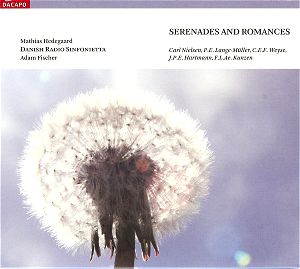
Danish Serenades and Romances Carl NIELSEN(1865 -1931)
Min pige er sa lys som rav from Moderen, op 41 (1920) [2:07] J.P.E. HARTMANN(1805-1900)
Ja, jeg,er hjemme, I mit kaere Danmark from Liden Kirsten (1849) [5:21]
P.E. LANGE-MÜLLER (1850-1926)
Genboens første vise, op 13 no 1 from I mester Sebalds have (1880) [1:58]
Serenade from Renaissance, op 59 (1901) [4:57]
Elskte, jeg lever from Peter Plus, op 42 (1891) [2:25]
Rosens elskov from Peter Plus, op 42 (1891) [1:39]
Romersk serenade (1908) [2:26]
Serenade from Der var engang, op 25 (1887) [3:40]
C.E.F. WEYSE (1774-1842)
Hyrden graesser sine far from Festen pa Kenilworth (1836) [3:15]
Skønjomfru, luk dit vindue op from Sovedrikken (1809) [2:14]
Natten er sa stille from Prinsesse Isabella (1840) [1:46]
Carl NIELSEN(1865-1931)
Den milde dag er lys og lang from Fynsk forar, op 42 (1922) [1:48]
Sa bittert var mit hjerte from Moderen, op 41 (1920) [2:51] F.L.AE KUNZEN(1761-1817)
Mitnattens mane from Erik Ejrgod (1798) [3:37] P.E. LANGE-MÜLLER Overture from Gildet pa Solhaug, op 32 (1888/1897) [4:11]
Gudmunds første vise from Gildet pa Solhaug, op 32 (1888/1897) [1:46]
Gudmunds anden vise from Gildet pa Solhaug, op 32 (1888/1897) [1:10]
Dance from Gildet pa Solhaug, op 32 (1888/1897) [4:05];
Carl NIELSEN
Ulignelige pige from Maskarade (1906) [3:54] Mathias Hedegaard (tenor),
Ditte Højgaard Andersen (soprano)
Royal Naval Choir Copenhagen; Danish Radio Sinfonietta/Adam Fischer
rec. 27-29 December 2006, Danish Radio Concert Hall. DDD DA CAPO
8.226012 [55:14]
I
have had a fascination with Danish music since learning the
Nielsen flute concerto while at school. The sound is fresh,
distinctly Danish and different from much other European
music at the time. Most people would be hard pushed to name
more than three Danish composers. Nielsen is obviously the
best known. Anyone who has looked beyond his music may also
know of Hartmann or Lange-Müller. Somehow it is only recently
that the Golden Age of Danish music seems to have come to
our attention. The composers on this disc demonstrate subtly
different styles of writing, from the quintessentially Danish
(Nielsen, for example), to the Schubertian (Weyse) and the
Wagnerian.
This
is a delightful recording of some beautiful repertoire. Light-weight,
but nevertheless highly enthralling, this collection of serenades
and romances is a joy. The singing is wonderful; Mathias
Hedegaard is the recording’s main artist and his voice is
perfectly suited to this kind of repertoire. I could listen
to him for hours. The orchestral playing is subtle in its
accompaniment, achieving a perfect balance with the singers.
There
are four Nielsen tracks on this album, taken from The
Mother, Springtime on Funen and Maskarade. The
opening, Min pige er sa lys som rav (as fair as amber
is my girl) is instantly recognisable as what I would think
of as quintessentially Danish. The melodic lines in this
love song are simple, the mood is lilting and the harmony
is tonal but sumptuous. One of Nielsen’s best known vocal
works, Springtime on Funen is not often performed
outside Denmark. Track 12, taken from that work, brings
to mind the Danish countryside in which the protagonist lives
(the tender day is light and long and full of sun and
blackbird’s song). The sound here is more symphonic,
with a rich orchestral skein.
J.P.E.
Hartmann’s only contribution to this album, ja, jege er
hjemme begins with an expressive orchestral introduction
and has a particularly satisfying bass line. This song is
taken from Liden Kirsten, Hartmann’s most successful
opera where all aspects are influenced by folk music. The
central orchestral interlude includes an exquisitely executed
clarinet solo [1:56]. The harmony is less progressive than
Nielsen’s yet it contains much variety, including major and
minor sections, and a real fluidity of line. This is the
longest track on the CD.
Another
favourite is Lange-Müller’s Genboens første vise. Full of lightness and
a flowing melody, this short song is beautifully performed.
This composer features often on this CD, with no less than
ten tracks. The Serenade from Renaissance is
a full-scale piece, with orchestra, choir and solo tenor. The
play is set in Venice and features a painter, Tintoretto,
as the lead character. A gondolier’s song with its gently
undulating quavers forms the perfect backdrop to the flowing
melodic lines. Elkste, jeg lever is reminiscent in
places of Wagner, and as such is slightly heavier than many
of the other works here. Taken from the opera Peter Plus,
this track features soprano Ditte Højgaard
Andersen alongside Hedegaard, once again with choral and
orchestral accompaniment. The two main voices complement
each other magnificently. Another track from the same opera, Rosens
elskov reminds me a little, stylistically at least, of
Tchaikovsky ballet music. The only two purely orchestral
tracks are taken from Gildet pa Solhaug, a setting
of a play by Ibsen. The dance is at times dark and
menacing, with repeated dotted rhythms feeling the heavy
burden of pedal bass notes and thudding, accented second
beats. The second section is, by contrast, light and charming,
with repetitions of the melodic lines heard between wind
and strings. This bright moment is however short-lived, and
the music returns to its dark and heavy rhythms. The overture,
too begins with a sense of foreboding; this is music of gravitas.
The melody is driving and broad, against a moving violin
accompaniment. Reminiscent of Sibelius, the minor key brings
to mind cold, bleak weather and man’s determination to survive
the odds. The work builds to a central climax and then trudges
off into the distance, with valedictory plodding bass notes.
This is intensely beautiful and would work on its own as
a short concert piece.
There
is a single track by Friedrich Kunzen, which is similar in
style to Schubert. The vocal line is presented with clarity
and understanding by Hedegaard. Kunzen’s opera, Erik Ejegod was
composed in 1798 and was his second work in the genre. Taking
elements from Danish history, it tells of the medieval king
Erik Ejegod. Although the work was a success at the time
of its composition, it has not been staged since 1827. This
recording includes the ballad Midnattens mane (The
Midnight Moon), which has become a part of the Danish concert
repertoire. The song tells of a love triangle between Lyna,
Uller and Alf and the murder of Lyna. In a fit of passion,
Alf dies of a broken heart.
The
remaining composer represented here is Weyse. A leading composer
in Denmark around the 1800s, he also worked as a pianist
and organist. His style, perhaps unsurprisingly, is once
again reminiscent of Schubert, particularly in the use of
the orchestra. His approach is more classical than some of
the others represented on this CD. The song from Prinsessa
Isabella, nattern er sa stille contains a beautifully
performed harp accompaniment, with an introduction and coda
which would not sound out of place in Welsh folk music.
This
is a delightful recording throughout, with excellent production
values. The performance is of a consistently high level and
the singing has a wonderful sense of phrasing and clarity. Hedegaard
has an exquisite voice which deserves to be heard.
Carla Rees
Please support our advertisers below by clicking on the logos for further information.

























 Mathias Hedegaard (tenor),
Ditte Højgaard Andersen (soprano)
Mathias Hedegaard (tenor),
Ditte Højgaard Andersen (soprano)