Editorial Board
MusicWeb International
Founding Editor Rob Barnett Editor in Chief
John Quinn Contributing Editor Ralph Moore Webmaster
David Barker Postmaster
Jonathan Woolf MusicWeb Founder Len Mullenger
Alexander SCRIABIN (1872-1915) Complete Solo Piano Works
see end of review for details Maria Lettberg
(piano)
rec. Deutschlandradio Kultur, Studio 10, Berlin, 2004-2007 CAPRICCIO
49586 [8 CDs and Bonus DVD: 63:58 + 72:51
+ 56:24 + 53:14 + 52:48 + 67:19 + 62:54 + 71:40]
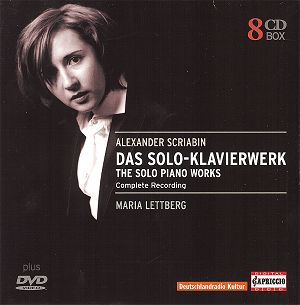
The rather unassuming slimline
box in which this set is presented hides a vast world of musical
invention and discovery, both in the incredible variety of
Alexander Scriabin’s work, and the remarkably high quality
interpretations of Maria Lettberg.
If, like me, you’d never heard
of Maria Lettberg as a recording artist, then this might be
partly because she seems to be developing a career several
notches below the usual pianistic radar, eschewing international
competitions and exploring the less conventional avenues of
the piano repertoire alongside the work of Brahms, Schumann,
Liszt and Schnittke. She is however a product of the widest
of musical backgrounds, having not only graduated from the
St. Petersburg Conservatory, but also having studied with renowned
pianists from the Royal Academy of Music in Stockholm and the
Sibelius Academy in Helsinki.
I would like to be able to
say that the bonus DVD, “Mysterium”, provides the key to some
of Scriabin’s music for piano and the recordings in this set,
but the filmed recordings are a bit of a let-down. We are given
excerpts from five of the sonatas and Vers la flame,
the bulk of which consisting of some footage of Maria Lettberg
looking dreamy behind a white Bösendorfer, surrounded by some
anthroposophical colour effects supposed to represent the synaesthetic
visions Scriabin associated with certain keys. This is occasionally
accompanied by some heavy-handed symbolism, such as hugely
magnified spermatozoa to give the ‘cycle of life’ a kick start.
More of interest is an interview in which Maria Lettberg explains
her background with and approach to Scriabin, again looking
rather different to the Gillian Anderson crispness of the cover
photo. This is conducted in German, but has English and French
subtitles. She has clearly studied Scriabin’s life and work
deeply, and refers to the composers own recordings as important
references. Instinctively sceptical about performers who record
the complete works of certain composers, she points out the
unique case to be made for Scriabin. There is an entire musical
universe to be found in Scriabin’s work, from the gracefully
Chopinesque through to the uncompromisingly avant-garde, some
of which still sounds modern today.
The recordings proper are very
well done indeed, the piano sound rich and vibrant, and the
studio acoustic proving pretty much ideal – not so dry as to
be tiring, not so reverberant that detail is obscured in the
thicker textures. The interpretations, while described as ‘unique
and original’, are actually in no way shockingly unconventional.
Lettberg describes feeling entirely comfortable with Scriabin’s
pianistic and musical language, finding it natural and ‘her
own’, when she finally came to start working with his music.
One of my favourite Scriabin performers of recent times has
been Artur Pizarro, whose recordings appeared on Collins Classics.
Comparing the two pianists with the 24 Preludes Opus 11 I
can’t honestly say which I would now prefer. Both have a highly
natural sense of rubato and phrasing, and while there are some
differences of emphasis and taste in voicing certain passages
I don’t find Lettberg lacking any of the poetry which draws
me towards Pizarro. There does seem to be a more overt narrative
going on in Pizarro’s playing; the stories seeming to gather
and build into substantial novel. Lettberg’s playing allows
the music to speak for itself a little more, the sense of abstraction
possibly indicating a more intellectual approach. There is
a searching among the notes more for questions than for answers – a
sense of the moment, rather than that of a definitive statement.
Scriabin’s ten Sonatas are
a key element in any set of his works for piano, and my principal
reference is that of Håken Austbø, whose 1990 recordings are
now available on a Brilliant Classics set which also has the
entire Piano Sonatas of Prokofiev and Shostakovich.
The first thing from this box
you are likely to hear is the opening of the Sonata No.1
Op.6, and Lettberg is impressively dramatic, the plunging
chords filled with sonority. I love the sustained quality of
the second movement, and you have a sense of Lettberg’s sensitive
touch in the long melodic lines. Her feel for the architecture
of the music is also beyond reproach, and if you think you
can get away with just dipping into the odd fragment here and
there think again, you’ll be hanging on to the bitter end as
the emotional message and drama of the music unfolds. Austbø is
a tad more tumultuous in the opening of this sonata, and the
development is more fragmentary, the passing notes given less
emphasis. I won’t say this is an invalid or lesser interpretation,
but the more overt piling on of textures in the heavier passages
is harder to take in my opinion. I get less of a sense of direction
in Austbø’s slower movements as well, and while I admire his
articulate Presto I do prefer Lettberg’s weightier left
hand in the Funèbre finale. The compact Sonata No.4
Op.30 has always been a fascination of mine – an elusive
combination of nostalgic longing, quicksilver magic and almost
salon banality. Lettberg has a fine hold on the impressionistic
feel of the first movement, and both she and Austbø are in
touch with Scriabin’s sense of ‘flying freely’ with a great
deal of air and space. I prefer Lettberg in the second movement
however, relieved to find that, despite her seemingly cerebral
approach at times, she is capable of finding the fun in the
music and communicating it with solid robustness.
The massive technical demands
of these sonatas is well known, and the demands we as listeners
place on the performer are a high pressure element of any recording.
Even given the allowance and luxury of the cosmetics of a studio
situation, Lettberg is clearly well up to the task in these
works: one never gets the sense that her technique is strained
in any way, and so it is the sense of being able to move beyond
the notes into the kinds of spiritual planes sought by Scriabin
that we have to look for to make these more than merely satisfactory
recordings. Listening to the later sonatas, such as Sonata
No.9 Opus 68 which has the forbidding subtitle Black
Mass, one can sense the ‘desecrated sacred relic’ in the
work’s disjointed climaxes and frenetic figurations, as well
as those grimly suspenseful dark shadows lurking in the underlying pianissmo sections
which open and close the piece. This is the kind of hothouse
romantic intensity which drives many people away from Scriabin,
and while it will never be an easy ride, Maria Lettberg’s impassioned
but clear-headed interpretation brings as much of the composers
incredible imagination to life as we can safely handle without
our loudspeakers exploding in a thick cloud of purple smoke.
The same is pretty much true of the other late Sonatas, the White
Mass included.
You may find yourself wondering
if it’s actually worth having 8 CDs worth of ‘the rest of Scriabin’,
but the remarkable thing is, there is really no such thing
as a filler in this box. Even taking some of the lighter works
such as the Impromptus, there are jewels and delights
to be discovered all over the place. The shorter pieces, the Poèmes and Morceaux for
instance, are all worlds in miniature, and the whole, as has
already been indicated, creates a unique musical universe.
There are one or two pieces
for which I have a special affection, if only because I associate
them with some concert experiences of my own. My accompanist
and mate Johan ‘the piano’ Cnossen is a passionate advocate
for the work of Scriabin. While Scriabin has not entirely been
ignored by record
companies (e.g. Yevgeny Sudbin on BIS
SACD1568) of late, my colleague regularly bemoans the reluctance
of audiences to accept him as a staple of concert programming,
at least over here in The Netherlands. He usually illustrates
what people don’t want to hear with the opening bars of Vers
la flameOp.72, and if it’s a nice piano and a receptive
crowd he’ll happily play the rest as well. I organise concerts
for the Royal Conservatoire in The Hague, and the reputable
Johan and I recently had fun trying out numerous pianos for
a client looking for a grand piano for one of our outside venues.
One thing I can confirm is that the instrument on these recordings,
whatever it is, has been well looked after and nicely intonated – I’ve
heard enough Scriabin ‘live’ demonstrated on a variety of instruments
to know what to listen out for: there’s warmth, colour and
singing tone aplenty on these recordings. Without being able
to guide you to a respectable recorded alternative, I can assure
you that Maria Lettberg’s massive five and a half minute crescendo
does ample justice to Scriabin’s obsessive Op.72 creation.
The other two pieces which we took all the way to the recording
studio were the Préludes Op.11 No.9 and 10, and
as these will now forever be engrained onto my musical hard-drive
I was also delighted to find that Lettberg’s idea about how
these pieces should go was not dissimilar to the ones my colleague
put in the can. Maria Lettberg is more daring in 10,
the climax rising like a cry of desperate and distorted joy
rather than the elegant arch with which I was more familiar.
This only serves to show how good this music is – like all
great pieces, able to take an almost infinite variety of subtle
transformations without losing its identity.
Do I have any criticisms of
this set? Yes, but they are mostly ones of presentation. The
slimline box is a usefully compact package, but the CDs are
put in those quasi-disposable paper envelopes which are sealed
with something nasty and rubbery, as if they are supposed to
have gone through the post. I hate those – they make your nice
new virginal box look like a car boot sale by the time you’ve
played all the discs. The booklet is also a bit of a mess.
Full of interesting and useful quotes from Scriabin himself,
and learned texts from Lettberg who did her thesis on the piano
music of Scriabin, the layout is messy and confusing, with
paragraphs, sentences and footnotes floating around like mystic
inventions in their own right. The musical benefits outweigh
all of these picky caveats, but with such a major project one
might have expected just a little more effort in these directions.
Complete sets of Scriabin’s
piano music are not thick on the ground. Michael Ponti squeezes
quite a lot onto a 5 CD set on the Vox label, but that set
doesn’t seem to have the absolute ‘complete’ credentials of
this 8 disc Capriccio box. There is also a set by Gordon Fergus-Thompson
on ASV from which you can pick-and-mix, as they are still available
on single discs. There are of course plenty of distinguished
versions of the complete Sonatas, Håken Austbø’s Brilliant
Classics box bargain very much among them, but if you are already
a Scriabin fan and reluctant to replicate certain pieces I
would still urge you to have a serious think about splashing
out on Maria Lettberg’s excellent set. There are qualities
in her playing which will have you re-discovering old favourites,
and there are so many other little extras which cast the more
famous pieces in broader or different lights, that you need
at the very least to put it on your wish list.
Dominy Clements
Track details
CD1 [63:58]
Sonata for Piano No.1 in F minor op.6 (1892-3) [24:32]
Sonata for Piano No.2 in G sharp minor op.19 'Sonata-fantasy' (1892-7) [12:28]
Sonata for Piano No.3 in F sharp minor op.23 (1897-8) [19:38]
Sonata for Piano No.4 in F sharp op.30 (1903) [7:20] CD2 [72:51]
Sonata for Piano No.5 in F sharp op.53 (1907) [11:33]
Sonata for Piano No.6 in G op.62 (1911-12) [13:34]
Sonata for Piano No.7 in F sharp op.64 'White Mass' (1911-12) [12:28]
Sonata for Piano No.8 in A op.66 (1912-13) [13:04]
Sonata for Piano No.9 in F op.68 'Black Mass' (1911-13) [8:23]
Sonata for Piano No.10 in C op.70 (1912-13) [13:16] CD3 [56:24]
24 Preludes op.11 (1888-96)
6 Preludes op.13 (1895)
5 Preludes op.15 op. 9 (1895-96)
5 Preludes op.16 (1895-95) CD4 [53:14]
7 Preludes op.17 (1895-96)
4 Preludes op.22 (1897)
2 Preludes op.27 (1899-1900)
4 Preludes op.31, op.33 (1902-03)
3 Preludes op.35 (1903)
4 Preludes op.37, op.39 (1903)
4 Preludes op.48 (1904-05)
2 Preludes op.67 (1912-13)
5 Preludes op.74 (1914) CD5 [52:48]
Trois Morceaux op.2 (1886-89)
12 Etudes op.8 (1894-95)
8 Etudes op.42 (1902-03)
3 Etudes op.65 (1911-12) CD6 [67:19]
Valse op.1 (1885-86)
10 Mazurkas op.3 (1887-89)
9 Mazurkas op.25 (1898-99)
2 Mazurkas op.40 (1902)
Quasi Valse op.47 (1905) CD7 [62:54]
Deux Impromptus a la Mazur op.7 (1891-92)
Deux Impromptus op.10 (1894)
Deux Impromptus op.12 (1895)
Deux Impromptus op.14 (1895)
Deux Poèmes op.32 (1903)
Deux Poèmes op.44 (1904-1911/12)
Deux Poèmes op.63 (1911-12)
Deux Poèmes op.69 (1912-13)
Deux Poèmes op.71 (1914) CD8 [71:40]
Allegro appassionato op..4 (1888-92)
Deux Nocturnes op.5 (1890)
Prelude & Nocturne for the left hand op.9 (1894-1900)
Trois Morceaux op.45 (1904), op.49 (1905), op.52 (1907)
Quatre Morceaux op.51 (1906-7), op.56 (1907)
Deux Morceaux op.57 (1908), op.59 (1910)
Deux Danses op.73 (1914)
DVD [55:00]
Bonus-DVD Alexander Scriabin: „MYSTERIUM“ – The Multimedia Project
NTSC, 16:9, Region Code: 0 [55:00]
Please support our advertisers below by clicking on the logos for further information.

























 Maria Lettberg
(piano)
Maria Lettberg
(piano)