Editorial Board
MusicWeb International
Founding Editor Rob Barnett Editor in Chief
John Quinn Contributing Editor Ralph Moore Webmaster
David Barker Postmaster
Jonathan Woolf MusicWeb Founder Len Mullenger
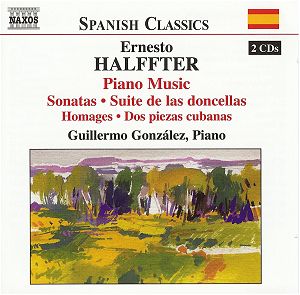
Ernesto HALFFTER (1905-1989) Piano Music CD1
Crepuscolos (1925) [10.32]; Marche Joyeuse (1922) [3.06]; Sonata per pianoforte
(1926) [6.57]; L’Espagnolade (1937) [5.57]; Grűss (1940) [2.29]; Serenata
a Dulcinea (1944) [6.22]; Dos piezas cubanos (1944) [7.13]; Preludio y danza
(1974) [6.44]; Llanto por Ricardo Viňes (1943) [5.00]; Sonate ‘Homenaje
a Domenico Scarlatti [1985) [8.13]; Nocturno otaňal ‘Recordando a Chopin’ (1987)
[4.05]; Homenaje a J. Turina (1988) [2.14]; Homenaje a F. Mompou (1986) [3.09];
Homenaje a R. Halffter (1987) [3.34] CD2
Suite de las Doncellas (1927-8) [35.12]; Valencia II –Pasodoble (1923) [3.37];
Panaderos (1923); Boleras de la Cachucha (1923) [7.31]; Tres piezas infantiles
(para cuatro mano) (1923) [2.31] Guillermo Gonzalez
(piano); Belen González Domonte (piano)
rec. Sala de concierto. Fundaciones Juan March de Madrid, 9
January, 5 April, 16 May 2006 NAXOS 8.570006/7 [75.33
+ 53.23]
First of all let’s sort out
our Halffters. They are all Spanish but of German extraction,
based mostly in Madrid. As well as Ernesto - under review here
- there is also his brother Rodolfo (1900-1987), a disc of
whose orchestral music is available in the Naxos Spanish Music
series. Then we come to Cristóbal Halffter (b. 1930), nephew
of the above men and composer of challenging avant-garde music.
Ernesto is probably the best known. ASV brought
out a disc of his orchestral music in 2000 (ASV DCA1078) conducted
by Adrian Leaper. That disc was part of my preparation for
this review. This allowed me to hear Ernesto’s the probably
most performed work of his – the Sinfonietta (1925). It’s a
student work like some of these piano pieces, written when
he was hardly out of his teens. He was a bit of child prodigy
and has been writing music seriously since he was about thirteen.
Another striking thing about the lovely Sinfonietta
is that it mixes nationalistic Spanish-sounding melodies and
rhythms with a strain of neo-classicism. This should be no
surprise when one considers, as we are informed in the extensive
booklet notes by Andres Ruiz Tarazona, that Halffter was, to
quote the composer himself, “just a pupil of Manuel de Falla”.
He also studied with Stravinsky during the 1920s at about the
time of the master’s ‘Pulcinella’ ballet and other neo-classical
works. He was a pupil of Ravel which would explain his lush
orchestration and, with regard to this disc, his efficacious
use of the piano. The works under consideration here are a
happy mix of ‘de Falla’ influence and Stravinsky inspiration.
So let’s take a few choice examples, first the nationalist
ones.
A title like ‘L’espagnolade’ is obviously a give-away
as is the equally Hispanic ‘Dos piezas cubanas’. They almost
out-Falla Falla. Contrast this with a work with a title like ‘Sonata
per pianoforte’ which you would expect to be neo-classical.
Actually it’s not quite as easy as that because what makes
Halffter’s musical language unusual is the way in which he
mixes the styles. The best example is the longest work on the
set the ‘Suite de las Doncellas’. This is a ballet originally
scored for orchestra and curiously entitled ‘Sonatina’(again
a possible neo-classical influence) but here heard for the
first time in its piano version. It comprises seven movements
which mix Spanish titles like ‘Danza de la gitana’ and ‘Fandango’ with
classical dances ‘Rigaudon’ and ‘Giga’; Spanish dances alongside
classical forms.
The very first work on disc ’Crepusculos’ is,
in a way, the most intriguing. It divides into three movements.
The first one I have returned to more often than anything else
on these discs. It inhabits a dark and mysterious nocturnal
world of uncertain tonality and fascinating piano textures.
It seems to me to lie within the world of Ravel – a world which
he obviously knew so well - especially in works such as ‘Gaspard
de la nuit’.
Halffter is fond of paying homage to various composers.
He never attempts a pastiche of their work but almost adds
a layer as if he is attempting to penetrate their characters
as well. It’s especially interesting to hear the ‘Homenaje
de Rodolfo Halffter’, written soon after his brother’s death.
It’s full of anger, passion and Hispanic beauty. The homage
to Chopin begins with a reminiscence of the great master. After
that, but with much lyricism, it goes off on its own course
of gentle obeisance. There is also homage to fellow Spaniard,
Federico Mompou. There is also a separate work ‘Preludio y
danza’ which is a better homage, I think, as it uses a title
and form which Mompou used throughout his long composing life.
Domenico Scarlatti is also recollected in the form of a flashy
sonata. He is remembered not only as a composer of the classical
period but also one who lived for almost the whole of his working
life with the Spanish Royal family. Finally we hear a little
trio of simple pieces (Piezas infantiles) in which González
is joined by his wife - four hands at the piano
The music has not been presented chronologically.
I am not sure why. There would still have been considerable
variety from track to track even if they had.
It is impossible to fault Guillermo González or
the recording venue, but of course I have no score and had
no prior knowledge of the music. As far I can tell he is clear
in his musical intentions and note perfect. He has crisp tone
and on the opposite side, a fine legato touch where necessary.
This set has given me great pleasure over the
weeks I have been listening to it and will no doubt continue
to do so. I adore Spanish music but here there is a unique
variety from track to track. Everything about it is beautifully
presented.
Gary
Higginson
Please support our advertisers below by clicking on the logos for further information.

























 Guillermo Gonzalez
(piano); Belen González Domonte (piano)
Guillermo Gonzalez
(piano); Belen González Domonte (piano)