|
Making
a Donation to MusicWeb
About MWI
Site
Map
More
Reviews
How to find a review
Books
Film
Music
Interviews
Nostalgia
Records Of The Year
Recommendations
Comment
Arthur Butterworth Writes
Phil
Scowcroft's Garlands
Classical
blogs
Reviewers
Logs
Announcements
Don't
Go Here!
Community
Bulletin Board
Reviewers
Helpers
invited!
Resources
Composers
British
Light Music Composers
Indexes
Label
Masterwork
Discographies
Composer
National
Themed
Review pages
Complete Books
Programme
Notes
External sites
British Music Society
The BBC Proms
Web Ring
Orchestra Sites
Recording Companies & Retailers
Online Music
Agents & Marketing
Publishers
Other links
Newsgroups
Web News sites etc
Editorial
Board
Classical Editor
Rob Barnett
Seen & Heard
Editor and Webmaster
Bill Kenny
MusicWeb Webmaster
Len Mullenger
Assistant Webmaster
David Barker
PotPourri
A
pot-pourri of articles
MW
Listening Room
MW
Office
Helping
MusicWeb
Advice
to Windows Vista users
Questionnaire
Site
History
What
they say about us
What
we say about us!
Where
to get help on the Internet
CD
orders By Special Request
Graphics
archive
Currency
Converter
Dictionary
Magazines
Newsfeed
Web Ring
Translation Service
Rules
for potential reviewers :-)
Do
Not Go Here!
April Fools
|

 |
 |
|

|
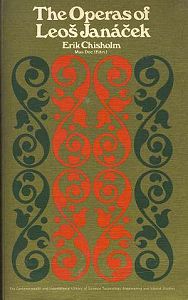
The Operas of Leoš
Janáček
by Erik Chisholm
Pergamon Press, first published 1971,
390 pages
Now only available in this online
version produced for the Erik
Chisholm Trust by MusicWeb International
|
|
Pedagogue, composer, writer on music,
inspiring teacher and music administrator
– Erik Chisholm was many things; he
was also an enthusiast for and an authority
on the music of Janáček. So in
1963 Pergamon Press commissioned him
to write a book about Janáček’s
operas. It took him two years to write
and was eventually delivered in 1965,
just before he died … probably of over-work.
It still remains one of the most lucid
English language books on Janáček’s
operas.
This is not a biography of Janáček.
Chisholm’s biographical introduction
is a mere sketch. It is very firmly
a guide to Janáček’s mature operas.
Curiously Chisholm chose to treat the
operas in reverse chronological order
so that we start with The House of
the Dead and finish with Jenufa.
There then follows a chapter dealing
with the lesser-known early operas,
Sarka, The Beginning of a Romance
and Osud.
Though the music of each opera is dealt
with extensively, complete with music
examples, in an appendix Chisholm gives
us a detailed thematic analysis of Siskov’s
monologue.
Some operas seem to interest Chisholm
more than others. The House of the
Dead is covered in 82 pages, The
Makropoulos Case in 48 pages, Sharp
Ears – The Cunning Little Vixen
in 44 pages, The Excursions of Mr.
Broucek in 74 pages and Jenufa
in 46 pages. The House of the Dead
is clearly a favourite with Chisholm
but we should not necessarily associate
length with preference. A point worth
bearing in mind is that Janáček’s
operas were far less common when the
book was first written; readers could
be expected to know only one or two
of them.
This is further emphasised by the illustrations,
which include some fascinating photographs
of then contemporary productions.
Each chapter gives a brief historical
introduction to the opera, detailed
synopsis of the plot and a detailed
musical analysis, act by act. The introductions
are not always extensive and not always
music-historically obvious. That for
The House of the Dead takes Janáček’s
visit to Britain in 1926 as its starting
point before going on to talk about
the composer’s speed notations. And
The Makropoulos Case starts with
Karel Capek’s visit to London in 1924.
The synopses are no mere single paragraph
affairs, but detailed plot analyses.
These were extremely helpful in pre-internet
days but still very helpful today when
trying to get to grips with these fascinating
but tricky operas.
For The House of the Dead, Chisholm
extends the chapter by comparing the
plot of the opera to the plot of Dostoevsky’s
novel. As Janáček was his own librettist,
this helps to shed fascinating light
on the composer’s methods; illuminating
indeed. Chisholm undertakes a similar
exercise for Katja Kabanova where
Janáček was again his own librettist.
As with The House of the Dead, the
relationship between the opera and its
source material sheds light on Janáček’s
methods.
Chisholm’s musical analyses of the operas
are always lucid. Sometimes you feel
that he is aware of the pressures of
space and wish he could have written
at greater length. As a an opera composer
himself, Chisholm was well placed to
analyse the operas and as an educator
he was able to present his analyses
in a lucid fashion.
Musicology and music-history have moved
on since Chisholm first wrote this book,
but other authors can be consulted if
musicology or music-history are your
interests. This volume remains a fine
introduction to the music-drama of Janáček’s
operas, illuminated by Chisholm’s intelligence
and graced by his lucid prose.
Robert Hugill
The
Complete Book on-line
|
|
Advertising
Rates
Visitor
stats
MusicWeb
International
has over 30,000 Classical CD reviews on offer
Gerard
Hoffnung Concerts &
The
Bricklayer Story

New
Releases

New
Releases


MusicWeb
sells the Polish
catalogue CDAccord
£10.50 post free W-W

MusicWeb sells the
Arcodiva catalogue
£12.00 post free W-W

£11.50
post-free world-
wide
Try
it and see - Sale or Return
MusicWeb
can now offer
you discs from the following catalogues:
Prices include postage
Musicweb
Special
Offers
Google Ads -
for information about privacy matters, click here.
|