For good reason the
re-issues of British repertoire from
the Lyrita label are receiving almost
universal acclaim. I have collected
the majority of the Lyrita discs and
the high standard of their performance
and sound is cause for celebration.
The growing number of British music
lovers should make these Lyrita releases
their first point of call. This is the
second of the two Lyrita discs that
contain the music of Sir Arthur Bliss.
The
other one comprises the: Mêlée
Fantasque; Rout; Adam
Zero Suite; Hymn to Apollo;
Serenade and The World is
Charged with the Grandeur of God on
SRCD.225.
Bliss attended Cambridge
University as a pupil of Charles Wood
and also studied with Stanford at the
Royal College of Music. He did not enjoy
the experience of working with Stanford
who, "had a devitalising effect"
on him (As I Remember by Arthur
Bliss. Pub: Faber & Faber, London
(1970) SBN 571 09282 9. pp. 28-29).
At the RCM, Bliss was surrounded by
a number of brilliant fellow students
including: Herbert Howells, Arthur Benjamin,
Ivor Gurney and Eugene Goossens. Wounded
and gassed and also tragically bereaved
by the death of his brother Kennard
it would be remiss not to mention the
devastating and enduring effect that
the Great War had on Lieutenant Bliss.
In relation to the
prevailing dynamic of the day in Britain,
Bliss was considered something of an
enfant terrible and an avant-gardist;
terms not generally used to describe
the RCM cohort. The experimental and
intrepid side to Bliss’s music gradually
became secondary as his concentration
on Romantic idioms increased. Following
his knighthood in 1950 he was appointed
Master of the Queen's Musick a position
that he took seriously and held until
his death in 1975.
The first work on the
disc, the Music For Strings from
1935, shares a kinship with Elgar’s
Introduction and Allegro, Op.
47 (1905) and Vaughan Williams’s Fantasia
on a Theme by Thomas Tallis (1910,
rev. 1913, 1919). With a design similar
to the other two scores Bliss employs
a string orchestra in a concerto
grosso form infused with a Romantic
character.
The three movement
Music for Strings is generally
a dark and serious score with dense
textures that are brought out superbly
by the CBSO under their conductor Hugo
Rignold. I found the opening movement
especially austere without the memorable
quality of themes found in the Elgar
and Vaughan Williams scores. The CBSO
convey moments of tenderness in the
central movement but the warmth is located
rather more under the surface. Bliss
in the closing movement places increased
emphasis on lyricism and as a consequence
the music becomes more interesting and
appealing. Here the CBSO manage to discover
an innate sense of mystery that at times
borders on the sinister. The final movement
felt as if it would make a splendid
stand-alone score.
Bliss composed his
Meditations on a Theme by John Blow
after being invited to write a work
for the City of Birmingham Orchestra.
After discovering what he described
as a "noble tune" in
the psalm ‘The Lord is my Shepherd’
from an edition of John Blow’s Coronation
Anthems and Anthems with Strings
he embarked on writing a set of variations.
On several occasions Bliss’s attractive
Meditations reminded me of the
dramatic and opulent sound-world of
Ravel’s Daphnis et Chloé
(1909-12).
In the marvellous Introduction
to the Meditations marked Largamente
- Agitato, ‘The Lord is my Shepherd’,
‘I will fear no evil’ the
CBSO bring out the warm, melodic and
emotionally moving qualities of the
music. I note how well Bliss contrasts
soothing moods of reassurance with others
heavy with threat and disturbance. The
Meditation I: Allegro moderato,
ma tranquillo, ‘He leadeth
me beside the still waters’ is music
with unsettling undercurrents that is
never allowed to relax. The robust and
muscular Meditation II: Allegro
deciso, ‘Thy rod and staff
they comfort me’ makes its weighty
presence felt. In Meditation III:
Scherzando, ‘The Lambs’
Bliss does a convincing representation
of frisky lambs playing on the spring
meadow. The CBSO brass adds a somewhat
martial character to the forceful and
brash Meditation IV: Allegro,
‘He restoreth my soul’.
In the Meditation V: Larghetto,
‘In green pastures’ the CBSO
create an inviting and comforting atmosphere
that convincingly evokes verdant pastures.
The spitting brass and shrieking woodwind
of the CBSO is a major feature of the
Interlude: Molto agitato,
‘Through the valley of the shadow
of death’ promoting a disconcerting
atmosphere of impending danger. The
Finale: Moderato e deciso,
‘In the House of the Lord’
has an impressively heroic central section
that could easily serve as the conclusion
to a great symphony.
Bliss wrote a number
of works for chorus a cappella
sometimes including a single instrument
such as a piano, organ or harp. His
score A Prayer to the Infant Jesus
was composed in 1968 for unaccompanied
women’s voices. The work is a setting
of the seventieth century prayer of
thanksgiving that Father Cyril made
to the Blessed Virgin Mary. The prayer
was in thanks for favours which had
enabled the restoration of the miraculous
statue of the infant Jesus of Prague.
The clothed statue is made of wood with
a wax coating and is installed up to
the waist in a silver sleeve and base.
Whilst visiting the statue at the shrine
of the Church of Our Lady of Victory
in Prague in 1966 Bliss copied down
the text of the thanksgiving prayer.
With the A Prayer to the Infant Jesus
Bliss has composed an engaging supplication
that conveys a respectful expression
of thanksgiving. The Ambrosian Singers
directed by Philip Ledger provide rapturous
singing that is highly persuasive.
The quality of the
performances and excellent sound make
this Lyrita disc a most attractive proposition.
Michael Cookson
























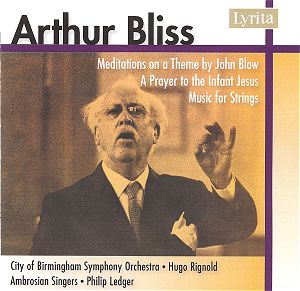
 for details
 City of Birmingham Symphony Orchestra/Hugo
Rignold
City of Birmingham Symphony Orchestra/Hugo
Rignold