Nowadays Purcell’s songs are
usually heard on CD with their authentic
instrumental backing of harpsichord,
bass viol and perhaps lute. Having piano
backing instead takes them into the
mainstream repertoire. Music for
a while (tr. 2) is first presented
by Eric Schneider in its bare ground
bass form, so when Christine Schafer’s
voice enters everything becomes smoother,
brighter, fresher. She sings of music
beguiling cares and only she demonstrates
this. Schneider does fill out his skeletal
accompaniment more as the song progresses
and this has a welcome improvisatory
feel. The approach is pacy and something
of the song’s aura of mystery is thereby
lost. But Schafer does convey its allure
and in the closing refrain adds ornamentation
which seems to mirror the occasional
jazzy elements in the accompaniment,
the combination making standard baroque
technique seem surprisingly modern.
Music’s role in evoking
love is now much in evidence. If
music be the food of love (tr. 3)
is eagerly delivered, love here an irresistible
impulse, though inconsistently the first
strain is repeated for the first verse
but not the second. Ah! How sweet
it is to love (tr. 4) is equally
exuberant and Schneider’s piano has
to be very nifty. This is very physical,
high powered and paced love. The opening
section of the epithalamium Thrice
happy lovers from The Fairy Queen
(tr. 6) is sung by Schafer as graphically
as I’ve ever heard it. She is regal
as Juno, yet with a smiling presence
and poise, playful and expressively
colouring the melismata, so that on
‘lovers’ (1:27) seems to picture them
enjoying themselves and the piano echoes
this. The setting really comes to life.
But in the second section, ‘Be to one
another true’ (1:54), Juno shows a different
face, one of temperate concern that
the lovers be faithful. Schafer begins
this in rather too forthright authoritarian
manner before softening later. To make
a piano accompaniment comparison, the
tenor Martyn Hill with Andrew Ball in
the realization by Michael Tippett and
Walter Bergmann recorded in 1994 (Hyperion
CDA 66749) begins in lighter, jollier
fashion. Ball’s piano contribution is
more ornate, Hill’s melismata more self
conscious, but their second section
is more kindly. In Sweeter than roses
(tr. 8) Schafer and Schneider do conjure
up the mystique surrounding ‘the dear
kiss’ before a second section, ‘What
magic has victorious love!’ (3:02),
all bubbling with vivacity. The soprano
Felicity Lott with Graham Johnson in
Benjamin Britten’s realization recorded
in 1995 (Hyperion CDD 22058) have a
more reflective but less immediate opening
section, with less climax at ‘the dear
kiss’ and less pointed recall of it
in a more festive second section.
At this point on this
CD enter George Crumb, with Night
(tr. 9), the first of his Three Early
Songs. It begins with a mercurial,
rippling piano accompaniment ostinato,
quicker than Purcell’s ground bass but
structurally similar. Serenity is evoked
by its opposite, brutality in the piano
(0:34) to indicate ‘stain’. The moon
glides across sleekly before another
clamour in the piano from 1:55 and approach
to a vocal climax indicating grandeur
and vastness, as does the sustained
closing ‘night’.
Purcell’s From rosy
bowers (tr. 11) is a dramatic scena
depicting five stages of madness. For
the opening, ‘sullenly mad’, Schafer
is contemplative and analytical till
the secret is out that the madness is
caused by infatuation. The second stage,
‘mirthfully mad’ (2:17) is quicker but
not that varied in tone. The third,
‘melancholy mad’ (2:56), is suddenly
chillier. The fourth stage, ‘fantastically
mad’ (5:11) is harder in resolve and
the final one, ‘stark mad’ (6:07) impetuous.
But more impressive is Not all my
torments (tr. 13), a stand alone
song yet equally dramatic, Schafer anticipates
her later Dido in her imperious negotiation
of the writhing roulades which in turn
evince torment, lack of pity, scorn,
sorrow and despair. This is magnificently
sung.
The second Crumb early
song, Let it be forgotten (tr.
14) starts with a gentle piano ostinato
matched by a vocal state of laid back
serenity you might readily associate
with a jazz song. The ostinato becomes
agitated for the opening of the second
stanza (1:28), the fracture lines showing
and Schafer and Schneider climaxing
(1:50) at the pained allusion to what
is to be forgotten before the calmest
ostinato and the voice closing with
a finely and comfortingly sustained
monotone line. After this, Purcell’s
ground bass in Crown the altar
(tr. 15) seems altogether bouncier while
Schafer has something of the same sunny
affability, yet also a searing vision
of ‘the bright seraphic throng’ in this
version as published in ‘Orpheus
Britannicus’, a fourth higher than the
original Birthday Ode setting and therefore
rising to high G.
The final Crumb early
song, Wind elegy (tr. 17) begins
with a poignantly flowing piano ostinato
and vocal line, explained by the words.
Nature carries on after the planter
has gone. Thereafter there’s ache as
well as activity but it too comes to
rest. In the recitative before Dido’s
lament (tr. 19) the welcoming of Death
is vivid, linking with that later in
Crumb’s Apparition. Schneider’s
dark grained descending ground bass
is sepulchral yet also of ineluctable
flow. Schafer’s lament is at first simple
and intimate but reaches a fittingly
imperious cry at the top G climax on
the third ‘Remember me’ (2:38) before
softening in graceful acceptance at
its repetition.
Apparition is
Crumb’s selection from Walt Whitman’s
When lilacs last in the dooryard
bloom’d whose focus is relating
to death. Crumb mixes songs and vocalises
and uses wordless melismata within songs.
The piano is amplified by a microphone
over the bass strings, creating an unusually
dense texture. The pianist is often
required to play the strings, for instance
with a glissando at the very
beginning and pizzicato in the
song Dark mother (tr. 23 0:55).
Vividly recorded in an attractively
slightly glowing acoustic, this Apparition
begins with an earthy piano sound and
voice of appreciable immediacy. The
effect is more graphic, dramatic and
involved than the greater purity and
objectivity of the 1982 recording by
Jan DeGaetani and Gilbert Kalish (Bridge
BCD 9006) for whom the work was written.
The climax of the opening song, The
night in silence under many a star
(tr. 20), which emphasises the vastness
of death is rendered more graphic by
Schafer’s slight vibrato. But the melismata
on ‘a’ that follow every line of the
poem are more impersonal than DeGaetani’s
relaxed lightness of articulation. This
Onyx recording’s slower overall timing,
24:59 in comparison with 22:45, partly
reflects a greater deliberation.
Schafer’s Vocalise
1, Summer sounds is animated.
The second song, When lilacs last
in the dooryard bloom’d (tr. 22)
is a sunny evocation on those words
which soon pales with portamento
effects on ‘mourn’, delicately realized
by Schafer. The third song, Dark
mother always gliding near with soft
feet (tr. 23) is a prayer of adoration
to Death presented by Schafer as a seductive
invocation with a creepily diaphanous
quality to the softest of whispers for
‘with soft feet’ though the soft climactic
top A isn’t as light as DeGaetani’s.
Vocalise 2: Invocation is violent and
stormy in full measure from Schafer
and Schneider, if not quite as maniacal
at the close as DeGaetani and Kalish.
The fourth song, Approach strong
deliveress (tr. 25) is decked out
as a bold march, Schafer vibrantly rising
to top D on ‘joyously’ where DeGaetani
sings the alternative D an octave lower.
Schafer’s Vocalise 3, Death Carol
(Song of the nightbird) seems a
little too scrupulously articulate for
the marking desolato, quasi lontano.
The fifth song, Come lovely and soothing
death (tr. 27) finds Schafer presenting
these words eagerly but not to quite
as languid or mesmeric effect as DeGaetani
who also finds a more loving appreciation
in the ‘mm’ refrain. Among the many
special effects called for from the
piano in this work, all deftly accomplished
by Schneider, the knocking sounds here
(0:31) are obtained by striking the
beams with the knuckles. The final song
(tr. 28) is The night in silence
once more with only small changes, but
Schafer’s voice now has more sense of
welcoming Death in it.
This is a strikingly
original and innovative CD. Purcell
and Crumb, equally accessible, make
a stimulating mix in a structure explained
in the booklet but Schafer’s selection
of connecting Shakespeare, as noted
in the heading, didn’t work for me.
Snippets don’t allow you thinking time.
Better read the full sonnets in the
booklet because the snippets are adulterated
by recording spectrum tricks, double
tracking of voice, electronic tones
and some instrumental effects from Apparition
taken out of context. But then you realize
how carefully applied Crumb’s effects
are.
Michael Greenhalgh
























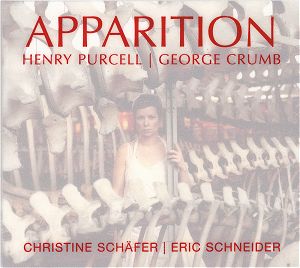
 *Sebastian Carewe (speaker), Christine
Schafer (soprano), Eric Schneider (piano)
*Sebastian Carewe (speaker), Christine
Schafer (soprano), Eric Schneider (piano)