Editorial Board
MusicWeb International
Founding Editor Rob Barnett Editor in Chief
John Quinn Contributing Editor Ralph Moore Webmaster
David Barker Postmaster
Jonathan Woolf MusicWeb Founder Len Mullenger
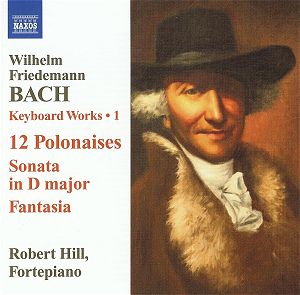
Wilhelm
Friedemann BACH (1710-1784) Keyboard Works Volume 1
Twelve Polonaises, F.12 (c.1765) [42:41]
Keyboard Sonata in D major, F.3 (1745) [18:13]
Fantasia in A minor, F.23 [3:08] Robert Hill (fortepiano)
rec. 25-28 September, 2005, Église St. Martin, Chaux, Territoire
de Belfort, France NAXOS 8.557966 [64:21]
Being
the son of a great father, perhaps privileged by the opportunity
to learn vital lessons at close quarters, but also burdened
with expectations, both those of other people and one’s own,
can never be easy. The literary critic Harold Bloom evolved
a whole theory, elaborated in his book The Anxiety of Influence (1973),
of how poets struggle against the work of their precursor (or
father) poets and how only the ‘strong’ survive the experience
and themselves become significant precursors for yet later poets.
How much more difficult the situation when that precursor really
is one’s father, as was the case with Wilhelm Friedemann Bach.
When that father has had a high opinion of your precious talents;
when that father has taken particular trouble over your education,
preparing your for what was confidently expected to be a distinguished
career, then the pressure must become enormous and, in some
respects at least, Wilhelm Friedemann Bach, eldest son of J.S.,
succumbed to it.
For
all his real gifts as an organist and a composer, W.F. Bach
led an unsettled and unhappy life. He held posts as organist
at the Dresden Sophienkirche and then as organist at the Liebfrauenkirche
in Halle; but he seems constantly to have been at odds with
his employers, often taking extended breaks without permission.
He seems to have found himself constantly in positions which
must have made him feel an outsider. In the Catholic city of
Dresden he held a post at a Protestant church at a salary far
lower than those paid to musicians at the Catholic Dresden court;
by the time he had moved to Halle, Bach had developed a fascination
for theological free-thinking – and Halle was governed by hard-line
Pietists. Eventually, in 1764, he walked out of his job and
never held another post with any real prospects or permanence.
He taught, wrote music and gave organ recitals, especially after
he moved to Berlin, around 1774. But he died in considerable
poverty, leaving his wife and daughter destitute: they had to
be supported by a charity performance of Handel’s Messiah.
Musically,
too, he found it difficult to fit in. Having worked closely
with his father, sharing his teaching, conducting rehearsals,
copying music. As such he was utterly steeped in the principles
of J.S. Bach’s music; he was an acknowledged master of counterpoint.
But the world of European music was changing and, in any case,
he doubtless wanted to do more than merely imitate his father’s
music. (Though there do seem to have been a few incidents when
he claimed credit for works actually written by his father).
His reaction to the huge exemplar of his father’s achievement
was strikingly inconsistent: at times he struck off in new directions,
doing things his father would never have done and would almost
certainly have disapproved of; at other times he wrote music
which might indeed have been mistaken for work by his father.
At
his best, Wilhelm Friedemann’s work reflects this sense of struggle
and uncertainty. There are often odd and unexpected changes
of direction and idiom even within individual works; that he
had an exploratory musical mind cannot be doubted and it is
this side of his musical character that is most in evidence
in the set of twelve polonaises which occupies much of this
CD. As Robert Hill suggests in his excellent booklet notes, “as
a form the polonaise was ideally suited to his purposes: it
was galant and fashionable, yet lacked most formal constraints
other than its time signature (3/4), binary structure and modest
dimensions … The polonaise could be in major or in minor mode,
lively or introspective in mood”. These polonaises certainly
are extraordinarily diverse in mood, full of unexpected twists
and turns, ofodd and complex harmonies and of poetic and expressive
gestures. It is not surprising that these pieces should have
been amongst the works by W.F. Bach that found admirers in the
nineteenth century; listening to them it is hard not to hear
anticipations of romantic keyboard writing.
The
remarkable Sonata in D major – which W.F. published as his Opus
1 – was planned as the first of a set of six, never completed.
Technically very demanding (especially in the final movement),
the sonata’s two outer movements (marked Un poco Allegro and Vivace)
make some use of the kind of phrasing one thinks of as galant,
but also of unexpected leaps and unresolved harmonies. In the
central adagio we are offered an impressively accomplished – and
attractive – fugue; Hill describes it perfectly as “a tour-de-force
of contrapuntal technique in the service of ‘sensibilité’”.
It is hard to think of another keyboard sonata quite like this
from the 1740s. Though it would be interesting to hear the piece
played on a contemporary harpsichord, it also works very well
on the modern reproduction of a fortepiano of around 1720 which
Robert Hill plays here.
The
Fantasia in A minor – which is surely a late work though no
date seems to be known for it – is full of unexpected rhythms
and sudden melodic flurries, of discontinuities and abrupt transitions,
and it concludes with a remarkable and powerful prestissimo section
which seems to speak of frustration and anger, emotions which
may perhaps have been Wilhelm Friedemann Bach’s own at this
time in his life.
This
excellent sampling of W.F.’s writing for solo keyboard is played
with great understanding and very fair technical assurance by
Robert Hill – whose recordings of Haydn have properly attracted
praise. Here he plays a beautiful modern instrument, a copy
made in 1999 by Keith Hill in the USA of a Florentine fortepiano
in the style of Bartolomeo Cristoferi. Even and firm, and with
an attractive tonal glow – perhaps because of the use of brass
strings – this is a lovely instrument and proves perfectly suited
to the expressive and poetic qualities of W.F. Bach’s writing.
Naxos
entitle this disc ‘Keyboard Works 1’. I hope I am right in taking
that to imply that there will be more to come.
Glyn Pursglove
Please support our advertisers below by clicking on the logos for further information.

























 Robert Hill (fortepiano)