Highly enjoyable
though this CD is, the coupling and order of presentation does
Sullivan no favours. After the whirlwind pace of Pineapple
Poll which brings together a huge number of tunes from Sullivan’s
operettas, his only symphony in its patient build-up and development
of themes is in danger of seeming a slow burn. Better then to
start at track 13. For this is a kind of anti-symphony in that
it behaves in a populist and original manner within an orthodox
symphonic frame. Even in the first movement introduction after
a brass fanfare the strings beam gently up like the dawn. The
Allegro first theme (2:26) David Lloyd-Jones treats as
sensitively forlorn, a tight knit piece of Mendelssohnian angst,
but the minor key is not sustained when the oboe starts a jollier
and homelier second theme (3:30) whose second part has the violins
rhapsodising (3:51). This, you feel, is where Sullivan’s real
sympathies lie. But it’s a tribute to his skill that he maintains
this ambivalence throughout the movement as if perfectly natural,
first in the exposition repeat which Lloyd-Jones cunningly yet
effectively takes more quietly and reflectively.
I compared the most
recent recording, made in 2000 by the BBC Philharmonic/Richard
Hickox (Chandos CHAN 9859). The comparative timings are:
|
Timings
|
I
|
II
|
III
|
IV
|
Total
|
|
Lloyd-Jones
|
12:54
|
7:25
|
6:18
|
8:36
|
35:13
|
|
Hickox
|
13:21
|
7:13
|
6:15
|
9:08
|
36:02
|
From the opening
more solemn fanfare Hickox’s phrasing is smoother and a touch
more expansive. He underplays the jollity of the second theme
and even the violins’ rhapsodizing is viewed within an overall
climate of unease. This makes for a more formal, structural
clarity with a grimmer development and he saves the lyricism
which Lloyd-Jones clarifies all along for a relaxed recapitulation.
In the slow movement
Sullivan, whose father was a band master, shows an affectionate
understanding of the poetic aspects of brass instruments. Its
main theme opens on horns and alto trombone. Lloyd-Jones gives
it a tender soft focus. Hickox’s brass are a little fuller in
tone which makes them less noble. Hickox is more sensitive to
dramatic colouring, Lloyd-Jones gives more focus to Sullivan’s
presentation of melody, particularly another passage again of
violins’ sweet rhapsodizing (2:55), gently treated, where Hickox
is soft and dreamy. Hickox brings sufficient edge to the section
marked un poco agitato without Lloyd-Jones’s arguably
moving on too quickly (tr. 14 3:29) but with Lloyd-Jones the
principal theme returns on strings with a satisfyingly contrasted
breadth and the clarinet bids it a long, florid farewell.
The scherzo is a
peach of a movement, graced by a jaunty march first presented
by the oboe, repeated by cellos who flirt with it by momentarily
putting it in the minor while violins sigh expansively around
before the full orchestra gives a hearty troop version. A jolly
second theme emerges from strings’ pizzicato (tr. 15
2:03) which Lloyd-Jones makes a delighted scamper which becomes
increasingly, though always dexterously, energetic to point
a greater contrast at the trio (3:05) presided over by two cool,
indolent clarinets to delicate string tracery. Lloyd-Jones’
scherzo is merrier than Hickox’s but the latter finds a more
contrasted trio of ethereal fairy atmosphere.
In the finale Sullivan
fuses a host of themes. Lloyd-Jones’ opening is all festive
bounce and brio but the second theme (tr. 16 0:51) rises more
gracefully and has a tenderly arching second strain (1:29) with
horns again to the fore. Hickox is slightly steadier here, bringing
more of a visionary quality. Lloyd-Jones goes for more sweetness
and lightness yet still has some reflection. In a development
that means business a third theme comes on oboe (2:50) in the
minor with the first theme skittering in the background, but
you sense it will eventually shine in the major. Hickox makes
the transition a little smoother by making this theme’s first
appearance in the recapitulation more lyrical where Lloyd-Jones
(6:32) isn’t quite as relaxed until its appearance on full strings.
Lloyd-Jones whips up the coda effectively from 7:33 and if triumphant
trombones then overpower vaulting high strings, that’s Sullivan’s
fault and better than Hickox taming them a bit. Both are recorded
in glowing sound, the Naxos a little more forward, Chandos more
spread with a denser bass.
Naxos understandably
go for the more immediately attractive Pineapple Poll
to begin this CD. This is a whistle stop Sullivan tour, Charles
Mackerras’s brilliant quick change medley of tunes from the
operettas and modernization of Sullivan’s orchestration. The
prevailing mood is one of confidence and swagger with some outlandish
moments in the brass that make you think of Malcolm Arnold.
What would Sullivan have thought? I think he’d be tickled that
his melodies had taken on a new life for a ballet and appreciate
Mackerras’s extension of his own practice of putting two tunes
together. But in the opening scene he might be disconcerted
by the appearance of the xylophone and generally vamped up percussion
and be surprised at the alacrity of the trombones in echoing
the theme. We just enjoy the high spirits.
But I feel the quieter
moments are closer to Sullivan’s sensibility. Like the soulful
clarinet theme (tr. 2 1:01) of Jasper’s infatuation as Poll’s
solo becomes a Pas de Deux with him and the strings take this
up with Tchaikovskian ardour while Poll’s indifference persists
in her theme Lloyd-Jones decently keeps in the background. Or
the strings depicting the simpering girls (tr. 3) melting before
the brazen swagger of Captain Belaye’s solo and a hell-for-leather
side drum at the end. In the Pas de Trois (tr. 4) the Captain
gets a comely waltz with his fiancée but her chatterbox aunt’s
theme is superimposed musically as well as her stage presence.
I compared Charles
Mackerras’s 1982 recording, his latest of four, with the Philharmonia
Orchestra (Decca 473 653-2). With a brighter recording he’s
more bracing in the heady material and, a touch slower, more
romantic in the quieter passages. Lloyd-Jones flows more in
these, but still keeps them tender without being sentimental.
The big tunes sing with more density of feeling and the warmer
Naxos recording helps where Mackerras, with a fuller body of
strings, is more assertive.
Scene 2, the shortest
of the three, is the most memorable and moving. This is partly
because Poll’s solo (tr. 6) with its encased in moonlight effect
via trumpet calls, idyllic feeling and later melodrama is from
one source, Iolanthe. Lloyd-Jones gets a softer, duskier
night scene focus but Mackerras’s melodrama is more tense. Even
more emotive power comes from Jasper’s solo (tr. 7), a tune
to which Lloyd-Jones brings real nobility of affection when
given to full strings, whose origin, ‘O goddess wise’ in Princess
Ida, is not that familiar. It expresses all the poignancy
of Jasper’s depth of unreturnable love seeing Poll’s discarded
clothes and thinking her drowned.
Scene 3 achieves
a happy ending via a Sailors’ Drill (tr. 8) from Lloyd-Jones
of gusto if not Mackerras’s devil-may-care quality. For Poll’s
solo (tr. 9) Lloyd-Jones has more winsome, lilting cellos on
a smaller, more intimate scale than Mackerras’s exquisite shaping.
But even finer is the delicately serene lyricism with just tinges
of sadness Lloyd-Jones catches for the reconciliation (tr. 11),
a reminder of how sensitively Sullivan conveys such a mood of
present contentment obtained with difficulty and what a lovely
tune ‘The battle’s roar is over’ from Ruddigore is. Lloyd-Jones
brings a more slender, comely fragility to it, lighter in tone
than Mackerras blithe but more chirrupy manner. Then it’s a
breezy Grand Finale (tr. 12) with barnstorming Yeomen of
the Guard close in which auntie stands tall as Britannia.
Lloyd-Jones by turns provides zip and charm. His orchestra is
clearly having fun as well.
I wouldn’t say Lloyd-Jones
outclasses the competition which has its own character but his
interpretations stands their corner and honour Sullivan’s melodic
gifts. This good value CD does have the advantage in price which
will I hope encourage many to become acquainted with Sullivan’s
symphony.
Michael Greenhalgh
























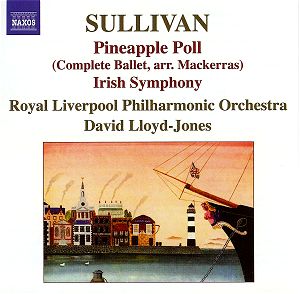

 Royal Liverpool
Philharmonic Orchestra/David Lloyd-Jones
Royal Liverpool
Philharmonic Orchestra/David Lloyd-Jones