Editorial Board
MusicWeb International
Founding Editor Rob Barnett Editor in Chief
John Quinn Contributing Editor Ralph Moore Webmaster
David Barker Postmaster
Jonathan Woolf MusicWeb Founder Len Mullenger
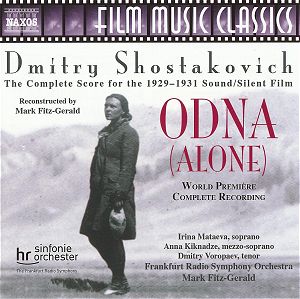
Dmitri SHOSTAKOVICH (1906-1975) Odna (Alone) (the complete score for the 1929/1931
sound/silent film) (reconstructed by Mark Fitz-Gerald) Irina Mataeva (soprano);
Anna Kiknadze (mezzo); Dmitry Voropaev (tenor); Mark van Tongeren
(overtone singer); Barbara Buchholz
(theremin)
Vokalensemble der HfMDK Frankfurt
Frankfurt Radio Symphony Orchestra/Mark Fitz-Gerald
rec. Sendesaal der Hessier Rundfunk, Frankfurt 29 November - 1
December 2006. Part studio and part live concert recording. DDD NAXOS 8.570316 [79:56]
Shostakovich scored
dozens of films, starting in the silent era with a long, almost
symphonic, accompaniment to Kozintsev and Trauberg’s New Babylon (1929).
At the last minute the censors imposed heavy cuts on the film
and there wasn’t time even to begin to try and make Shostakovich’s
music fit what was left of the film. For his next film Odna (Alone)
Shostakovich decided to make things easier for everybody and wrote
music in easily assimilated portions ranging in duration from
about 30 seconds to four and a half minutes. There are 48 cues
on this CD – the complete score for the film.
Odna was planned
as the first Soviet sound film but, due to the bulkiness of the
sound recording equipment, it was shot, on location, as a silent
with the soundtrack being added later at the Leningrad studios.
As the soundtrack was poor, title cards were used as well as sound – hence
the description of a sound/silent film. The plot is simplicity
itself. Elena, a young teacher looks forward to a life with her
husband-to-be in Leningrad but she is sent to the Altai, on the
Mongolian border. She tries to teach the children, and they enjoy
their lessons, but the parents need them to tend the sheep. Elena
nearly dies in a snowdrift but is rescued “thanks to the Soviet
State”, as a title card tells us. Finally, Elena leaves the Altai
and returns to Leningrad, but we have no idea if her presence
in the village has made any difference to the lives if the people
she leaves behind. Shostakovich is much more positive in his closing
music, giving a quite optimistic view.
The music covers a
wide variety of styles and moods. There’s a lot of the kind of
music we know from The Age of Gold, and the opera The
Nose, circus music similar to that which appears in the first
movement of the 4th Symphony, highly serious
(but with a slight thumbing of the nose) for the village Soviet
chairman waking up (track 29), but there’s also high drama,
especially in the scenes where Elena nearly freezes to death,
a very evocative use of the Theremin here.
The booklet tells
us that this is one of Shostakovich’s best scores. It’s certainly
one of his most varied and it’s easy to follow the slender plot.
There’s also some delightful orchestrations – I particularly loved
the duet for bassoons and harp and the duet for oboe and wood
blocks! – ranging from full orchestra to chamber music combinations.
You can hear the orchestral sound Shostakovich became famous for,
sometimes in embryo, in almost every track.
The restoration of
the score was obviously a labour of love. Much time and effort
has obviously gone into the making of this disk. The performance
is excellent: the orchestra is on top form and the soloists are,
mercifully, lacking the kind of wide vibrato we used to get from
Soviet singers.
All in all, an exciting
release which finally does justice to a score we have only really
known, in tantalisingly incomplete form, through Rozhdestvensky’s
short Suite - which he recorded in the early 1980s, and
which is now available in a 14 disk set from BMG/Melodia, or as
a 2 disk set of Manuscripts from Different Years 74321 59058 2 - a version of the Suite by Dmitri
Smirnov for wind ensemble (Netherlands Wind Ensemble, Meladina Record MRCD0021) and
a Russian Disc issue of 1995 (RD CD 10 007) which included 29
cues from the score.
This is the real thing
and it was worth the wait. Recording and notes are superb.
This Naxos series
of Film Music Classics simply goes from strength to strength.
Bob Briggs
Please support our advertisers below by clicking on the logos for further information.

























 Irina Mataeva (soprano);
Anna Kiknadze (mezzo); Dmitry Voropaev (tenor); Mark van Tongeren
(overtone singer); Barbara Buchholz
(theremin)
Irina Mataeva (soprano);
Anna Kiknadze (mezzo); Dmitry Voropaev (tenor); Mark van Tongeren
(overtone singer); Barbara Buchholz
(theremin) 