Editorial Board
MusicWeb International
Founding Editor Rob Barnett Editor in Chief
John Quinn Contributing Editor Ralph Moore Webmaster
David Barker Postmaster
Jonathan Woolf MusicWeb Founder Len Mullenger
Joaquín
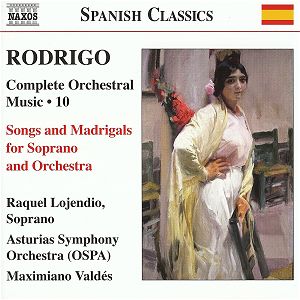
RODRIGO (1901-1999) Complete Orchestral Music - Volume 10: Songs and
Madrigals Cuatro madrigales amatorios (1948) [7:47] Cantos de amor y de guerra (1968) [14:03] Tríptic de Mossèn Cinto (1936) [11:21] Romance del Commedador de Ocaña (1947) [6:01] Cuatre cançons en llengua catalana (1935) [10:58] Rosaliana (1965) [12:42] Cántico de la esposa (1934) [3:49] Raquel Lojendio
(soprano);
Asturias Symphony Orchestra/Maximiano Valdés
rec. 25-28 August 2003, Auditorio Príncipe Felipe, Ociedo, Asturia,
Spain
Texts and translations available online NAXOS 8.555845 [66:42]
Volume 10 of the Naxos series of the
complete orchestral music of Rodrigo,
this CD brings together a selection
of Rodrigo’s work for soprano and orchestra.
In date the works chosen range from
1934 to 1968, but the innocent ear would,
I suspect, have some difficulty in very
confidently guessing which were the
earliest and which were the latest works
here – there is relatively little to
be heard in the way of consistent stylistic
development. Conversely, the quality
is consistently high.
The Cántico de la esposa (Song
of the Bride) was written for Rodrigo’s
own wife Victoria, when difficult circumstances
forced their temporary separation only
a year after their marriage. It sets
a text by St. John of the Cross – or,
to be more precise, part of a text.
What Rodrigo sets is the first four
stanzas of a poem (Canciones entre
el alma y elEsposo) of some
forty stanzas. The chosen stanzas draw
on imagery from the Song of Songs and,
taken on their own, are, like a lot
of the mystical poetry of the seventeenth
century (and like a lot of the sacred
poetry of the Spanish Islamic tradition),
ambiguous in reference, it being unclear
whether their primary reference is secular
or sacred. The first stanza – I quote
it in Roy Campbell’s fine translation
rather than in the more functional version
by Graham Wade which Naxos provides
on its website
– gives the exquisite flavour:
Where can your
hiding be,
Beloved, that
you left me thus to moan
While like the
stag you flee
Leaving the
wound with me
I followed calling
loud, but you had flown.
This – like the stanzas which follow
it – is full of imagery utterly characteristic
of the Spanish baroque. Rodrigo’s beautiful
setting, with a melodic line which is
reminiscent of early Spanish sacred
music and a (relatively) lush orchestration
which draws on a very different set
of traditions, characteristically relates
to the Spanish musical tradition without
settling for mere pastiche.
Relatedly, the Cuatro madrigales
amatorios which open the CD (just
as the Cántico de la esposa closes
it) set anonymous sixteenth-century
poems which were previously set for
vocalist and vihuela in the Renaissance.
Graham Wade’s helpful booklet note tells
us that Rodrigo heard these early settings
in Paris in the late 1930s; Rodrigo’s
own versions adapt and (respectfully)
vary the original melodies (save in
the last of the four songs, ‘De los
Alamos vengo, madre’ in which he uses
the older melody ‘straight’). Rodrigo
has a real genius for this ‘updating’
of earlier materials and both Raquel
Lojendio and the Asturia Symphony Orchestra
do full justice to the passion and drama
of these brief lyrics.
Another such revisioning of earlier
music lies behind the Cantos de amor
y de Guerra, texts prepared by the
composer’s wife Victoria Kamhi from
sixteenth-century cancioneros,
romances of the wars between Moors and
Christians. Again the original melodies
are, in four out of five cases, varied
slightly, while in one case (the fourth
song, ‘Sobra Baza estaba el Rey) the
original line is left unaltered. Throughout
the five songs, Rodrigo’s orchestral
accompaniment is spare and transparent.
These anonymous texts touch on experiences
and emotions central to the evolution
of the Spanish psyche and Rodrigo has
the good judgement to give them room
to communicate in their resonant simplicity.
The performance has an appropriate,
and utterly unpretentious, dignity and
the results are quite lovely.
In the Romance del Commedador de
Ocaña Rodrigo’s text is taken (with
some changes) from a seventeenth-century
play by Lope de Vega, Peribáñez y
elCommedador de Ocaña – adapted
by Joaquín de Entrambasaguas –
andtells a tale of wifely fidelity
in the face of a would-be seducer. The
third-person narrative is interwoven
with the wife’s own repeated affirmation
of her fidelity, a verbal structure
which Rodrigo effectively imitates in
his richly coloured setting, sung with
intensity and subtlety by Raquel Lojendio.
More modern texts – and more oblique
relationships with earlier Spanish musical
idioms – characterise the remaining
works on the disc. The Tríptic de
Mossèn Cinto sets some fine poems
by the Barcelona-born Jacinto Verdaguer
(1845-1902) a poet-priest usually thought
of as a particularly important figure
in the Catalonian Renaissance of the
nineteenth century (de Falla also set
texts by him). The three lyrics set
here all contain clear hints to any
composer inclined to set them, as their
very titles suggest: ‘L’harpa sagrada’,
‘Lo violí [violin] de Sant Francesc’
and ‘Sant Francesc i la cigala [cicada]’.
Without being unduly obvious, Rodrigo
responds to such hints with a wit and
inventiveness which never distract from
the essentially simple sentiments of
Verdaguer’s lyrics. The text of the
second song, ‘Lo violí [violin] de Sant
Francesc’ mentions a whole host of instruments
by name and Rodrigo clearly relishes
the possibilities; there is some delightful
writing here, rhapsodically beautiful
in some places, vivaciously rhythmic
in others, everywhere sympathetic both
to text and to the pleasures of the
voice (for singer as well as listener
I would guess).
The Cuatre cançons en llengua catalana
are settings of texts by several poets
and, again, they display Rodrigo’s skill
in unforced word-painting, his real
care and attention to text and his command
of the orchestral palette, a command
almost always subordinated to his desire
to ensure that his music genuinely serves
and illuminates the text. The orchestral
‘birdsong’ which opens the first of
the four songs – the ‘Canço del Teuladí’
(‘The Song of the Sparrow’) is particularly
delightful; so too – though very different
– are the moving waters conjured up
by the orchestral accompaniment of the
final song, ‘Brollador Gentil’ (‘Gentle
Fountain’).
In Rosaliana, Rodrigo turns his
attention to the poems of the Galician
Rosalía de Castro (1837-1885), musically
capturing the often nostalgic melancholy
that haunts much of her verse. The words
of the four songs – even if that sense
of nostos (the deep sense of
home and homecoming) is never far away
– actually encompass a fair range of
moods, and Rodrigo responds to all of
them (not least those of the emotionally
upbeat last song), his melodies often
having a folksong-like quality, though
I am not sure whether any of them actually
are traditional. That uncertainty of
mine is, in a sense, the clue to what
makes Rodrigo’s music so special to
those of us who love it. He writes melodies
which sound as if they are centuries
old, - and sometimes they are. But then
– in these orchestral songs, at any
rate – he puts them in a context which,
harmonically, is clearly the work of
the composer who studied in modern Paris.
The result is a particular kind of creative
tension.
Maximiano Valdés is a conductor thoroughly
at home in this music, as are his orchestra
here. They play a full role in the success
of this CD. The young soprano Raquel
Lojendio doesn’t perhaps have a compelling
music personality as yet, but she sings
with obvious understanding of the idiom,
excellent diction and an attractive
variety of tone. All lovers of the Rodrigo
will surely want this latest volume
in a very valuable series.
Glyn Pursglove
Please support our advertisers below by clicking on the logos for further information.

























 Raquel Lojendio
(soprano);
Raquel Lojendio
(soprano);