Editorial Board
MusicWeb International
Founding Editor Rob Barnett Editor in Chief
John Quinn Contributing Editor Ralph Moore Webmaster
David Barker Postmaster
Jonathan Woolf MusicWeb Founder Len Mullenger
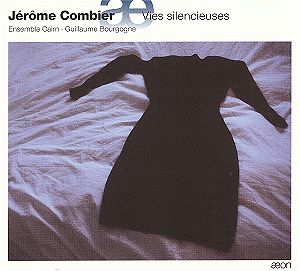
Jérôme
COMBIER (b. 1971)
Essere fumo (2005) [5:27]
Heurter la lumière encore (2005) [5:08]
Interlude 1 [2:30]
Feuilles des paupières (2005) [5:11]
Interlude 2 [2:32]
Bois sombre (2006) [9:19]
Essere neve (2005) [5:56]
Essere pietra (2004)a [6:03]
Interlude 3 [2:12]
Respirer l’ombre (2005)a [6:19] Ensemble Cairn/Guillaume
Bourgognea
rec. Espace de Projection, IRCAM, Paris, 24-25 February 2007 AEON AECD0754 [50:59]
Now
in his late thirties, Jérôme Combier first studied with the
composer and conductor Hacène Larbi. In 1997 he was at the CNSM
in Paris where his teachers were Emmanuel Nunes and Michaël
Levinas. 1998 saw him appointed composer-in-residence at the
Royaumont Foundation where his studies were further continued
with Brian Ferneyhough and Antoine Bonnet. After a two-month
residency in Japan, where he won further distinctions, he entered
IRCAM to study computer-assisted composition. In 2002 his orchestral
work Pays du vent, les Hébrides was awarded a
prize at the UNESCO International Composition Rostrum. A scholarship
allowed him to stay at the Villa Médicis in Rome from 2004 to
2006 where he composed his instrumental cycle Vies silencieuses and
met the artist Raphaël Thierry who was to realise the visual
installations for that work.
Vies
silencieuses is a cycle of seven short works for the Ensemble Cairn founded by
Jérôme Combier who is also its joint musical director with
Guillaume Bourgogne. The instrumental set-up is as follows:
viola, piano, flutes (one player), percussion (one player),
cello, clarinet and guitar. However all but one of the pieces
call for smaller instrumental combinations: Essere
fumo (flute, viola and cello), Heurter la
lumière encore (guitar, percussion and piano), Feuilles
des paupières (flute, clarinet, percussion and piano), Bois
sombre (solo viola), Essere neve (clarinet,
guitar and cello), Essere pietra (guitar,
percussion, piano, viola and cello) and Respirer l’ombre (the
full ensemble). All but two of the seven (Essere pietra and Respirer
l’ombre), are without conductor. Although the composer’s
insert notes do not necessarily make it absolutely clear,
it seems that he later added three electronic interludes
using the sounds of stone, sand and wind as recorded by
Raphaël Thierry. The seven pieces were obviously conceived
as a cycle since they often share material, and the overall
effect is remarkably coherent. Combier evinces remarkable
instrumental flair and a real liking for subtle and refined
sounds. The music is inventive and imaginative in its handling
of small instrumental combinations.
In
his insert notes, the composer comments on his concern with
the work of Giorgio Morandi (1890-1964) and Giuseppe Penone
(b. 1947) - terra incognita to me. A quick internet search
gave me a rough idea of their work, although I am not much the
wiser for that. However, the titles of some of the pieces in
the cycle of seven come from Penone, who apparently used to
title his works with a verb in the infinitive and a noun such
as Essere fumo (“To be a smoke”), Essere pietra (“To
be a stone”) or Respirare l’ombra (“To breathe the shadow”).
The common threads involve aspects of Nature and the ‘mineral’ sound-world
all imaginatively evoked and conjured. I suppose that this facet
of the cycle is still more evident when heard in conjunction
with the visual realisations by Raphaël Thierry; but the music
alone speaks for itself, enough so, anyway, to make its point
in a fairly direct way.
Jérôme
Combier’s music was new to me. It impressed me through its sheer
invention and its assurance. I now look forward to hearing more
of it some day. I would be particularly interested to know if
Combier’s music can work in longer time-spans than in these
relatively short instrumental works. Certainly a name to watch
for.
Hubert Culot
Please support our advertisers below by clicking on the logos for further information.

























 Ensemble Cairn/Guillaume
Bourgognea
Ensemble Cairn/Guillaume
Bourgognea 