Editorial Board
MusicWeb International
Founding Editor Rob Barnett Editor in Chief
John Quinn Contributing Editor Ralph Moore Webmaster
David Barker Postmaster
Jonathan Woolf MusicWeb Founder Len Mullenger
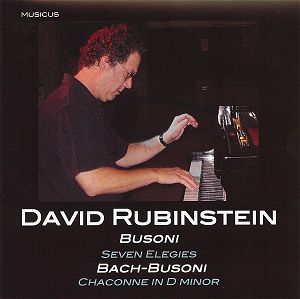
Ferruccio BUSONI (1866-1924)
Elegien, Sieben neue Klavierstücke (1907/1909) [44:06] Johann Sebastian BACH (1685–1750) Chaconne
in D minor, BWV 1004 (arr. for piano (1897) by Busoni) [16:07] David Rubinstein
(piano)
rec. 13 April 2007, details of venue not supplied. DDD MUSICUS 1001 [60:30]
As recently as 25
years ago, Ferruccio Busoni was still seen as the younger member
of the Bach/Busoni partnership. His arrangements of the master,
and others, were seen as anachronisms and consigned to oblivion
as un-PC in the music world. To that extent they were seen as
belonging with arrangements by Stokowski and others. Busoni then
started to make his own way in the world and, fortunately for
us, his arrangements - and those of Stokowski and others - are
now rehabilitated and enjoyed without question, except, perhaps,
amongst the purists.
This CD shows us both
sides of Busoni’s art.
Busoni was the master
pianist of his age and it is said that he could hold an audience
spellbound with the concentration of his interpretation. The same
could be said of his own post-1900 compositions.
After writing using
the tried and tested 19th century models, Busoni broke
free into a radical new harmonic and technical world. The Sieben
Elegien can be seen as the start of his modernism. In general
this music is dark and brooding, full of a sense of foreboding;
stark unisons, strange shifts of tonality, sometimes with the
tonality totally obscured. A restrained use of dissonance colours
this music. The Elegien is not just a tour de force for
the pianist but a tour de force of composition; Busoni understood
this and wrote to composer Jose Vianna da Motta, “The Elegies signify
a milestone in my development. Almost a transformation … I have
expressed the very essence of myself in the Elegies”. Indeed
he had.
Five of the pieces
are based on already existing music and two are totally new compositions.
The set starts with one of the new compositions, Nach der Wendung,
Recueillement (After the Turning Point, Self communion)
which is surely the composer’s admission that he was moving into
new realms and aspects of composition. Truly a musical manifesto. All’Italia!
In modo napoletano (To Italy! In Neopolitan Style)
is a thorough reworking of music from his Piano Concerto. Meine
Seele bangt und hofft zu Dir…Choralvorspiel (My Soul is
afraid and has its hopes on Thee, Chorale Prelude) is the
other truly original composition in the set. Based on a hymn tune, Allein
Gott in der Hoh’ sei Ehr (To God alone in the heights
be praised) often used by his beloved J S Bach this is a Chorale
Prelude unlike any other. Perhaps rather oddly, Busoni used this
music as the opening section of his Fantasia Contrappuntistica in
1910. The next two Elegies are based on music from the Turandot
Suite, which was used as incidental music for a production
of Gozzi’s play in 1911, which in turn Busoni turned into an opera
in 1917. The main theme of Turandots Frauengemach Intermezzo (Turandot
in the Women’s Quarters), Turandot being as Chinese a subject
as there could be, is Greensleeves! Busoni dedicated each
of the Elegien to a different pianist and the dedicatee
of Turandots Frauengemach was Polish-American Michael von
Zadora, who played to the composer as he lay on his deathbed. Die
Nachtlichen Walzer (Nocturnal Shadows – Waltz) is just
that, a waltz in shadows. The penultimate piece Erscheinung – Notturno (Apparition
- Nocturne) is a reworking of music from his first opera Die
Brautwahl (The Bride’s Choice) which Busoni was working
on at the same time as the Elegien. The final Elegy, Berceuse (Lullaby),
is probably the best known of the set but not in the version for
solo piano. It started life as a piece for small orchestra, Berceuse élégiaque – Des
Mannes Wiegenlied am Sarge seiner Mutter (Elegiac Lullaby – The
Man’s Cradle Song at his Mother’s Coffin), and Busoni transcribed
it for piano after the first six Elegien had been published
and later added it to the set.
What an astonishingly
varied set of pieces the Elegien is! And what a challenge
it sets for the pianist. The concentration needed to understand
the music is matched only by the immense virtuosity required to
play it. But despite the quite often dense, almost orchestral
textures Busoni employs, the music is laid out quite clearly for
the two hands – even if, at times, it sounds as if four hands
are at work. A lesser pianist could find the music to be bass
heavy and thus obscure the argument with the thick accompaniment,
Rubinstein rises to the occasion, throws himself into the music
and gives an excellent performance – with a subtle and judicious
use of rubato – by turns virtuosic and extrovert, delicate, melancholic
and regretful.
The transcription
of Bach’s great Chaconne in D minor is well known so all
I need to say is that Rubinstein essays it with the aplomb and
rubato he employs for the Elegien.
The recorded sound
is clear but takes a little getting used to. It sounds as if the
piano is situated in a large hall and the engineers have allowed
a bit too much of the ambience of the empty room to encroach into
the recorded sound. At the start you can almost believe you are
sitting, listening, in an empty swimming pool, not a particularly
big one it must be said, but the ear soon adjusts and the music
can be heard clearly and with a wide dynamic range, but lacking
a true pianissimo.
Now for my only moan,
and anyone who has read my pieces will probably know what is coming.
The Elegien ends in total repose on a chord of C major
with an added ninth. A most beautiful sound and I don’t want to
have my reveries interrupted by the loud chord of D minor which
heralds the start of the Chaconne. The Elegien should
be allowed to fade into infinity; I don’t want to hear anything
after it. When will record companies realise that the music is
what is important on the disk and not how well they can fill it?
I accept that the Chaconne is basically a fill-up for the Elegien,
but it would have been better placed at the start, and not the
end, of the disk.
A fine disk of, possibly,
Busoni’s most approachable piano work in the modern style, in
performances worthy of the music.
Bob Briggs
Please support our advertisers below by clicking on the logos for further information.
























 David Rubinstein
(piano)
David Rubinstein
(piano) 