I
purchased this première recording of Ex Maria Virgine
without trying to obtain a review copy, having seen it prominently
displayed in Naxos’s advertisement in the December music magazines.
I can’t claim that I’ve completely absorbed it yet – it’s a
paradox that Tavener’s Christmas music seems to take longer
to seep into the psyche than, say, The Protecting Veil,
with its much more immediate appeal. I see the potential of
the music, as I did when King’s first commissioned The Lamb
for the Christmas Eve service of lessons and carols – I just
hope that it doesn’t take me as long this time to bring the
music on board. When I’ve done so, I’m sure it will be as established
a part of the Christmas scene as Britten’s Ceremony of Carols
has become.
Tavener
has taken a number of texts, both the familiar and the less
familiar, and woven them into a sequence not unlike the Britten
Ceremony, though with no sense that he is imitating the
more established work. Whereas Britten opens with the plainsong
Hodie, Tavener sets the words in a modern idiom from
the start, and that idiom, as I have already indicated, is a
fairly uncompromising one. The familiar words from the opening
of St John’s gospel in Verbum caro factum est are set
in unison but, though the music displays what the excellent
notes (by David Truslove) describe as ‘poignant chromaticism’,
this is a tough chromaticism and its irregular rhythms indicate
that we had better not sit back and wallow in the familiar message.
Tavener’s Word made flesh is more a challenge to the world than
a consolation. Yes, it is ‘serene’, to quote the notes again,
but it is an unsettling serenity.
Where
earlier composers, including Britten, have either adapted traditional
melodies or sought to produce a synthesis between medieval/renaissance
evocations on the one hand and a modern idiom on the other –
a synthesis which I must admit to cherishing in a familiar piece
such as Joubert’s Torches – you won’t find the same blend
in Tavener. You will, however, find rhythmic excitement to
more than match Torches in Nowell! Nowell! (track
2)
If
there is any trace of the familiar late-medieval tune of Sweet
was the song (track 4) or of There is no Rose (track
6) or of the traditional tune in Ding! Dong! Merrily on high
(tr.7) I can’t hear it. Only Rocking (‘We will rock
you’, tr.8) seems to me to evoke anything close to the comfortingly
familiar – and this soon leads into another powerful and impressive
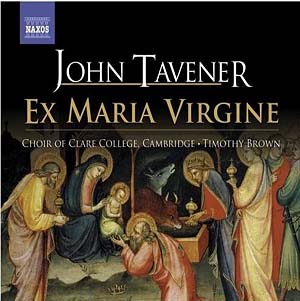
setting of Unto us is born a Son (tr.9). In this respect,
the beautiful late-medieval painting of the Adoration of
the Magi (Mariotto di Nardo, fl.1394-1424) is inappropriate
window-dressing, though I’m sure that it will lead to many impulse
purchases. For once, Naxos haven’t chosen a picture appropriate
to the music, though their presentation is in every other respect
first-class.
As
I write, Ex Maria Virgine has yet to receive its first
complete public performance, scheduled for St John’s College
on 12th December, 2008. I’m sure that it will be
the first of many and that it is destined to become part of
the Christmas scene. Even the more powerful sections, such
as Unto us is born a Son (tr.9) have their quietly beautiful
moments, though the majority of this section is pretty angular.
This multi-lingual work (parts of tr.9 are in Greek and Arabic)
ends as it began with Verbum caro (tr.10), this time
in a more peaceful form – the serenity that was only partly
present at the beginning now asserting itself, though the effect
is still rather unsettling.
The
other works on the CD, ranging in date from 1985, the first
version of Angels (tr.16) to Marienhymne, another
2005 composition, add to the value of this recording. They
also remind us of the wide range of Tavener’s interests, from
the Greek Orthodox in O Thou Gentle Light (Phós hilaron,
the evening hymn, tr.15, usually translated ‘Hail gladdening
light’) to the German Marienhymne (tr.14). Most of them
relate to one of the fixed points in Tavener’s music, his response
to what the notes call ‘The Eternal Feminine’ in the form of
the Virgin Mary.
The
programme ends appropriately (tr.16) with an assertion of the
Byzantine doctrine of the Angels – the same angels who spread
the mantle of the Virgin over Constantinople in its hour of
need in The Protecting Veil; this music is as thrillingly
beautiful as that earlier piece. The evocation of earlier musical
forms, which I found to be largely absent from the sections
of Ex Maria Virgine, plays its part here and in the preceding
O Thou Gentle Light (tr.15); I certainly hear more than
a hint of Orthodox chant in this beautiful music. Angels
rounds off the whole programme in the same mood as that wonderful
prayer which Cranmer translated as the closing collect of Anglican
Evensong – ‘Lighten our darkness ...’
Angels receives a beautiful
performance, wholly worthy of its tone, as do the other works
and the various sections of Ex Maria – Timothy Brown,
his soloists and his choir are ever alert and sympathetic to
the moods of the music. They have clearly absorbed the idiom
more readily than I have – after all, their college commissioned
the new work. If they haven’t yet taken me fully into the heart
of this major commission, I’m sure they will – if not this year,
then perhaps next.
The
notes are very helpful and the texts are already online for
anyone who wants them if they’ve downloaded the recording (available
in 320k sound from classicsonline and passionato, also from
eMusic). The transliteration of Phós hilaron leaves
something to be desired, with ’Ihsou CristeV (Iésou Christes) rendered as Ilsou
Xhriste.
As
with all the Naxos CDs of English choral music that I have heard,
the recording is wholly worthy of the performances. Strongly
recommended – but you may need to persevere. It’s well removed
from the cosy Christmas of renaissance art or of chestnuts roasting
by the fire, though there’s a place for those, too. If you
want the latter, go for another Naxos CD, Leroy Anderson’s Sleigh
Ride and Other Holiday Favorites (8.559621). That Anderson
CD is available only in North America, but it’s available to
download anywhere – see my December, 2008, Download Roundup.
Brian
Wilson