When the LP format appeared in the early 1950s this Decca recording
was one of the first complete sets in the opera/operetta genre
to appear. It also had the market to itself until the middle of
the decade when Karajan's Columbia version with Schwarzkopf, Gedda
and Kunz, maybe not swept the board but anyway was a more than
worthy alternative (see review).
It was unfortunately recorded in mono even though the stereo technique
was already employed and one can understand Karajan's wish to
do it again in updated sound. It came five years later, a spectacular
production with the famous gala performance where a dozen of the
world's greatest singers appeared in light repertoire. With Hilde
Güden singing Rosalinde as on the Krauss recording and a
fine line-up of other singers, including Vienna born Waldemar
Kmentt as Eisenstein, it was a fine achievement and it is one
of the gems in my collection but for the true Viennese feeling
the Krauss set under consideration is hard to beat.
It has its drawbacks though. The recording is more
than acceptable, considering the date, but the dynamics are limited
and the string tone is not the warmest. Nimbus have done a good
job, transferring it, and no one with some tolerance need hesitate
on technical grounds. One quickly adjusts to the sound picture
which is clean, though there is some background rumble. Naxos
also released this recording a couple of years back. I haven't
heard that transfer but knowing a lot of other issues of historical
material from both companies I know that they are normally running
each other close.
The other drawback - at least to those who are
fluent in German - is the total omission of the spoken dialogue.
For repeated listening this can sometimes be a blessing but it
certainly disrupts the structure of the piece and one loses the
continuity of the plot.
With such idiomatic playing and singing these omissions
are easily forgiven, however, and from the first bars of the overture
we are in a joyful Viennese mood, rather light and swift with
that inimitable lilt that is associated with Strauss and the Austrian
tradition. Clemens Krauss was a close friend and champion of Richard
Strauss but he was also the instigator of the famous New Year's
Day Concerts at Musikverein, which he led until his death in 1954.
Viennese charm also permeates the singing from
the first notes of Alfred's Täubchen, das entflattert
ist, meltingly sung by the legendary Mozart tenor Anton Dermota.
Wilma Lipp is the most glittering Adele one can imagine and in
both her set pieces she is in the same league as Rita Streich
on the first Karajan set or Renate Holm on the Boskovsky. Güden
is an alluring Rosalinde and in marginally fresher voice than
on the second Karajan set made almost ten years later. She is
as enthralling as Schwarzkopf. Orlofsky is sometimes sung by a
tenor - as on the first Karajan and Karl Böhm's set from
the early 1970s or, peculiarly, by the bass Ivan Rebroff singing
the part falsetto on the Carlos Kleiber recording - but here it
is the fruity contralto of Sieglinde Wagner who impersonates the
Russian prince and she is almost as good as Brigitte Fassbaender
on the Boskovsky set.
Julius Patzak wasn't equipped with one of the largest
and most sappy tenor voices but he was expressive, sang off the
words and could charm an audience with his elegance and sensitiveness
- not a common feature in all operetta performances. Gedda on
the Karajan set is of course superb, which he also is on the Boskovsky
but there he is almost to boisterous - in the dialogue that is.
Alfred Poell is a manly and sonorous Falke and he sings what for
me is the highspot of this operetta, Brüderlein in
the second act finale in true Viennese spirit - though I have
to admit that no one has ever surpassed Dietrich Fischer-Dieskau
on the Boskovsky. Kurt Preger is a more than usual lyrical Frank.
On these factors alone the set can be recommended,
if not as a first choice at least as an historic alternative to
a more modern recording. But it has other advantages as well.
One is the Gala Performance, inserted towards the end of act II,
with some really outstanding numbers culled from other sets or
separate recordings of roughly the same vintage. Schwarzkopf,
Gedda and Kunz all starred in the series of operettas recorded
by Columbia under Otto Ackermann and they are too well known to
be commented upon. Kunz's Ach wie so herrlich, by the way,
is not from the complete set but a slightly earlier (1949) recording
with another expert on Viennese music, Anton Paulik, conducting.
Julius Patzak appears also here in a riveting performance of Barinkay's
Als flotter Geist from Der Zigeunerbaron, Lisa Della
Casa and Danish born Helge Roswaenge are splendid in the duet
from Der Zarewitsch, and the czardas from Zigeunerliebe,
complete with un-credited violinist, is outstandingly sung by
the great Ljuba Welitsch. What a voice! Krauss opens the Gala
with a riveting Eijen Magyar and after the Gala, included
in the complete recording as ballet, we are treated to a lovely
version of Frühlingsstimmen.
But there is even more to come. As a bonus we get
eight Viennese songs, sung by Patzak and idiomatically accompanied
by the Schrammel Quartet. As a lifelong lover of these songs I
enjoyed them intensely and, apart from Erich Kunz, few have sung
them so to the manner born. Some of Kunz's recordings can be found
on a Preiser disc, which I reviewed
about four years ago, and it is well worth having, not only for
the songs - there is some overlapping - but also for his genial
and charming Mozart.
The set as a whole is a pleasure from beginning
to end and every lover of this most scintillating of operettas
should hear what is by some distance the most idiomatically Viennese
recording of it. The bonuses further adorn this issue.
Göran Forsling
























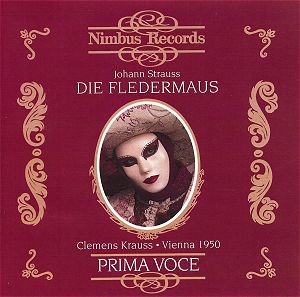
 TheVienna Philharmonic
Orchestra/Clemens Krauss
TheVienna Philharmonic
Orchestra/Clemens Krauss
