The second volume
in Naxos’s edition of Alfred Hill’s string quartets gives us an
even numbered trio of works where the first (see review)
offered the opening salvo of the first three of them. The quartets
recorded here come from three different decades. The earliest,
the Fourth, was written slap bang in the middle of the First World
War whilst the second came just before the Great Depression. No.8
dates from 1934, so that chronology has been replaced by a more
discursive, selective approach.
As before I’ve not
heard any rival recordings – though it would have been interesting
to have heard the Australian Quartet in the Sixth (Marco Polo
8.223746) and before the Eleventh is released I’d like to hear
them in that too, as Hill always said that this was his favourite
from amongst his corpus of quartets.
So let’s get down
to it. As we saw in the previous volume the post-Leipzig hangover
lasted quite a time for Hill and I have to report that the same
range of influences is strongly active in these works though
as we move forward the importance of Debussy becomes more evident.
The Fourth Quartet dates from 1916. Immediately one thinks of
Dvořák and maybe very early Bridge – the Bridge who arranged
lighter fare such as Londonderry Air for example and certainly
not the later exploratory chamber composer. Slavic elements
are present, as well as maybe a little Elgar in the slow movement,
which is gravely lyric in Hill’s best style. The scherzo is
engaging with a lilting B section and a strong drone running
through, folkloric and Dvořákian once more. Hill sometimes
evoked Schubert in these works – and there’s an element of that
in the finale along with some generous lyricism and plenty of
vitality. Incidentally the first two movements of the quartet
were recycled by Hill for the first two movements of his Symphony
in C minor known as ‘The Pursuit of Happiness’.
Quartet No.6 was
probably composed in Sydney, in 1927. Its subtitle, The Kids,
refers to his composition students at the New South Wales Conservatorium
of Music where he taught. It’s light and frothy, very much in
the vein of an educative work, written for students and not
too demanding at all. It adheres to classical principles but
is at its best in the second movement which advances a fine
chorale-like tune and some interesting opportunities for characterisation.
The third movement is the most harmonically up-to-date; elsewhere
there’s a fugal, Haydn influenced finale.
Stronger challenges
come in the Eighth Quartet. This is influenced by Debussy though
there are still residual Dvořákian elements as well, even
this relatively late in the compositional day. The scherzo is
fleet, fast and furious and over in a flash. But the Debussian
slow movement resolves to warmly lyric writing and is the centrepiece
of the quartet. The fusing of impressionist and pleine air
moments is a marked feature of the writing.
The recording quality
once again is excellent and the playing committed. There’s more
to get one’s teeth into with this volume of the quartets though
I am keenly awaiting as I noted earlier the volume containing
a performance of No.11.
Jonathan Woolf
























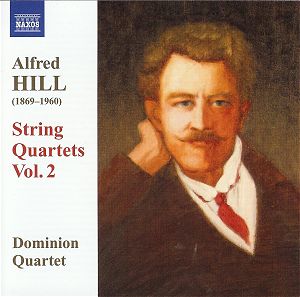

 Dominion Quartet

