Editorial Board
MusicWeb International
Founding Editor Rob Barnett Editor in Chief
John Quinn Contributing Editor Ralph Moore Webmaster
David Barker Postmaster
Jonathan Woolf MusicWeb Founder Len Mullenger
Olivier
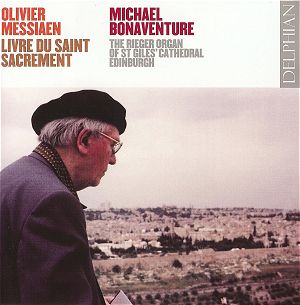
MESSIAEN (1908-1992) Organ Works Volume III Livre du Saint Sacrement (1984) CD 1 Adoro te [4:08] La Source de Vie [2:46] Le Dieu caché [8:11] Acte de foi [2:07] Puer natus est nobis [6:06] La manne et le Pain de Vie [11:21] Les ressuscités et la lumière de Vie [4:27] Institution de l'Eucharistie [6:15] Les ténèbres [4:44] La Résurrection du Christ [7:03] L'apparition du Christ ressuscité à Marie-Madeleine [17:02] CD 2 Le Transsubstantiation [6:27] Les deux murailles d'eau [6:59] Prière avant la communion [6:32] La joie de la grâce [5:32] Prière après la communion [6:29] La Présence multipliée [2:59] Offrande et Alleluia final [7:49] Michael
Bonaventure (organ)
rec. 9-10 January 2007, St Giles’ Cathedral, Edinburgh DELPHIAN DCD34076 [72:10
+ 44:58]
One
might hope for a raft of good Messiaen discs in this,
the composer’s centenary year, but when it comes to his
organ works there are already a number of fine cycles
in the catalogue. Dame Gillian Weir’s, first released
on Collins Classics and now available on Priory, is indispensable,
as is Jennifer Bate’s on the bargain label Regis.
I
was fortunate enough to hear the latter play Livre
du Saint Sacrement at the Royal Festival Hall twenty years ago, in the presence of Messiaen
himself. It was a deeply moving experience, made more
so by the frail, stooped figure of the composer acknowledging
the applause afterwards. A wonderful occasion, but really
the RFH organ doesn’t have quite the heft and thrill
of a large church instrument.
No
such qualms about Weir’s performance (Priory PRCD 925/6).
The mighty Frobenius in Århus Cathedral, Denmark, is
as powerful a beast as one could hope for, producing
sounds of staggering depth and breadth. Bate’s world-premiere
recording (Regis RRC2052) is also played on a fine organ – the Cavaillé-Coll in Messiaen’s own church of Sainte-Trinité, Paris – while
Michael Bonaventure has chosen a much more modern instrument,
the 1992 Rieger in St Giles’ Cathedral, Edinburgh.
Mystico-spiritual
texts are central to Messiaen’s œuvre and Livre
du Saint Sacrement is no exception. Such writings,
by St Thomas Aquinas among others, provide the ‘programme
for this work, which is divided into three distinct sections:
the first four movements are devoted to the worship of
Christ, the next seven to his life and the rest to that
holiest of sacraments, the Eucharist.
As
expected ‘I adore Thee, O hidden divinity!’ majors on
majesty, ‘The Source of Life’ radiates calm, ‘The Hidden
God’ has a questing, improvisatory air and ’Act of Faith’ has
some wonderfully sustained passages and ecstatic outbursts.
The Delphian recording is close and bright, the acoustic
not especially reverberant, which tends to emphasise
the clear-eyed nature of Bonaventure’s reading. He misses
the deeper sense of mystery and devotion that both Bate
and Weir capture so well, and even though his recording
is the most modern it doesn’t yield to either of its
rivals in terms of depth and detail.
In
many ways Bonaventure’s performance sounds too generalised
alongside Bate and Weir, who also find much more colour
and variety in this kaleidoscopic score. But if it’s
grandeur you’re after Weir is in a class of her own.
Of course the recording, produced with the help of the
BBC, has a lot in its favour, with floor-shaking pedals
and a spacious acoustic. Even Messiaen’s speciality – those
shimmering coronas of sound that seem to hang suspended – are
well caught here.
Moving
on to the second section Bonaventure produces some fluid
playing in ‘Unto us a child is born’, but he finds little
to celebrate. The organ doesn’t impress either, especially
in the lower registers. Indeed, he makes those ethereal
chords in ‘Manna and the Bread of Life’ sound rather
lumpen – Bate and Weir are much more buoyant here – and
those single notes that pierce the gloom like shafts
of coloured light sound much too plain. That said, he
does manage those high-lying figures that hover on the
edge of audibility rather well, as indeed he does the
jubilant opening to the seventh movement, ‘The Risen
and the Light of Life’.
I’m
delighted to say Bonaventure’s reading improves at this
point, and he produces some thrilling sounds in ‘Institution
of the Eucharist’. Here at last is plenty of colour and
lustre, the music hypnotically beautiful. His plunge
into ‘Darkness’ is simply awe-inspiring – much more so
than either of his rivals – as is his performance of
the coruscating ‘Resurrection of Christ’. Now this is
much more like it, the Rieger organ finally coming into
its own. And then there’s the gloriously affirmative
close to this movement, simply breathtaking in its scale
and splendour.
Jennifer
Bate has the advantage of a reedier Cavaillé-Coll, which
gives this music a uniquely piquant flavour. Clearly
this is the kind of sound Messiaen would have been used
to but there’s no doubt that the Frobenius and Rieger
instruments have their strengths as well. Bate may seem
just a little self-effacing compared with her rivals – she
can sound a little dry and austere as well – but there’s
little doubt she understands the structure of these works
better than most. Just listen to her serene, deeply felt
rendition of ‘Institution of the Eucharist’ and you begin
to understand why the composer admired her playing so
much.
Bonaventure
does convey the air of simple piety in ’The Risen Christ
appears to Mary Magdalene’, although in the more ecstatic
moments his playing takes on a hard, diamond-like glitter
that may not appeal to everyone. He can sound a little
relentless when placed alongside Bate and Weir, both
of whom are preferable here. That said the deep sense
of reverence that he finds in the final bars – an extended
musical genuflection – is very moving indeed.
In
the strangely haunting twelfth movement, ‘The Transubstantiation’,
Bonaventure articulates those stratospheric arpeggios
with consummate skill, the organ producing some highly
unusual sonorities. Those great ascending splashes of
sound and the Stygian pedals of ’The Two Walls of Water’ are
truly apocalyptic in his hands. It’s all too easy to
be swept away and Bonaventure very nearly succumbs, especially
in the great surge of sound at the end. Bate is not as
visceral but make no mistake the French organ still lumbers
and roars as only a Cavaillé-Coll can. In the end, though,
Weir strikes the best balance, with a performance of
great power and breadth.
The
Danish instrument sounds almost ideal in the pre- and
post-Communion prayers, the vast acoustic adding a profound
sense of calm to Messiaen’s gentle cadences. By contrast
Bonaventure is more up front, and although he doesn’t
achieve the same degree of stillness he does coax some
lovely sounds from the Rieger. In ‘The Joy of Grace’ he
manages the string of trills very well; unfortunately
Bate’s reading is marred by too much mechanical and ambient
noise at this point. Once again Weir is peerless in her
response to this transporting score.
The
panoply of sound that is ‘The Multiplied Presence’ is
admirably suited to the weight and breadth of the Århus instrument.
Predictably the Rieger sounds massive, although Bonaventure
can’t match the sheer heft and reverberation of Weir’s
reading. Regrettably the Delphian recording becomes a
wall of sound in the great outbursts; it’s hard on the
ears but it will probably appeal to hifi buffs keen to
give their woofers a workout.
Bonaventure’s
reading of the jubilant final movement, ‘Offering and
Final Alleluia’, is similarly afflicted. Perhaps he needs
to be reminded that this isn’t Liszt, and that this music
becomes noisy and incoherent when treated like a showpiece.
Inevitably I returned to Gillian Weir to hear how it should be
done. Goodness, there is ecstasy and jubilation aplenty
there, and all presented without a hint of brashness
or bravado.
Don’t
be tempted to write off Bonaventure; his version of this
mammoth score contains some good things, but just not
enough of them. By contrast Weir and Bate offer illuminating,
well-rounded and consistently satisfying accounts of
this work. Initially I wasn’t persuaded by Gillian Weir’s
Messiaen but I’ve since come to admire her thoughtful,
implacable way with this music. As for Jennifer Bate
her recording of Livre du Saint Sacrement will
never replace that treasured RFH performance, but she
demands respect and gratitude for her devotion and fidelity
to Messiaen’s great scores.
I’m
eager to hear the next instalment in Bonaventure’s cycle,
but when it comes to Messiaen in general – and Livre
du Saint Sacrement in particular – Weir and Bate
still reign supreme.
Dan
Morgan
Please support our advertisers below by clicking on the logos for further information.
























 Michael
Bonaventure (organ)
Michael
Bonaventure (organ) 
