Unlike several other
MusicWeb International reviewers, I
am very far from being an expert on
English music. Therefore Berkeley is
new to me, a name that I have heard
before but not having anything to associate
with it. Biographical overviews emphasize
the degree to which he was influenced
by the musical life of France — he studied
with Nadia Boulanger, becoming "her
most distinguished pupil." Along
the way he gained an admiration for
colleagues such as Ravel, Poulenc and
Stravinsky.
While in his Piano
Concerto I hear some of the sound of
the gentler French influences such as
Ravel and Poulenc, it is marked from
the opening with the sweep and drama
that clearly places it in the same orchestral
tradition as the work of Elgar and Vaughan
Williams. The notes for this recording
indicate both Berkeley’s self-deprecation
regarding his piano-playing abilities
and his passion for this instrument
as a centerpiece of his musical life.
This work is entirely indicative of
the latter feeling, as it is of his
compositional understanding of weaving
the concerto narrative from the dialogue
of piano and orchestra. The first movement
is fiery and impetuous. The second opens
with a quiet, perhaps romantic, conversation
between piano and strings. The third
movement strikes another mood: playful,
and a touch sly. There are, however,
occasional background intimations of
industrial ponderousness, a combination
of forces evocative of Shostakovich
and other Soviet composers writing at
the same time as Berkeley. Though for
this American reviewer, the genre of
"British piano concerto" doesn’t
call to mind a host of examples, Berkeley’s
is as fine an exemplar as one could
hope for. The composer said of David
Wilde’s performance that it was "really
first-class", and in this he was
correct.
The Concerto for Two
Pianos has a more Russian sound, starting
out almost like a light version of Rachmaninov’s
First Piano Concerto. The formal structure
of the work, however, is less conventional.
It has two movements, a shorter first
movement with a slow-fast-slow tempo
layout, and then an extended (nearly
twenty-five minutes) theme and variations.
The latter is a faithful copy of the
genre of modernist-romantic that was
prevalent early in the century, although
the present work didn’t receive its
concert-hall premiere until 1958. As
a complete piece, however, this work
hangs together less well, feeling episodic
by the end, and is therefore less compelling
than its discmate. Whether the composer
or the pianists Beckett and McDonald
bear responsibility, the possible dramatic
relationship between the two pianos
is not exploited. It’s often hard to
tell that there’s more than one instrument
at play.
These works can also
be found in the Chandos series underway
(the piano concerto on CHAN 10265, the
two-piano concerto on CHAN 10408) which
combines Lennox Berkeley’s works with
those of his composer-son Michael. These
newer releases, which I have not heard,
are sure to have more modern sound,
though that of the Lyrita issue late-analog
wears its age well. These are works
that deserve comparative performances
— even with my reservations about the
Concerto for Two Pianos — so it’s good
to have choice.
Brian Burtt
see also review
by Gary
Higginson and Jonathan
Woolf
























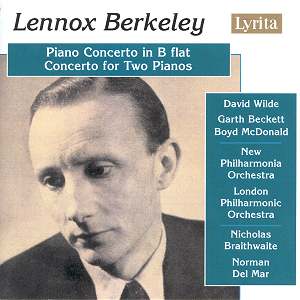
 David Wilde (piano, op. 29)