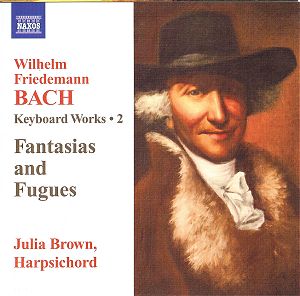
By all accounts Wilhelm Friedemann Bach had a difficult character.
It is food for a psychologist to figure out what made him the
personality he was, but it is very likely it was the result of
being the favourite of his father. Reinhard Goebel, former leader
of the disbanded ensemble Musica antiqua Köln, may be right when
he writes that "he could probably have benefited from an
occasional kick up the backside". Fact is that he never got
a job which gave him or his employers any real satisfaction. Towards
the end of his life he tried to earn a living as a freelance organist,
giving concerts in Germany. But even though he was generally considered
the greatest organist alive the heyday of the organ had gone.
In 1784 he died in Berlin, a poor and embittered man.
It is tempting to see Friedemann's character reflected in his music.
Whereas he composed a number of church cantatas which are stylistically
very close to his father's, in his instrumental works and his
compositions for keyboard he seems to wander forth and back
between the style of the baroque era and the styles which were
fashionable in his own time. His character and his music have
given Robert Hill reasons to label him as "the first Romantic".
In the programme notes of his recording of the 12 Polonaises
- Volume 1 of this Naxos series - he writes: "From his
unhappy biography to his perhaps deserved reputation as the
ungrateful recipient of an over-involved father's attention,
the artist Wilhelm Friedemann Bach presents us with a mix that
by most definitions would qualify as 'Romantic': his individualism,
his use of superb compositional technique in the service of
poetic poignancy, the way he set up technical barriers for the
keyboardist to overcome, his anticipation of harmonic devices
central to nineteenth-century tonal language, all these are
marks of a genius who was unable to fit into the career paths
available in his time".
It is probably these features which resulted in almost none of his
keyboard works being printed during his lifetime. Even while
still alive his compositions were widely disseminated in manuscript
and their authenticity can't always be established. In the programme
on this disc, for instance, the Fantasia in c minor (Fk nv2),
has also been attributed to Johann Wilhelm Hässler (1747-1822),
another organ virtuoso who travelled through Germany to give
concerts. This, by the way, also puts the unique character of
Friedemann's compositions into some perspective. The features
of his oeuvre partly reflect the time in which he lived, where
old and new met, conflicted, and sometimes merged.
The music on this disc reflects this. The eight fugues are written
for keyboard without pedal, but are often played on the organ.
There is no objection to this: there is an authorised copy of
these fugues with a dedicatory letter to Princess Anna Amalia
of Prussia, sister of Frederick the Great. She was an avid player
of the organ: Friedemann's brother Carl Philipp Emanuel wrote
his organ sonatas for her. But character-wise they are rather
chamber music. The subjects are very peculiar and often surprising.
A feature of these fugues is that the tonalities are clearly
characterised, much in accordance with the definitions by Johann
Mattheson. As Julia Brown writes: "The variety of affects
used and the highly individualized subjects make them sound
more like character pieces". As Friedemann was famous for
his improvisations I like the way Julia Brown plays them, with
subtle rubato and slight variety in the tempo. They really sound
as if they are improvised which makes this interpretation truly
captivating.
The fugues are interspersed with a number of Fantasias. In fact, it
is the other way round: as the fantasias are much longer they
are interspersed with the fugues. These fantasias also reflect
the conflict between old and new. The longest contain a large
number of contrasting sections. It is a shame the track-list
doesn't specify them. Just to give one example, the Fantasia
in e minor (Fk 21/BR A 24) has no less than 16 character indications:
furioso, recitativ, furioso, andantino, grave, prestissimo,
andantino, recitativ, andantino, recitativ, andantino, recitativ,
andante (prestissimo), grave, largo, furioso. This sums up pretty
well how modern this fantasia is, very much in line with the
aesthetics of the Empfindsamkeit. But in the Fantasia
in d minor (Fk 19/BR A 22), for instance, Johann Sebastian shows
up: it begins with a toccata-like section which is followed
by a fugal section - just like some of Bach's harpsichord toccatas.
Several fantasias contain many scales and arpeggios and there
are sometimes surprising harmonic progressions.
In her performances Julia Brown aims to pointing up the contrasts in
these Fantasias. She takes her time in the slow sections, some
of which are played really slow; also she isn't afraid of breathing
spaces between phrases or sections. The fast sections could
have been taken a bit faster, as the Fantasias take considerably
more time here than in other recordings. Having said that Julia
Brown is well able to keep the listener's attention, even in
the first Fantasia on the programme which lasts almost 19 minutes.
As I have said, the fugues are often played on the organ. Another option
would be for the fugues and the fantasias to be played on the
clavichord. Its dynamic possibilities are very appropriate to
underline the contrasts within the fantasias. But the choice
of the harpsichord is plausible as the date of composition of
most pieces is not known, and the harpsichord was very much
in use until Friedemann's death in 1784.
Wilhelm Friedemann Bach's keyboard music never fails to fascinate and
the unmistakable qualities of his oeuvre come well to the fore
in Julia Brown's fine interpretations.
N.B. The tracklist only gives the numbers of the out-of-date catalogue
by Martin Falck (1913). As far as possible I have added the numbers
in the new catalogue, Bach Repertorium (BR), being prepared by
Peter Wollny.
Johan
van Veen