Editorial Board
MusicWeb International
Founding Editor Rob Barnett Editor in Chief
John Quinn Contributing Editor Ralph Moore Webmaster
David Barker Postmaster
Jonathan Woolf MusicWeb Founder Len Mullenger
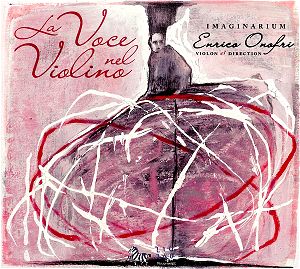
La Voce nel Violino Giovanni Paolo CIMA (c.1570
- 1630) Sonata per il Violino [3:41] Giovanni Marco UCCELLINI (c.1603
- 1680) La Luciminia Contenta [3:48] Giovanni Battista FONTANA (1589?
- 1630?) Sonata II [6:41] Giovanni Paolo CIMA Sonata per Cornetto, over Violino [4:43] Giovanni Battista FONTANA Sonata III [4:00] Claudio MONTEVERDI (1567
- 1643) Mentre vaga angioletta, madrigal [8:32] Richardo ROGNONI (c.1550
- 1620) Ancor che col partire, passeggiato [3:16] Dario CASTELLO (1st
half 17th Century) Sonata II [5:20] Carlo GESUALDO da Venosa (c.1561
- 1613) Asciugate i begli occhi [3:31] Giovanni BASSANO (1560/61
- 1617) Ricercata II [1:51] Claudio MONTEVERDI Armato il cor d'adamantina fede [2:29] Girolamo FRESCOBALDI (1583
- 1643) Se l'aura spira [2:44] Giovanni Antonio PANDOLFO
MEALLI (fl 1660 - 1690) Sonata II La Cesta, op. 3,2 [7:01] Francesco Maria VERACINI (1690
- 1768) Finale: Canone sopra Ut re mi fa sol la [2:55] Imaginarium:
(Enrico Onofri (violin), Alessandro Tampieri (violin,
lute), Margret Köll (harp), Riccardo Doni (harpsichord,
organ)); Maria Cristina Vasi (viola), Alessandro Palmeri
(cello)
rec. July 2006, Oratorio di Santa Croce, Mondovi (Curneo),
Italy. DDD ZIGZAG TERRITOIRES
ZZT 071102 [60:31]
Under
the intriguing title "The Voice in the Violin" the
Italian violinist Enrico Onofri, with his ensemble Imaginarium,
presents a programme of music by Italian composers of the
first half of the 17th century. In fact Pandolfo Mealli
and Veracini belong to a later era. In this programme Onofri
wants to show how closely instrumental and vocal music
were connected at that time.
In
the renaissance the human voice was considered the main
instrument. Of course, all kind of musical instruments
were played, but their role was mostly limited to supporting
the voice by playing 'colla parte' or to replace the voice
when necessary. They also played instrumental versions
of vocal music. The only original instrumental music was
dance music. Even when in the 17th century other forms
of independent instrumental music came into existence the
voice was still dominant. The more an instrument was able
to imitate the human voice the more it was appreciated.
Therefore the violin and the cornett were at the top of
the ladder as they were considered most ideally suited
to doing just that. During this time instrumental pieces
of several kinds were composed; many of them had their
origin in vocal music. Even sonatas show the traces of
vocal music, as the programme on this disc demonstrates.
Through
music specifically written for the violin by a number of
virtuosos the violin became more independent. "However,
throughout the first half of the century their works were
to remain closely linked to the domain of vocal music,
despite attempts to create a specific instrumental language
- to such an extent that the writing in certain sonatas
is very often similar to that of vocal music". So
writes Enrico Onofri in the booklet. He has chosen a number
of sonatas to illustrate that point. Most of these pieces
are fairly well-known, but they amply illustrate his point,
in particular as he has added some vocal items to the programme
which are performed here instrumentally. In particular
the two pieces by Monteverdi show great similarity in style
to some instrumental works here if they are performed this
way, more than if they were sung. Onofri underlines the
connection in his ornamentation, which is partly used in
both the vocal and the instrumental items.
Ornamentation
is one of the main features of music of this time and place:
This is absolutely essential in vocal and instrumental
music alike. Onofri's performances are very virtuosic and
also fairly dramatic. In the latter respect he is helped
by the realisation of the basso continuo which underlines
the theatrical character of this music - as did practically
all Italian music of this time. The sonority and sometimes
sudden outbursts of the harp are especially effective.
How common it was to perform vocal music on instruments
and how that music was ornamented is demonstrated by the
'passaggi' Rognoni composed over the famous madrigal 'Ancor
che col partire'.
The
only item where, in my view, the instrumental performance
doesn't work is the madrigal 'Asciugate i begli occhi'
by Carlo Gesualdo da Venosa. I have asked myself why I
feel that way. It could have something to do with the very
specific character of Gesualdo's musical language which
was fundamentally different from what was common at the
time. He rejected the 'seconda prattica', unlike the other
composers in the programme. He tried to include modern
expressivity in the old form of the madrigal. He wrote
almost no instrumental music - only a handful of pieces
that survive. Where other composers used instruments in
their vocal music - Monteverdi is a famous example - and
included vocal effects in the instrumental parts, Gesualdo's
vocal music is strictly a capella. His musical language
is so individual that it seems hardly possible to 'translate'
it to instruments.
The
disc ends with a most curious piece by Francesco Maria
Veracini, pupil of Arcangelo Corelli and a violin virtuoso
who worked in several places in Europe. As Onofri explains: "the
recording ends with a short piece which the Florentine
violinist Francesco Maria Veracini had printed on the last
page of his Sonata (sic) Accademiche of 1744.
Composed in a virtual pastiche of seventeenth-century style,
and concluding a set of violin sonatas whose writing gives
free rein to instrumental virtuosity, this archaic canon
on the plainchant theme Ut relevet miserum fatum (Ut
re mi fa sol la) seems intended to remind the performer
of the old debt the violin owes to the voice; this is why
we have chosen it as the finale to our programme".
It
makes for a worthy end to a most original programme concept
which is performed brilliantly. Nobody interested in Italian
music of the early 17th century should miss this disc.
Johan
van Veen
Please support our advertisers below by clicking on the logos for further information.

























 Imaginarium:
(Enrico Onofri (violin), Alessandro Tampieri (violin,
lute), Margret Köll (harp), Riccardo Doni (harpsichord,
organ)); Maria Cristina Vasi (viola), Alessandro Palmeri
(cello)
Imaginarium:
(Enrico Onofri (violin), Alessandro Tampieri (violin,
lute), Margret Köll (harp), Riccardo Doni (harpsichord,
organ)); Maria Cristina Vasi (viola), Alessandro Palmeri
(cello) 
