Olivier Messiaen’s Quatuor pour la fin du Temps is one
of the composer’s most frequently recorded works, and Jonathan
Cohler admits that “the decision to produce a new recording was
not taken lightly” for this very reason. His highly informative
and detailed booklet notes do however soon reveal this recording’s
claimed USP, and part of its reason for taking up the challenge
against some very stiff competition indeed. Having taken stock
of the existing recordings of the piece, and comparing the results
of these against Messiaen’s original score and his own writings
on the work, Cohler and his musicians’ aim has been to restore
those original intentions, and the status of Messiaen’s own commentaries
on performing the piece.
Cohler writes at
length on this subject, and gives clear and logical reasons
for deviating from Messiaen’s own 1957 recording with the composer
at the piano, the tempi of which seem too swift when compared
with the score. Another of his references is that on from 1991
from EMI with the composer’s wife Yvonne Loriod. This latter
version has by chance recently become available in a new coupling
with André Previn’s LSO account of the Turangalila-Symphonie,
and as a result I have it for direct comparison.
For a start, whatever
the arguments, this is a fine recording and performance of the
Quatuor pour la fin du Temps on any terms. The technical
problems which in the past have lead musicians to speed up the
tempi in the slowest movements of the piece have numerous reasons
– breathing for the clarinettist, bowing for the violinist,
the character of the piano at the pianist’s disposal and any
number of other factors. More interesting is the deviation the
composer’s own recording shows from the original score, with
several movements coming in well short in terms of expected
timings, and as a result being considered too quick. I don’t
have this recording to hand, but taking what must be considered
his last ‘thoughts’ on the work, I was intrigued to see how
little average difference there in fact was between the 1991
composer-supervised Loriod recording and this Ongaku performance.
Only the fifth movement seems to deviate with any genuine significance,
but listening again to Loriod and Fischer-Dieskau and their
Louange à l’Éternité de Jésus, while not willing to linger,
does seem in proportion with the rest of this ensemble’s approach
to the work as a whole. Cohler provides a comparative
table which makes for intriguing reading, his ‘Abyss of the
Birds’ third movement coming in 30% over time, because he takes
literally the request of the composer that the whole E notes
should be held “until you can’t blow any more.” Cohler certainly
has tremendous breath control, and this movement attains as
much a timeless quality as those with the solemnly chiming,
repeated piano chords.
No, the most important
differences are in the character of the playing. In any case,
a composer’s own performances of their work need not necessarily
be taken as in any way definitive: can you imagine Mozart playing
his own piano concertos the same time three nights running?
Composers often ‘hear’ their own music differently as performers,
and I’ve run into the same trap of rushing through my own pieces
without realising, or being willing to accept that the tempi
are all wrong: it’s like reading an over-familiar story to an
unfamiliar child, who then makes you wonder why they can’t follow
your diction. Messiaen was of course a highly skilled performer
at the keyboard, and I would be the last to cast doubt on his
own recording, but neither would I blame him if he ‘felt’ those
tempi that way on that day and did a little on-the-spot inventing
to make the music ‘go’ as he felt it should. Loriod’s EMI recording
from 1991 with Wolfgang Meyer, Christoph Poppen and Manuel Ficher-Dieskau,
is direct and confrontational where the music demands percussive
violence, and still retains an undercurrent of sturm und
drang in those long, tender movements. Janice Weber and
all of the other players do achieve more of a sense of repose
in these visions of eternity, while still being able to kick
in with plenty of wildness in the other sections. Theirs is
however a controlled fury, the strings digging less deep, the
ensemble less willing to give the music the rough edges which
make Loriod and her crew more exciting. Just compare the Danse
de la fureur pour les sept trompettes and you’ll hear what
I mean.
The Thème et
Variations, the piece which also accompanies the 1991 Loriod
Quatuor, receives a fine performance here. The musicians
respond well to Messiaen’s earlier and more romantic style,
but I was intrigued to see that their tempi shave a goodly margin
from Yvonne Loriod and Christoph Poppen’s overall timing: 12:18
as supervised by the composer, and a swift 8:34 from the present
duo. These musician’s technical prowess is not in doubt however,
and the music doesn’t sound particularly rushed. The final ecstatic
Très lent movement holds a climax which will bring you
back for more, guaranteed.
So, to sum up, this
is a very fine Quatuor pour la fin du Temps, but I didn’t
find myself stunned by any really mind-blowing revelations as
a result of the musician’s no doubt intense and highly detailed
research. The playing is excellent and the recording equally
so, and I am all for ‘urtext’ interpretations bringing us back
from wayward developments in performing tradition for a work,
but in the end the differences just aren’t that big. The spirit
behind the notes is every bit as important as accurate tempi,
if not more so. These musicians’ performance is valid and convincing,
but achieves its results from a softer, more rounded sonic palette
to that of Yvonne Loriod’s ensemble on EMI. For students of
this piece the booklet has extensive quotes from Messiaen’s
own preface to the work. If you can get past the truly awful
cover art this is a genuinely fine recording of some of the
20th centuries defining chamber music, and will give
up its rewards warmly and generously.
Dominy Clements
























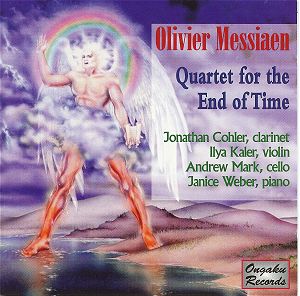

 Jonathan Cohler
(clarinet); Ilya Kaler (violin); Andrew Mark (cello); Janice Weber
(piano)
Jonathan Cohler
(clarinet); Ilya Kaler (violin); Andrew Mark (cello); Janice Weber
(piano) 
