Attilio Arisoti
is one of those composers who always
seem, for all their success, to
exist on the fringes, to be outsiders.
He was born in Bologna, into an
illegitimate line of an aristocratic
family. He took holy orders, becoming
a monk at the end of the 1680s (and
was henceforth often known as Frate
Ottavio); but he soon left the monastery
and led the life of an itinerant
musician, as composer, organist
and harpsichordist, cellist and
player of the viola d’amore, combining
this with the occasional diplomatic
mission or spying venture; he spent
time in, amongst other places, Mantua,
Venice, Berlin, Vienna and London.
He was often involved in controversy
and scandal; at least one ex-patron
recommended to the pope that Ariosti
should be expelled from the Servite
Order which he had joined in his
youth. He died in some poverty and
with a reputation for minor financial
fraud and for shameless begging
from his friends. Though he wrote
successful operas, oratorios, cantatas
and music in a number of other genres,
it has always struck me as apt that
as a composer such a liminal figure,
a man who made intermittent appearances
here and there without ever achieving
a really stable position or residence,
should be particularly associated
with the viola d’amore, to the repertoire
of which instrument he made an important
contribution. It is apt because,
as Paul Griffiths observes in his
notes to this excellent CD, the
viola d’amore is an instrument which
has never really established a stable
position in the western tradition,
an instrument which "comes
from outside the common routes and
enclosures". As Griffiths suggests,
"A few Bach pieces require
it; there are guest appearances
in Meyerbeer (Les Huguenots)
and Janáĉek (Katya
Kabanova); but it has no continuing
history, comes always as a visitor.
As a bowed instrument with sympathetic
strings – strings not played but
resonating in sympathy with those
that are – it has no companions
except in rather distant cultures:
the sarangi of India, the Hardanger
fiddle of Norwegian folk music".
One of Ariosti’s
‘Lessons’ is at the heart of this
fascinating programme, played with
immense panache and feeling by Garth
Knox, former viola player of the
Arditti quartet. It’s a marvellous
piece, the sfumato sound of the
resonating strings heard to beautiful
effect. The slow sarabande movement
is an absolute delight. I have heard
other recordings of Ariosti’s viola
d’amore music but this performance
has a sheer musicality and punch
that I haven’t previously encountered.
Nor have I ever heard a more exciting
version of Marais’ Les Folies d’Espagne,
arranged as a duet for cello – played
by the brilliant Agnes Westerman
– and viola d’amore. There is a
timbral variety and rhythmic drive,
a quasi-improvisational quality,
that is exhilarating and intoxicating.
Tobias Hume’s pavane
actually sounds better in this arrangement
than it does in the original for
viola da gamba! The distinctive
sound of the viola d’amore has a
special magic which makes Hume’s
competent piece into something very
beautiful. The instrument’s affinity
with folk instruments such as the
Hardanger fiddle is exploited in
Knox’s arrangements of Irish and
Scottish tunes and what Knox describes
as a "fictitious" jig;
these tunes, writes Knox, "found
their way out of my fingers before
I’d even really thought about them,
childhood memories mixing with musical
exploration". The sense of
spontaneity is evident. As, indeed,
it is elsewhere on this disc. Both
Knox and Westerman have extensive
experience as improvising musicians.
Knox has worked, for example, with
Steve Lacy and George Lewis, while
Westerman’s CV includes work with
Vincent Courtois and Ernst Reijseger.
This experience seems to inform
much of the playing heard here.
Of the modern compositions
heard here – has anybody published
a study of the range of modern music
written for early instruments? –
Klaus Huber’s piece, an elegy for
Luigi Nono, requires that three
of the instrument’s strings be tuned
in thirds, and the resulting piece
is a poignant tribute, its silences
as eloquent as its fragments of
melody (in a way reminiscent of
Nono’s late music). Roland Moser’s
two pieces also require some retuning
of the instrument and make an effectively
contrasting pair, the eloquence
and rhetoric of ‘Poem’ succeeded
by the gruff insistence of ‘Anecdote’.
Knox’s own version of the song ‘Malor
me bat’ – a Flemish song sometimes
attributed to Ockeghem (Obrecht
and Josquin de Prez wrote masses
based on the song) but now more
often attributed to Johannes Martini
or Albertijne Malcourt – is wonderful
and startling. After an opening
cadenza for the viola d’amore Knox
and Westerman embark on a fiercely
inventive exploration of the tune
and its possibilities in which it
is impossible with any certainty
to distinguish between what is written
and what is improvised; more than
anywhere else on the disc the intuitive
interplay of Knox and Westerman
is evident here. This is a piece
which transcends all cosy divisions
between ‘ancient’ and ‘modern’;
in a sense it is a powerful manifesto
for everything that follows on this
highly individual disc.
There are a number
of accomplished modern players of
the viola d’amore, such as Marianne
Ronez, Thomas Georgi and Christoph
Angerer, to name but three; yet
much as I have enjoyed their work,
I have never previously heard the
instrument deployed with the inventiveness
and flair that characterises this
album. The work of Knox and Westerman
is well served by a beautiful recorded
sound.
Glyn Pursglove
























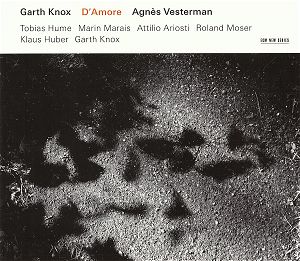
 Garth Knox (viola d’amore), Agnès
Vesterman (cello)
Garth Knox (viola d’amore), Agnès
Vesterman (cello) 
