There are times when a disk drops through my letterbox and, after
tearing the wrapping off the parcel, I look at the CD and despair,
wondering do we really need yet another, in this case, recording
of Debussy’s popular orchestral works? Then I play the disk and
am pleasantly surprised. So it is with this disk. Märkl’s
up against very stiff competition – Ansermet, Barbirolli, Boulez
and Martinon to name but a few – but he’s his own man and gives
us his own view of the music.
The Prélude is very well done. The solo flute
is suitably sensuous, and is ably complemented by the solo oboe.
Also, I have never heard the two solo violins, at the end, sound
quite as winsome as they do here. The big tune in the middle
is allowed to expand as it should and the delicate final pages,
with slightly too reticent antique cymbals, is well controlled.
La Mer is almost as fine a performance.
Starting very mysteriously, Märkl builds up the tension until the music bursts forth with animation.
It’s a fine achievement. However, when the second part of the
first movement begins, with cellos in eight parts, it’s too
reticent and lacks the momentum required to push the music forwards.
When Satie first heard this movement, From Dawn to Midday
on the Sea, he quipped that he especially enjoyed the bit
at a quarter to eleven. Strange as this may seem I think I know
the moment he means – at four bars after rehearsal number 13
there is a static section where cor anglais and two solo cellos
play a long breathed theme over sustained chords, it’s a magical
moment which prepares us for the build up to the climactic final
bars. Märkl makes these few bars quite magical and the calm is quite stunning.
The coda is well built but the final three chords – which should
beat us about the head with their power – fail to completely
satisfy. The scherzo, Play of the Waves, is too heavy
handed and the important colouristic glockenspiel part all but
inaudible. The tension and suspense of the final movement, Dialogue
between the Wind and the Sea, is very well done. The climaxes
are well developed and the changes of mood and tempo very well
handled. There is one strange moment – at rehearsal number 53
the horns play a triplet, followed, in the next bar, by two
minim chords. In this recording we are treated to an extra triplet
chord! I’ve played this moment several times, thinking my ears
were deceiving me, but no, it’s there, an extra triplet beat.
As it’s an exact repeat of what they played six bars earlier
I’m mystified by what happens. Why is this extra chord there
and what is the purpose? I doubt it’s an editing error so the
conductor must have heard it as the horns played the passage.
Curiouser and curiouser. Better news is that four bars after
rehearsal number 59, under the big chords for winds and strings,
Märkl plays the brass fanfares
which, more often than not, are ignored by conductors as not
being in a real Debussy style. Perhaps they are somewhat unsubtle
for Debussy, and for this moment, but without them the music
suddenly stops dead, it seems empty, something has to be played
there and if these fanfares are all we have then we have to
have them. It’s a good performance but it lacks that final insight,
that ultimate injection of energy which makes the Hallé/Barbirolli
recording so memorable and compelling.
Jeux is one of Debussy’s most elusive scores
(it was his last orchestral work). It’s a ballet which concerns
a lost tennis ball and a boy and two girls who look for it,
as they play hide and seek, try to catch one another, quarrel and sulk without cause.
Their games are interrupted when another tennis ball is mischievously
thrown in by an unknown hand which surprises and alarms them
and they disappear into the nocturnal depths of the garden.
The story isn’t important. Debussy’s music is. It receives an
excellent performance here – Märkl fully understands what is going
on in the music and leads his players through the myriad tempo
changes, keeps the ever changing orchestral colouring alive
and generally makes clear music which so often sounds confused
and muddled. You’d be hard pressed to find a finer performance
on disk.
André Caplet
was a close friend of Debussy and worked on the orchestration
of the latter’s incidental music for Gabriele D’Annunzio’s
play Le Martyre de Saint-Sébastien and the ballet La Boîte à joujou. He also made two, superb, reductions
for two pianos, four hands and six hands, of La Mer,
and made orchestral transcriptions of several piano works. Children’s
Corner is a delightful six movement suite for solo piano;
it’s light hearted, full of fun and several of the movements
have become popular independently of the suite – The Little
Shepherd and Golliwog’s Cake-walk in particular.
Caplet’s orchestration has always struck me as being rather
heavy handed – odd for so skilful an orchestrator – but here
he has met his match with perfect piano music which does not
lend itself to orchestration. Märkl
does his best but, ultimately, it’s still too heavy and much
of the humour is lost.
Apart from Jeux, which is superb, I would not put these performances
of La Mer and the Prélude ahead
of other recordings which are currently available - those conductors
listed above - but they are very serviceable and if you’re on
a tight budget, or just wanting to dip your toes in the Debussian
water for the first time, then at the bargain price you’ll get
much from these atmospheric readings.
Bob
Briggs
























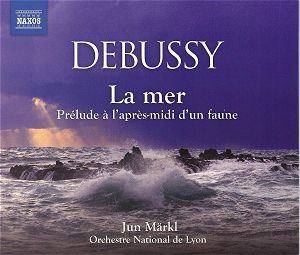

 Orchestre National de Lyon/Jun M
