|
EXPLORE
Musicweb - CLICK
------------------
Message Board
Announcements
Twitter @MusicWebINt
------------------

Schubert
complete symphonies
Bamberger Symphoniker
Jonathan Nott

Only complete set
on the Market
35CDs £67

RECORDING
OF THE MONTH
Momentous!
BARGAIN
OF THE MONTH

Italian Cello Concertos
and Sonatas
3CDS £10.95

Brahms Symphonies Zinman
£26.85
RECORDING
OF THE MONTH
Beethoven Symphonies
Thielmann


Magic Moments of Opera
10 Operas Arthaus £95

Brilliant Classics 40CDs

Brilliant Classics 60CDs

9 Symphonies Chailly
£31.90

9
Symphonies C Davis
£18.70
BARGAIN
OF THE MONTH
Absolutely marvellous!
£5.99 post free

Bruch VC1 Gluzman
Quite the finest performance of the Bruch concerto
I have ever heard.

The best opera DVD of the year so far [ST]

Mahler Song Cycles
Katarina Karnéus
Available
again
The Raga Guide
4CDs + 196 page book
£33 post-free world-wide
15,000 copies sold
Editorial
Board
Classical Editor
Rob Barnett
Seen & Heard
Editor Emeritus
Bill Kenny
Editor in Chief
Stan Metzger
MusicWeb Webmaster
Len Mullenger
Assistant Webmaster
David Barker
|
 |
 |
|
alternatively
CD:
AmazonUK
Download: Classicsonline
|
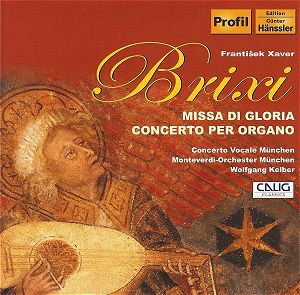
Frantisek
Xaver BRIXI (1732–1771)
Missa di Gloria in D major [45.47]
Organ Concerto No 1 in D major [14.45]
Friederike
Wagner (soprano); Reiner Schneider-Waterberg (alto);
Bernhard Hirtreiter (tenor); Michael Mantaj (bass);
Christoph Hammer (organ); Concerto Vocale München; Monteverdi-Orchester
München/Wolfgang Kelber
rec. 1993, Klosterkirche Ensdorf. DDD
HÄNSSLER PROFIL PH06029 [60.32]  |
|
|
Frantisek
Xaver Brixi came from a well known family of Czech musicians,
including a number of distinguished organists and composers.
Frantisek’s father was Simon Brixi (1693-1735), and his
cousin married into the Benda family thus leading to
another Czech musical dynasty.
Frantisek
studied philosophy in Prague and was organist at a number
of churches and monasteries there. By the 1750s he had
a substantial list of sacred compositions to his credit.
He was appointed musical director of St. Vitus’s Cathedral
in 1759 and remained in post until his death. His compositional
style owed something to the Neapolitan school but also
mixed in influences from the Viennese Court composers
such as Caldara. In his life-time his compositions were
popular; though mainly sacred his extensive output includes
two symphonies, concertos for harpsichord and for organ.
The Missa
di Gloria is a youthful work; the earliest known
copy is dated 1759. It is one of a group of masses
from his early years which set just the Kyrie and Gloria but
do so on an extended scale - the Missa di Gloria lasts
some 45 minutes. The work is laid out for soloists,
four-part choir, strings, two baroque trumpets and
organ continuo. It seems to have been one of his most
popular pieces and copies can be found in many music
libraries.
The Kyrie,
set in three parts, comprises a homophonic Kyrie section,
a Christe set for soprano and alto duet and then
a final Kyrie set as an extended fugue. The Gloria is
in ten movements, the joyful opening choral sections
giving way to more thoughtful solo and ensemble passages
with sombre choral passages for the Qui tollis and Miserere.
Despite
his extensive output and influence few of Brixi’s works
seem to have found their way into the catalogue so it
is good to have this charming mass available in an attractive
performance. In style it hovers between the world of
early Mozart masses and the earlier baroque period. The
orchestration - for strings and high trumpets - very
much lives in the old world whereas the lively bass lines
and choral writing remind me of early Mozart.
The
soloists, choir and orchestra acquit themselves admirably;
whilst not strictly virtuoso, Brixi’s vocal writing requires
a degree of control which the soloists find well within
their capabilities.
The
mass is accompanied by the first of Brixi’s organ concertos.
Again we have a fascinating confluence of late baroque
and early classical. To me, the organ concerto form is
redolent of Handel so that Brixi seems to be mixing baroque
forms with classical construction. The organ part is
written for an instrument without a pedal board and is
capable of being played on a harpsichord. For most of
the time, the organist’s left hand simply plays the basso
continuo with the right hand executing the virtuoso passages.
Organist Christoph Hammer is a stylish player, suitably
accompanied by The Monteverdi-Orchester München directed
by Wolfgang Kelber.
Kelber’s
tempi are always well judged and his performers turn
in neat performances in both works. The orchestra are
a period instrument band founded by Wolfgang Kelber in
1982.
These
pieces are no forgotten masterpieces, but they would
seem to be the only Brixi masses and organ concertos
available at the moment. As such they give us a fascinating
glimpse into the influential world of mid-18th century
Czech music.
Robert
Hugill
|
|
Advertising
Rates
Visitor
stats
MusicWeb
International
has over 40,000 Classical CD reviews on offer
Discs
received
Having a problem
Donating?

Gerard
Hoffnung Concerts &
The
Bricklayer Story
MusicWeb
can now offer
you discs from the following catalogues:
Prices include postage
There will be NO
VAT Rises
Musicweb
Special
Offers
Monthly
Best Buys
New
Releases

New
Releases


MusicWeb
sells the Polish
catalogue CDAccord
£10.50 post free W-W

MusicWeb sells the
Arcodiva catalogue
£12.00 post free W-W

£11.75
post-free world-
wide
Google
Ads - for information about privacy matters, click here.
Amazon Musicweb International is a participant in the Amazon
EU Associates Programme, an affiliate advertising programme designed to provide
a means for sites to earn advertising fees by advertising and linking to Amazon.co.uk
and Amazon.com
|