I’ve had quite a hunt for recordings of Brahms’s solo
piano works on fortepiano, but have had to conclude that
they
are fairly thin on the ground. All the more reason to
welcome the start of a new series from MDG: that of Brahms’s
Early
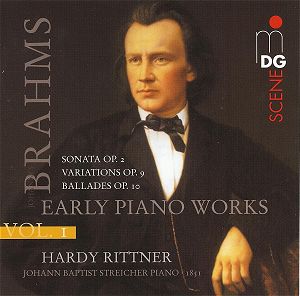
Piano Works performed by the multi prizewinning Hardy
Rittner, on a Johann Baptist Streicher fortepiano.
The history of the Streicher name in fortepiano building
in the 19
th century is given in the booklet
notes, and the instrument used for this recording is
a fairly recently restored example from 1851 – so it
would have been brand new when the works on this disc
were composed. Brahms certainly knew and approved of
these instruments, recommending them to friends and colleagues
in letters which have been preserved for posterity. The
sound we have on this excellent SACD recording is therefore
one we know must have been familiar to the composer.
This legacy of authentic sound is surprisingly rich and sonorous,
and most certainly not clattery and fatiguing. The development
of the fortepiano from its invention in the late 18
th century
meant that by the mid-1850s such instruments had grown
from the rather delicate examples which composers such
as Haydn would have known. The Streicher instrument on
this recording has a full-fat seven octaves, and uses
the jack action patented by Streicher in 1831 which claimed
advances on the more ubiquitous Viennese mechanics of
the time. The hammers sound robustly firm, but not overly
hard. This means that the attack is good and has plenty
of clarity, but that the warmth of tone in the strings
can also be brought out by the player.
More often than not I prefer to compare like with like in
such reviews as these, but all of my alternatives are
played on modern grand pianos. I did have a listen, to
remind myself of the pieces, and to see if there were
any essential differences which the modern instrument
made to the overall impression of the music. Taking Martin
Jones on his complete 1992 Brahms box from Nimbus, and
I was intrigued to hear how similar the general picture
was – in musical terms at least. The dramatic Beethovenian
twists and turns of the
Sonata No.2 Op.2 hold
equal weight on both instruments of course, and with
few places for the potential added sustaining power of
the modern grand one might not expect so much stretching
to go on. The associations one can have with other composers
in this work come through with an even more pungent sense
on the fortepiano, and whiffs of Schubert and Liszt are
unmistakeable, along with those of late Beethoven. This
is however strong music in its own right, and Rittner
gives a sterling rendition of its virtuosic and even
theatrical splendour.
Martin Jones has never been one for expressive eccentricities,
and in fact Rittner’s timings are, other than in the
Variationen,
consistently longer. Where the changes are most apparent
is in the difference in cumulative power in, for instance,
the first of the
Ballades Op.10. Sheer orchestral
force is an element in big piano playing of today, but
Brahms’s effects in this piece on the Streicher are,
while dramatic enough, more those of colour than of sheer
volume. Other aspects of the music are brought out as
a result, and I can imagine even the most seasoned of
Brahms fans hearing these works with new ears.
Pedalling
is also a feature of the Streicher. You could never get
away with the kind of atmospheric wash of sound Rittner
obtains in the opening of the second
Andante of
the
Ballades, but the effect here is quite stunning.
The light, swiftly sequential chords later on sound like
river water flowing over rounded pebbles – every corner
of these works reveals new delights on this recording.
The dry, repeating bass in the
Intermezzo movement
has a strange obsessive quality, but the subtle differences
Brahms throws in are all clearly audible –sometimes with,
sometimes without that added fifth: and the contrast
with that ethereal higher section is quite magical. The
final
Andante con moto of the
Ballade No.4 was
the only time I felt there might be a case for arguing
for a little less pedal here and there, or more half
pedalling to give us just a little more clarity. The
effect will do no harm to Brahms’s avant-garde credentials,
but the piece sounds more other-worldly here than even
Glenn Gould in his rather more (over)passionate 1982
recording.
The central gem on this disc is the gorgeous
Variationen über
ein Thema von Robert Schumann Op.9. What a difference
two years had made between the precocious
Op.2 Sonata
and these
Op. 9 and
Op.10 masterpieces.
Rittner captures the freshness of invention in these
variations, and gives them that sense of improvisational
spontaneity which I always feel they need. There were
again one or two moments when I felt myself urging
the pianist to raise that pedal a little, but there
is no loss in the expressive quality in the lyrical
variations, and the contrapuntal effects which are
revealed in Rittner’s playing make for a more moving
experience than in many performances I have heard.
There is an increasing variety of ‘historical’ recordings
of
composers from the romantic period now appearing, including
a nice set of the
violin
sonatas on Challenge Classics which also uses a Streicher
piano. Fortepiano has appeared more often in Brahms’s
chamber music than for his solo piano pieces, and this
is understandable to an extent. Brahms’s piano music
is so rich and ‘complete’ that the need for any kind
of authentic performance has until now seemed to be less
of an issue than with earlier classical composers. With
current advances in restoration techniques for these
ancient instruments we can be pretty confident that the
composer would have revelled in the results from this
release, and we can all now close our eyes and imagine
ourselves transported to a 19
th century concert
hall.
Dominy
Clements

























 Hardy
Rittner (fortepiano)
Hardy
Rittner (fortepiano)  [66:53]
